Kakao Strike Looms as Wage Talks Fail; Stock at 52-Week Low
Kakao Corp. (035720.KS), the Korean platform giant behind the KakaoTalk messenger, is on the brink of the first general strike in its 16-year history after a second round of government-mediated wage talks broke down on May 27. Shares fell to a fresh 52-week low on May 28, and CEO Chung Shin-a posted an internal apology the same morning while announcing a product-organization split — moves that frame the labor dispute as a governance event, not a one-day operational risk.
What collapsed, and what is now legally on the table
Kakao's union and management negotiated for roughly eight hours at the Gyeonggi Regional Labor Relations Commission on May 27, but the commission ultimately issued a "mediation halt" decision after the two sides could not bridge differences on the design of the 2026 compensation package, according to ETNews and The Korea Times. The halt clears the union's legal path to industrial action.
The union has scheduled a rally for June 10 at Pangyo, south of Seoul, from 9 a.m. to 4 p.m., with roughly 1,200 members expected to attend, The Korea Times reported. The rally itself is not the walkout — union officials have said the strike date and format will be disclosed separately — but it is the moment around which the market is now sizing up the dispute.
This would be Kakao headquarters' first strike since its founding. The only recent precedent inside the group is a two-hour partial walkout at Kakao Mobility in June of the previous year after a separate wage breakdown, per Seoul Economic Daily.
The dispute is about how to count bonuses, not headline pay
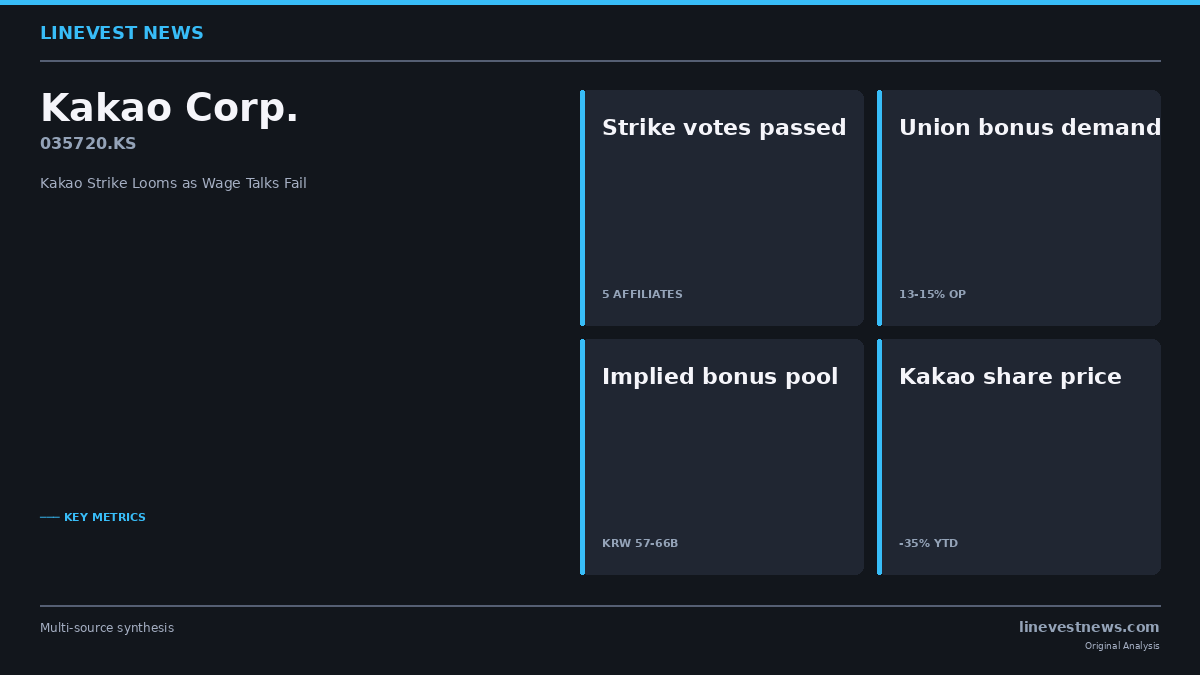
The substantive disagreement is narrow but ideological. The union is demanding a performance-bonus pool worth 13–15% of Kakao's operating profit, and — critically — it wants restricted stock unit (RSU) grants excluded from the calculation of performance pay, according to Asia Business Daily and Seoul Economic Daily. Union members value those RSUs at roughly ₩5 million ($3,650) per eligible employee per year, per Asia Business Daily; the union's argument is that equity grants are a separate retention tool and should not absorb cash-bonus expectations.
Management's counter, as Kakao said publicly, is that it "failed to reach agreement over the design of compensation structure" — i.e., the company is willing to talk about the amount but not about reclassifying RSUs out of the incentive pool (The Korea Times).
The sizing matters. Applying the union's 13–15% formula to the roughly ₩440 billion ($321 million) operating profit Kakao posted last year would imply a bonus pool of about ₩57–66 billion ($42–48 million), based on the operating-profit figure cited by Seoul Economic Daily. For per-employee context, the same outlet cites a union benchmark of approximately ₩15 million ($10,949) per worker. The closest domestic precedent the union cites is SK hynix's 10%-of-operating-profit performance pool — a lower percentage, but from a vastly larger profit base (Seoul Economic Daily).
Why the market is reacting beyond the bonus math
Kakao closed at ₩41,350 on May 26 and traded at ₩39,650 ($28.94) by 11:30 a.m. on May 28, down 2.10% intraday and at what ETNews described as a 52-week low. The stock is down roughly 35% from around ₩64,000 at the start of the year, while the KOSPI has moved in the opposite direction over the same period, per Seoul Economic Daily.
The disconnect between the size of the cash dispute (tens of millions of dollars) and the magnitude of the share-price reaction (a multi-billion-dollar market-cap loss year-to-date) suggests the market is pricing something larger than a one-time payroll adjustment. Five Kakao entities — the parent, Kakao Pay, Kakao Enterprise, DK Techin, and XL Games — have all passed strike votes, raising the prospect of a coordinated walkout across the group rather than a single unit, Seoul Economic Daily reported. That breadth is what makes this different from the 2025 Kakao Mobility action.
There is also a product overhang. CEO Chung's May 28 internal note paired the apology with a structural reorganization: the existing product organization will be split into a "KakaoTalk" unit and a "Business" unit, dispersed design teams will be consolidated, and a new "User First TF" will sit inside the KakaoTalk unit, according to Chosun Biz and MK Economy. Separately, Chief Product Officer Hong Min-taek is preparing to resign following backlash over a recent KakaoTalk update, The Korea Times reported. A labor dispute and a product-leadership reshuffle landing the same week compounds the perceived execution risk on Kakao's "Kanana" AI roadmap, which Seoul Economic Daily flagged as the most exposed initiative if engineering teams join a walkout.
What the CEO said — and did not say
In the internal post, Chung wrote: "I sincerely apologize for the failure to swiftly resolve various concerns and uncertainties," and added that "the wait for the crew has grown longer as discussions have dragged on," according to Chosun Biz. Notably, the message contained no revised offer on the bonus formula and no commitment on the RSU classification question — the two issues that broke the mediation. The substantive content of the post was the org chart, not the wage table.
What to watch next
- June 10 Pangyo rally: turnout against the ~1,200-member expectation reported by The Korea Times will be the first read on cross-affiliate solidarity.
- A strike date and format announcement from the union, which Seoul Economic Daily indicated would come "at a later date" following the May 27 mediation halt.
- Any movement on the RSU-classification question — the technical issue that, more than the headline percentage, is what has prevented a settlement to date.
Kakao did not comment publicly beyond the CEO's internal note as of the date of this article. Whether this becomes Kakao's first strike or its first averted strike is likely to be settled in the two-week window between the May 27 mediation halt and the June 10 rally.
This article is for informational purposes only and does not constitute investment advice. Figures are sourced from publicly reported coverage as cited; readers should verify current prices and disclosures independently. USD conversions use an approximate rate of 1 USD = 1,370 KRW.
Sources
- ETNews — Kakao CEO apologizes, labor-management negotiations collapse, 2026-05-28
- The Korea Times — Kakao CEO apologizes for failing to ease concerns over wage talks, 2026-05-28
- Seoul Economic Daily — Kakao strike looms as five affiliates vote to walk out, 2026-05-21
- Seoul Economic Daily — Kakao union demands bigger bonuses, files for labor mediation, 2026-05-10
- Seoul Economic Daily — Kakao plunges 35% as strike vote passes, shares break, 2026-05-26
- Seoul Economic Daily — Kakao labor-management talks collapse again, 2026-05-27
- Asia Business Daily — Kakao union and management in dispute over RSU classification, 2026-05-27
- Chosun Biz — CEO Chung Shin-a apologizes over Kakao wage talks collapse, 2026-05-28
- MK Economy — Kakao union announces June strike, CEO apologizes, 2026-05-28