A Relief Rally, Sized
The combined market capitalization of Samsung Group's listed affiliates pushed past ₩2,200 trillion ($1.61 trillion) intraday on Thursday, May 21, 2026, after Samsung Electronics (005930.KS) closed up 8.51% at ₩299,500 (about $219), according to Yonhap News Agency, Korea's national wire service. (The Asia Business Daily separately reported the gain as 8.1%.) The benchmark Kospi index jumped 606.64 points, or 8.42%, to close at 7,815.59 — the largest single-day point gain on record, eclipsing the prior high of 490.36 points set on March 5, 2026, per The Asia Business Daily.
The trigger was narrow and specific: the National Samsung Electronics Union (NSEU), the company's largest labor union, suspended an 18-day walkout that had been scheduled to begin Thursday and run through June 7, after reaching a tentative wage agreement late on May 20. Talks had collapsed earlier that day before being restarted under mediation by Kim Young-hoon, South Korea's Minister of Employment and Labor, according to Bloomberg and Japan Times reporting summarized in search results.
For a fund manager looking at the print, the question is not whether the rally happened — it did, in size — but whether the deal that triggered it actually de-risks earnings or simply locks in a different cost line at peak cycle.
What the Wage Deal Actually Says
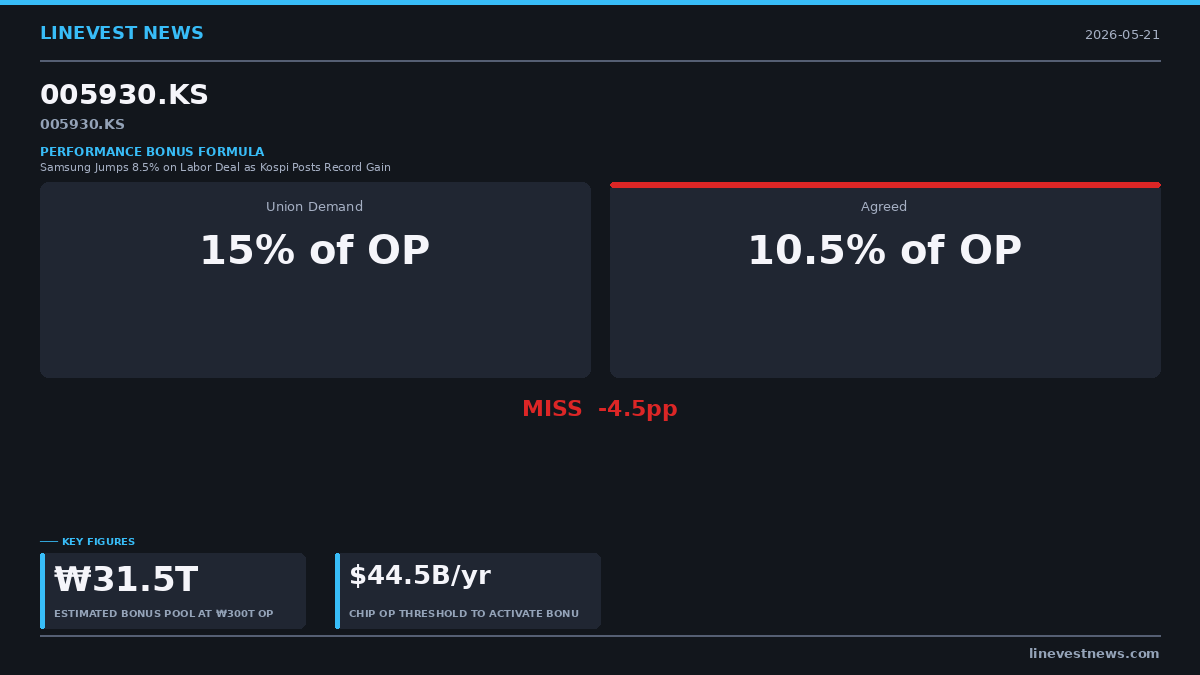
The headline term: Samsung agreed to abolish the cap on its performance bonus and tie payouts to 10.5% of operating profit, versus the 15% the union had asked for, per coverage summarized by Datacenter Dynamics and CNBC. The bonus is to be paid 100% in treasury stock rather than cash, with one-third tradable immediately and the remaining two-thirds locked up for one and two years, according to a Hankyung breakdown.
Applied to the brokerage consensus for 2026, the numbers are striking. Korea Investment & Securities analyst Chae Min-sook on May 19 raised the firm's full-year 2026 operating profit forecast to ₩377 trillion (about $275 billion), up 13% from the prior estimate, and lifted the Samsung Electronics price target to ₩570,000 from ₩370,000, per Seoul Economic Daily. The Maeil Business Newspaper (MK) reported the same day that Samsung component and materials suppliers are publicly pressuring the company to "normalize" delivery prices, citing the ₩370 trillion-class profit outlook as the basis for their demand.
A Hankyung calculation, citing internal company assumptions of roughly ₩300 trillion in operating profit, estimates the resulting bonus pool at ₩31.5 trillion ($23.0 billion), translating into per-employee payouts of approximately ₩590 million ($431,000) in the memory division, ₩210 million ($153,000) in foundry, and roughly ₩320 million ($234,000) for shared-services staff. At the 10.5% formula and the higher ₩377 trillion brokerage forecast, the implied pool scales linearly higher.
The deal also includes a 10-year contract term designed to remove the annual negotiation cycle that produced the country's first-ever Samsung Electronics walkout in 2024. According to Datacenter Dynamics' summary, the bonus structure is contingent on the chip division clearing aggregate operating profit targets of $133.65 billion across 2026–2028 (about $44.5 billion per year) and $66.4 billion across 2029–2035.
Why That Threshold Matters Now
Samsung's Q1 2026 result already cleared the bar in a single quarter. The Device Solutions (DS) Division, which houses memory and foundry, reported ₩81.7 trillion ($59.6 billion) in revenue and ₩53.7 trillion ($39.2 billion) in operating profit for Q1 alone, per the Samsung Global Newsroom Q1 release. Memory was the dominant contributor, driven by HBM (high-bandwidth memory) shipments to AI accelerator customers.
At that quarterly run-rate, the chip division annualizes well above the $44.5 billion-per-year threshold required to activate the new bonus formula. In other words, the wage settlement does not merely defer a strike; under current memory pricing it converts a meaningful slice of the upcycle into a contractually committed labor expense paid in dilutive treasury stock.
Who Was Actually Buying
The composition of Thursday's tape is the most important number in this story. Institutional investors were net buyers of ₩3.259 trillion (about $2.4 billion) on the Kospi, while foreign investors sold a net ₩463.5 billion (about $338 million) and retail investors sold a net ₩2.855 trillion (about $2.1 billion), per The Asia Business Daily, citing market data. A Daishin Securities researcher quoted in the same report framed the move as resolution of "strike risk related to Samsung Electronics," alongside easing U.S. Treasury yields, lower oil, and positive Nvidia earnings.
Samsung Group affiliates ran ahead of the parent on the day: Samsung Life Insurance +13.3%, Samsung Electro-Mechanics +13.2%, and Samsung C&T +13.0%, per The Asia Business Daily — a pattern consistent with a basket squeeze rather than security-specific re-rating. SK Hynix (000660.KS), Samsung's primary HBM competitor and not a Samsung Group affiliate, rose more than 11% to reclaim the ₩1.9 million ($1,387) level, per BloomingBit.
Historical Frame
The ₩2,200 trillion milestone caps a steep one-month climb. As of April 24, 2026, the same Samsung Group basket was worth ₩1,802.82 trillion ($1.24 trillion) with Samsung Electronics alone accounting for ₩1,406.58 trillion, per BloomingBit. By May 5, 2026, the figure had moved to ₩1,981.8 trillion ($1.44 trillion), per a Korea Exchange snapshot cited by Seoul Economic Daily. Thursday's intraday print therefore represents roughly a ₩400 trillion (about $292 billion) gain in 27 days, the bulk concentrated in the parent.
The last comparable strike-risk episode is the 2024 walkout that produced a multi-day production disruption at the Hwaseong campus and forced the wage-system review that ultimately produced this week's framework. The new deal is the company's first attempt to remove that risk for a full decade.
What to Watch
The NSEU ratification vote runs May 22–27, per CNBC and Japan Times summaries. A "no" vote would re-open the strike calendar and unwind the specific catalyst behind Thursday's print. Beyond that, two data points will determine whether the relief rally extends or fades:
- Q2 2026 earnings (date not yet disclosed): the first quarter in which the new bonus accrual will hit the operating-expense line, providing the first concrete read on the margin offset.
- DRAM contract pricing for Q3: Korea Investment raised its Q2 commodity DRAM ASP growth assumption from 30% to 60%, per Seoul Economic Daily. A failure of those prints to materialize would compress the operating profit pool that the bonus formula is keyed to.
The arithmetic of the deal is unusually clean for a Korean labor settlement: 10.5% of operating profit, paid in treasury stock, gated on a chip-division target Samsung is on track to clear at current run-rate. Whether that arithmetic is bullish or bearish depends entirely on where memory prices settle in the second half.
This article is for informational purposes only and does not constitute investment advice. Figures convert at approximately 1 USD = 1,370 KRW unless otherwise sourced. Stock movements described reflect a single trading session and are not indicative of future performance.