South Korea's five largest commercial banks lost nearly ₩19 trillion ($13.7 billion) in demand deposits over the two weeks ending April 16, prompting KB Kookmin Bank and Hana Bank to raise time-deposit rates this week as KOSPI's sprint toward 8,000 drains household cash from low-yield savings products, per The Korea Times (May 18) and Seoul Economic Daily (April 22).
How the rate moves landed
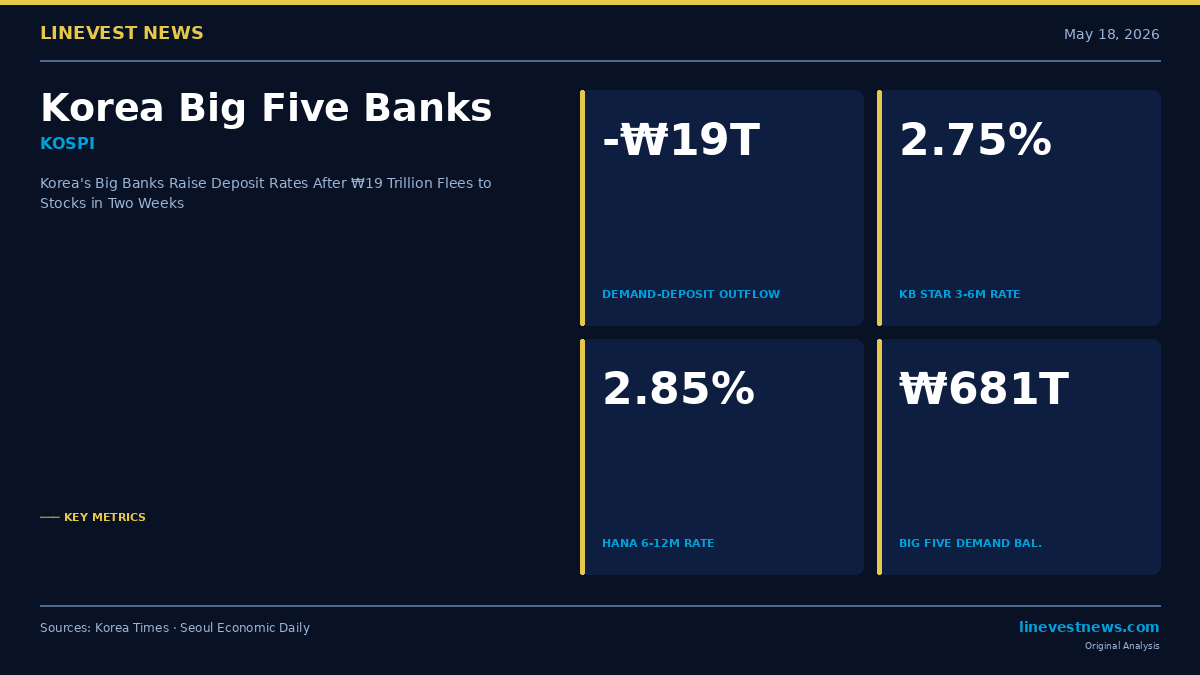
KB Kookmin Bank, Korea's largest commercial lender by assets, lifted its flagship KB Star Deposit rate for three-to-six-month deposits to 2.75% from 2.65%, and the six-to-twelve-month tier to 2.85% from 2.80% (Korea Times, May 18). Hana Bank matched the move — three-month rates to 2.75% from 2.65%, and six-month rates to 2.85% from 2.80%. KakaoBank, Korea's largest internet-only bank, lifted time-deposit and installment-savings rates by up to 0.1 percentage point.
A bank source quoted in The Korea Times framed the increases as "preemptive measures on expectations that money flowing into stocks could return to deposits if the Bank of Korea raises the benchmark rate." In other words: the rate hikes are not yet about competing head-to-head with equities — they are about positioning to reclaim that cash when BOK tightening begins.
Sizing the outflow
The combined demand-deposit balance at KB Kookmin, Shinhan, Hana, Woori, and NH NongHyup — Korea's "Big Five" commercial banks — fell from ₩699.91 trillion on March 31 to ₩680.92 trillion on April 16, a ₩18.98 trillion ($13.7 billion) decline in 16 days (Seoul Economic Daily, April 22). Customer cash sitting in brokerage accounts simultaneously climbed back toward ₩120 trillion ($87.6 billion) for the first time in 17 trading sessions — a near one-for-one rotation from banking-system liabilities into equity-market dry powder.
The Korea Times illustrated the trend with two household cases: a Yangcheon-district saver in her 60s who liquidated ₩50 million ($33,000) in CDs at KakaoBank and NH NongHyup Bank to buy Samsung Electronics (005930.KS) and SK hynix (000660.KS) shares, and a 30-something office worker who cancelled a ₩500,000-per-month KakaoBank installment savings plan after concluding low-3%-range pre-tax yields no longer justified the lock-up.
What's pulling the money
KOSPI is up roughly 80% year-to-date in 2026, building on a 76% gain in 2025 — the index's largest annual rise since 1999 (Bloomberg, May 6). The benchmark moved from 7,000 to a record near 8,000 in seven trading sessions (Bloomberg, May 15) before retreating 6.12% to close at 7,493 on profit-taking. It opened the May 18 session at 7,443.29, per The Korea Times. Samsung Electronics and SK hynix — the high-bandwidth-memory duopoly tied to AI infrastructure capex — have anchored the rally.
The BOK angle
The deposit-rate moves make more sense once paired with the rate-path signal. Seoul Economic Daily (May 5) reports that Bank of Korea Deputy Governor Yoo Sang-dae has formalized the central bank's tightening stance, with markets pricing a first hike in July and a follow-up in October or November 2026 that would lift the base rate to roughly 3% by year-end. BOK is responding to inflation pressure linked to Middle East energy disruption, with major international banks lifting their 2026 Korea CPI forecasts to 2.7–2.9%.
For the Big Five banks, that path is the timer on the deposit-defense playbook: pre-position rates now, then ride higher policy rates back to a more attractive deposit-versus-equity spread before retail investors fully commit their savings to KOSPI.
Historical precedent
A similar retail rotation out of bank deposits and into KOSPI played out during the 2020–2021 "donghak ant" rally, when small investors helped double the index from its March-2020 lows. That wave reversed once the BOK began its hiking cycle in August 2021, and deposit balances rebuilt over the following 12 months as rates climbed past 3%. The current setup compresses the same dynamic into a tighter window: KOSPI's two-year gain of well above 200% already exceeds the 2020–2021 episode, and BOK tightening is arriving alongside, not after, the rally.
What confirms or refutes the thesis
Two data points to watch. First, the Big Five's May-end demand-deposit balances — typically released in mid-June — will show whether the ₩19 trillion April drain has accelerated, stabilized, or reversed. If outflows extend, expect Shinhan Bank, Woori Bank, and NH NongHyup Bank, none of which have moved publicly yet, to follow KB Kookmin and Hana with their own deposit-rate hikes. Second, the BOK's July Monetary Policy Board meeting will reveal whether the consensus 25-basis-point hike materializes. A delivered hike would validate the banks' pre-positioning; a hold would leave them carrying higher funding costs without the policy-rate tailwind.
Disclaimer: This article is for informational purposes only and does not constitute investment advice. All financial decisions should be made after consulting a qualified professional.
Sources
- The Korea Times — Banks raise deposit rates as stock rally accelerates cash exodus, May 18, 2026
- Seoul Economic Daily — Korean bank deposits flee to stock market amid KOSPI rally, April 22, 2026
- Seoul Economic Daily — Bank of Korea signals rate hikes, base rate seen reaching 3%, May 5, 2026
- Bloomberg — Korea's KOSPI races from 7,000 to record 8,000 in seven sessions, May 15, 2026
- Bloomberg — Up 75% already in 2026, Korea's stock market is hotter than ever, May 6, 2026