Korea's 'Citizen Dividend' Pitch on AI Profits Whipsaws KOSPI, Hits Samsung
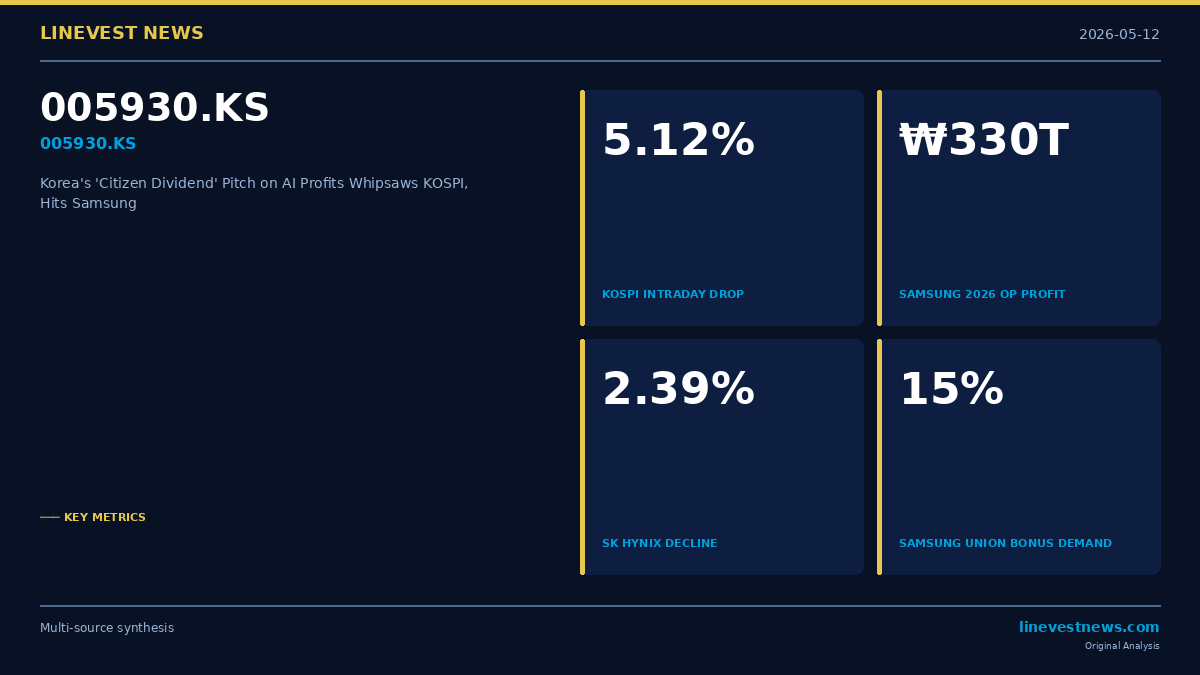
TL;DR - Korea's presidential policy chief Kim Yong-beom floated a 'National Dividend' funded by AI-era excess tax revenue, sparking a sharp KOSPI sell-off before the Blue House called it a personal view. - The KOSPI plunged as much as 5.12% intraday from a record high near 7,999 and closed down about 2.3%, with Samsung Electronics off 2.28% and SK Hynix off 2.39%, per Seoul Economic Daily. - Watch whether President Lee Jae-myung's office formalizes any AI-revenue redistribution framework, and how Samsung's pending bonus-allocation dispute resolves.
Lead
A Facebook post by Kim Yong-beom, chief of the Presidential Office's policy planning office, proposing a so-called 'National Dividend' (국민배당금) funded by Korea's AI-era windfall sent the benchmark KOSPI from a record high to an intraday loss of more than 5% on May 12, 2026. The presidential office (Cheong Wa Dae) moved within hours to characterize the post as a 'personal opinion unrelated to internal discussions,' according to Chosun Biz. The episode underscores how quickly debate over redistributing AI-boom gains can move Korea's most heavily weighted technology names.
What Happened
Kim, who serves as President Lee Jae-myung's policy chief, posted overnight on Facebook arguing that 'the fruits of the AI infrastructure era are not the result of a few specific companies alone' and that 'a portion of those fruits should be structurally returned to all citizens,' per Chosun Biz's verbatim quotation of the post. He proposed channeling AI-era 'excess tax revenue' into youth start-up capital, rural basic income, artist support, strengthened old-age pensions, and AI-transition education accounts.
Markets initially read the proposal as a potential windfall levy on chipmakers. The KOSPI, after touching an intraday record of 7,999 points, reversed sharply around 10 a.m. Seoul time and dropped as much as 5.12%, before closing down roughly 2.3%, according to Seoul Economic Daily. Samsung Electronics (005930.KS), Korea's largest company by market capitalization, fell 2.28%; SK Hynix (000660.KS), the country's leading high-bandwidth-memory supplier, fell 2.39% — their first declines in six sessions, per the same outlet. Bloomberg reported the index swung after Kim later clarified he was referring to 'excess tax revenue' generated by the AI boom rather than a new tax on corporate profits.
Why It Matters
This is the first concrete signal that the Lee administration's 'inclusive growth' rhetoric could collide with the market-cap concentration that Korea's AI and memory boom has produced. Bloomberg projects Samsung Electronics will post ₩330 trillion ($220 billion) in operating profit this year — a figure that, if realized, would place it second only to Nvidia among the world's most profitable companies, ahead of Apple and Alphabet. SK Hynix is projected at ₩239 trillion (roughly $174 billion at recent exchange rates), per Bloomberg. When two issuers account for that much of national operating profit, even a Facebook post from a senior policy adviser becomes a market event. Kim's reference to Norway's sovereign wealth fund model, noted by Seoul Economic Daily, frames the debate as structural rather than cyclical: how Korea institutionalizes redistribution of AI rents, not whether one quarter's profits get taxed.
Business Impact
For Samsung Electronics and SK Hynix, the immediate impact was the single-session share-price reversal noted above; the presidential office's same-day walk-back limited further drawdown. The political backlash, however, was severe. Per Seoul Economic Daily, People Power Party leader Jang Dong-hyuk characterized the proposal as 'communist ideology'; PPP floor leader Song Eon-seok demanded Kim's dismissal, warning of 'a negative signal that it is a difficult market to do business in'; Reform Party leader Lee Jun-seok criticized the framing as overreach beyond taxes and shareholder dividends; and PPP lawmaker Ko Dong-jin, a former Samsung Electronics president, labeled the idea 'populist.'
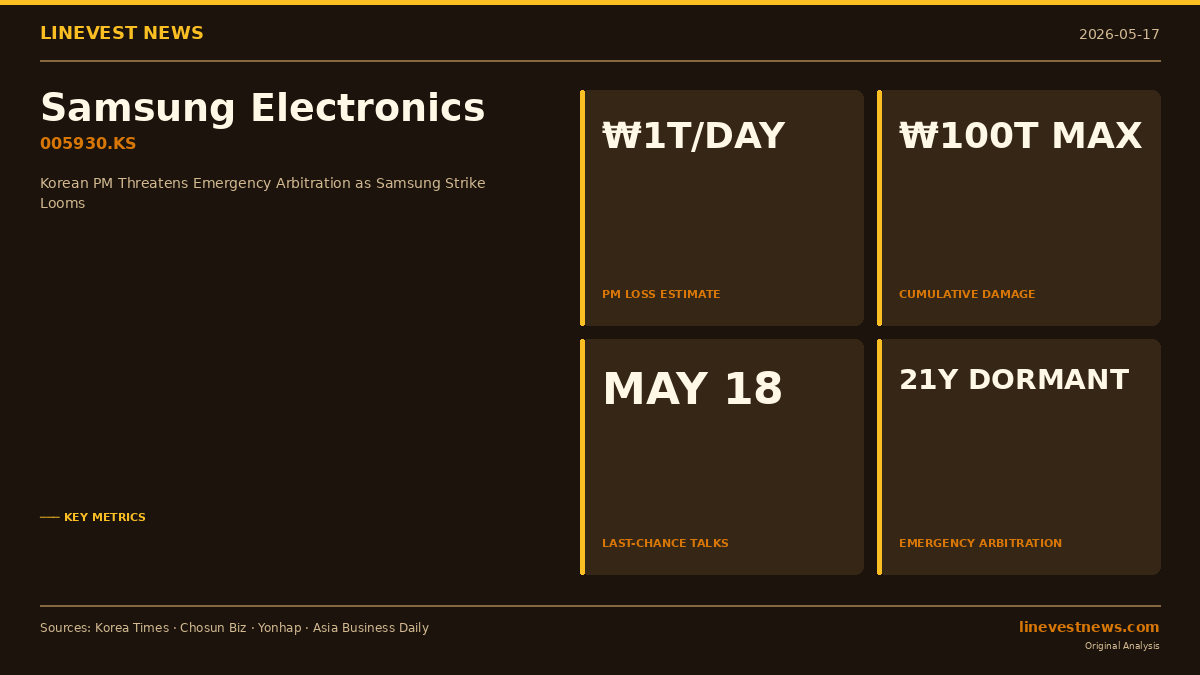
The timing also intersects with an unresolved labor flashpoint. Korea Times reported that SK Hynix has agreed to allocate 10% of operating profit to employee bonuses, while Samsung Electronics is in contentious negotiations with unions demanding a 15% allocation, with an 18-day strike threat outstanding. Any government move that signals further claims on chipmaker excess profits would complicate that negotiation.
Industry & Historical Context
Memory-chip rents accruing to Korean producers have widened the gap between top-tier exporters and the broader economy throughout the current AI cycle. Kim's post explicitly named 'memory company shareholders, key engineers, and Seoul-metropolitan asset holders' as the cohort capturing AI gains through market mechanisms, while arguing middle-income households benefit only indirectly via won strength and limited fiscal transfers, per Chosun Biz. The 'National Dividend' label evokes earlier Korean basic-income debates, but Kim's framing — anchoring redistribution to 'excess tax revenue' rather than direct corporate clawback — is closer in design to a sovereign-wealth distribution mechanism than a windfall tax. Foreign-media pickup was immediate: Bloomberg, The Japan Times, and Bloomberg Tax all carried the story within hours, per their respective URLs.
What to Watch
- Whether the Lee administration formalizes any version of Kim's proposal in upcoming budget or tax-revision discussions, or continues to characterize it as a personal view.
- Resolution of Samsung Electronics' bonus-allocation negotiations, given the dispute's overlap with the redistribution debate.
- Whether KOSPI volatility around senior officials' social-media posts persists, given index concentration in Samsung and SK Hynix.
- Comparable foreign-investor commentary on Korea's 'discount,' which conservative lawmakers cited as a near-term risk.
Sources: - Bloomberg — https://www.bloomberg.com/news/articles/2026-05-12/korea-floats-citizen-dividend-using-ai-profits-samsung-falls - Bloomberg (video) — https://www.bloomberg.com/news/videos/2026-05-12/korea-floats-citizen-dividend-from-ai-gain-video - Chosun Biz — https://biz.chosun.com/policy/politics/president_office/2026/05/12/IZFIPMUWMVHZNCNMKF6APBH36A/ - Seoul Economic Daily — https://en.sedaily.com/finance/2026/05/12/kim-yong-beoms-ai-dividend-remarks-rattle-korean-market - Seoul Economic Daily — https://en.sedaily.com/finance/2026/05/12/kim-yong-beoms-national-dividend-proposal-sparks-opposition - Korea Times — https://www.koreatimes.co.kr/business/companies/20260513/chief-policy-staffs-idea-of-national-dividends-using-ai-profit-triggers-concerns - The Japan Times — https://www.japantimes.co.jp/business/2026/05/12/tech/korea-citizen-dividend-ai-gains/
By LineVest Markets Desk — 2026-05-12
This article is for informational purposes only and does not constitute investment advice.