Korea's 'Big-Hand' Retail Orders Hit Record as Samsung-Hynix Drive KOSPI Past 7,000
TL;DR - Korean retail investors placed a record 1.19 million orders of ₩100 million ($73,000) or more in April, with roughly 30% routed into Samsung Electronics and SK Hynix shares, per Maeil Business Newspaper. - The buying surge coincided with the KOSPI breaking 7,000 on May 6 and Samsung Electronics (005930.KS) crossing a $1 trillion market capitalization, only the second Asian company after TSMC. - Watch the May 21 Samsung Electronics labor union action, the foreign-flow reversal after May 7-8 net selling of ₩12.3 trillion ($9.0 billion), and whether Samsung Foundry's 80% utilization rate holds into Q2.
Lead
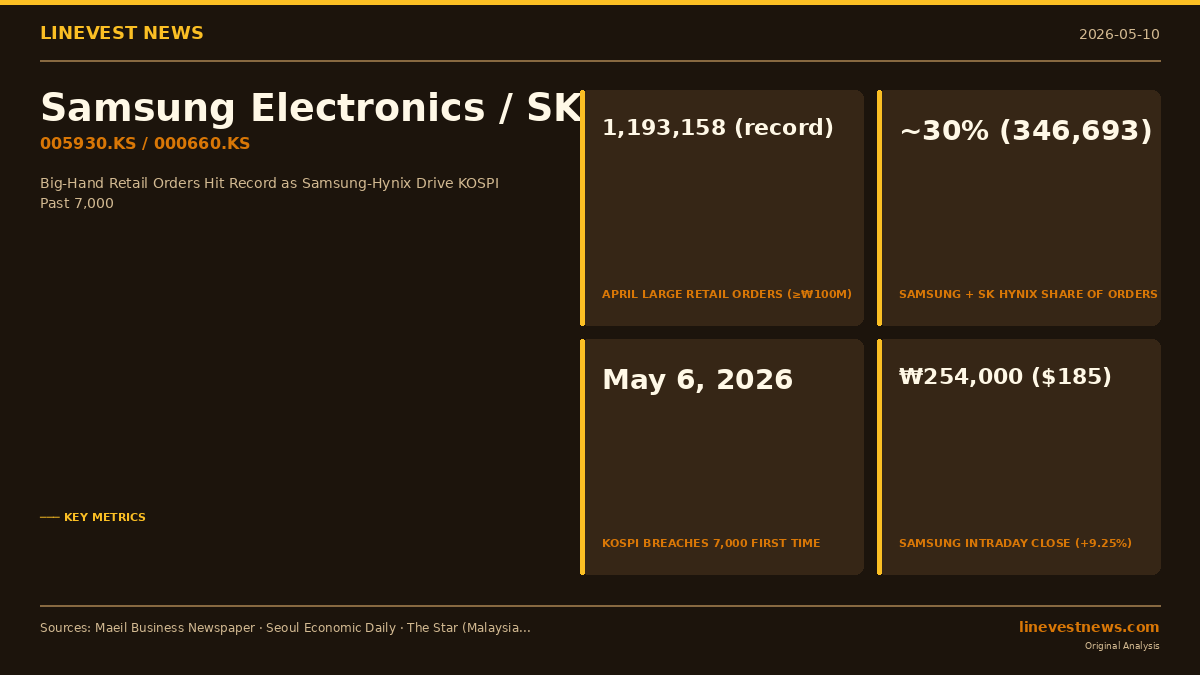
Korea's wealthiest retail investors are pouring money into the country's two semiconductor giants at an unprecedented clip. In April, individuals placed 1,193,158 stock orders worth ₩100 million ($73,000) or more on the KOSPI (Korea's benchmark equity index) — the highest monthly total on record — and roughly 30% named Samsung Electronics or SK Hynix, per Maeil Business Newspaper, a leading Korean financial daily, citing Korea Exchange (the country's main bourse operator). The surge accompanies a benchmark that broke 7,000 for the first time on May 6.
What Happened
Block orders of ₩100 million or more on the KOSPI reached 1,193,158 in April, up 16.8% from 1,021,744 in March and surpassing the prior peak of 1,153,301 set in January 2021, per Maeil Business Newspaper citing Korea Exchange. Samsung Electronics (005930.KS), Korea's largest semiconductor maker, drew 204,025 of those tickets and SK Hynix (000660.KS), the country's leading memory-chip rival, drew 142,668 — together 346,693, or about 30% of the total. Through May 7, the daily-average pace jumped to 83,067 large orders, a 53% rise over April's daily average of 54,234, the same data showed.
The buying lined up with a benchmark milestone. The KOSPI opened at 7,093.01 on May 6, up 2.25%, breaking 7,000 intraday for the first time, per Seoul Economic Daily, a Korean financial newspaper. Samsung Electronics and SK Hynix each leapt more than 10% in a single session, both at all-time highs, together accounting for 44% of the KOSPI's total value, per The Star, a Malaysian English daily covering Asian markets. Seoul Economic Daily put the intraday moves at 9.25% to ₩254,000 ($185) for Samsung Electronics and 10.23% to ₩1.595 million ($1,164) for SK Hynix. Samsung Electronics briefly carried a $1 trillion market capitalization, becoming only the second Asian company to do so after TSMC (Taiwan Semiconductor Manufacturing Company), also per The Star.
Why It Matters
This is the first concrete signal that Korean household capital allocation is reorganizing around two semiconductor names. With nearly one of every three large retail orders flowing through Samsung or SK Hynix, single-stock concentration in retail portfolios has reached levels rarely seen in prior cycles. The shift challenges the consensus that Samsung's discount to TSMC reflected a permanent governance penalty — Chaewon Lee of Life Asset Management, a Korean fund manager, noted that Samsung trades at roughly 6 times forward 12-month earnings versus 25 times for TSMC and 10 times for Micron Technology, in comments reported by the Financial Times. SK Hynix's 12-month forward P/E sits at 5.2 times, also below global semiconductor peers, per Seoul Economic Daily.
Business Impact
For Samsung Electronics, the rally aligns with operational tailwinds in its foundry arm. Samsung Foundry posted approximately 80% utilization in the first quarter of 2026 — its highest level in over a year — with AI-related contracts including Tesla's AI6 chips and ongoing 2nm process discussions with AMD, per SemiWiki's reporting on industry analyst commentary. The May 10 Maeil Business Newspaper report added that AI data-center spending is now extending demand into legacy (mature-node) foundry lines, broadening Samsung's revenue base beyond cutting-edge logic.
The trading backdrop has been violent. Foreign investors net-bought roughly ₩6 trillion ($4.4 billion) of Korean equities on May 4 and 6 combined, then flipped to net-selling ₩12.3 trillion ($9.0 billion) on May 7-8 — with a single-day sale of ₩7 trillion ($5.1 billion) on May 7, per Seoul Economic Daily. That whipsaw, met by sustained retail buying, has pushed customer deposits at Korean brokerages to roughly ₩130 trillion ($94.9 billion), with margin-lending balances at record highs, per DigitalToday, a Korean tech and finance publication.
Industry & Historical Context
The KOSPI first crossed 6,000 on February 25, 2026, per DigitalToday — the index has added more than 1,000 points in roughly ten weeks, riding the same AI-memory complex that lifted the Philadelphia Semiconductor Index 4.2% to a record high overnight ahead of May 6, per Seoul Economic Daily. Korea Exchange has triggered eight buy-side sidecars year-to-date, also per Seoul Economic Daily.
The structural shift behind the flows is the re-rating of Samsung's foundry business, which trailed TSMC on advanced-node yields through much of 2024-2025. Samsung's Q1 2026 disclosure flagged improving high-performance-computing demand, with new LPU (large-scale processing unit) products and 4nm memory targeted for the second half of 2026, per Samsung Global Newsroom.
What to Watch
Three near-term tests. First, the scheduled Samsung Electronics labor union action on May 21, reported by Seoul Economic Daily, is a supply-side variable for memory output. Second, foreign flow after the May 7-8 net selling of ₩12.3 trillion ($9.0 billion) — whether overseas funds return on dips will decide if retail bids alone can absorb the index. Third, Samsung Foundry's Q2 utilization rate versus Q1's near-80% reading, per SemiWiki; any slip would directly test the valuation-gap argument against TSMC.
Sources: - Maeil Business Newspaper (MK Economy) — https://www.mk.co.kr/news/stock/12042535 - Maeil Business Newspaper (MK Economy) — https://www.mk.co.kr/news/stock/12042679 - Fudzilla (citing Financial Times) — https://fudzilla.com/samsung-joins-the-trillion-dollar-chip-club/ - Seoul Economic Daily — https://en.sedaily.com/markets/2026/05/10/kospi-hits-7400-as-retail-investors-grapple-with-fomo-and - Seoul Economic Daily — https://en.sedaily.com/finance/2026/05/06/kospi-breaks-7000-for-first-time-as-global-investors-take - The Star — https://www.thestar.com.my/business/business-news/2026/05/06/korea039s-kospi-breaks-7000-as-ai-chip-rally-lifts-samsung-into-us1-trillion-club - DigitalToday — https://www.digitaltoday.co.kr/en/view/53184/kospi-enters-7000-era-as-concentration-and-leverage-risks-grow - SemiWiki — https://semiwiki.com/forum/threads/more-clients-leads-to-80-utilization-at-samsung-foundry-in-1q2026.24627/ - Bloomingbit — https://en.bloomingbit.io/feed/news/111745 - Samsung Global Newsroom — https://news.samsung.com/global/samsung-electronics-announces-first-quarter-2026-results
By LineVest Markets Desk — 2026-05-10
This article is for informational purposes only and does not constitute investment advice.