The Samsung Electronics labor union has declared an 18-day general strike starting May 21, 2026 — and the financial stakes are staggering: ₩30 trillion ($22 billion) in potential losses, 1,764 suppliers at risk, and global chip supply disrupted. Here is everything you need to know.
Introduction: Why Every Korean Should Care About Samsung
There is one company that drives South Korea's economy today: Samsung Electronics. Samsung is not just famous for its smartphones and home appliances. The deeper reason it touches every Korean household is staggering — Samsung Electronics has more than 4 million retail shareholders. Add the National Pension Service, which holds roughly 7.8% of the company, and it's no exaggeration to say that virtually every Korean citizen is a Samsung shareholder.
A portion of every monthly pension contribution moves with Samsung's stock price. The retirement security of 4 million households is tied directly to this single company's performance. That is exactly why the news breaking right now matters so much: dark clouds are gathering over a company that had been sailing with the wind at its back. The Samsung Electronics labor union has declared an 18-day general strike — and the numbers behind that decision are nothing short of alarming.
The Headline Number: ₩30 Trillion Lost in 18 Days
Let's confront the figures directly. The union itself acknowledges that 18 days of stoppage will create a direct production gap of ₩18 trillion ($13 billion). Add the cost of restoring idle semiconductor equipment and the total damage climbs to ₩30 trillion (about $22 billion). That is roughly 68.8% of Samsung Electronics' entire 2025 operating profit (₩43.6 trillion). A full year's harvest reduced to ash in just 18 days.
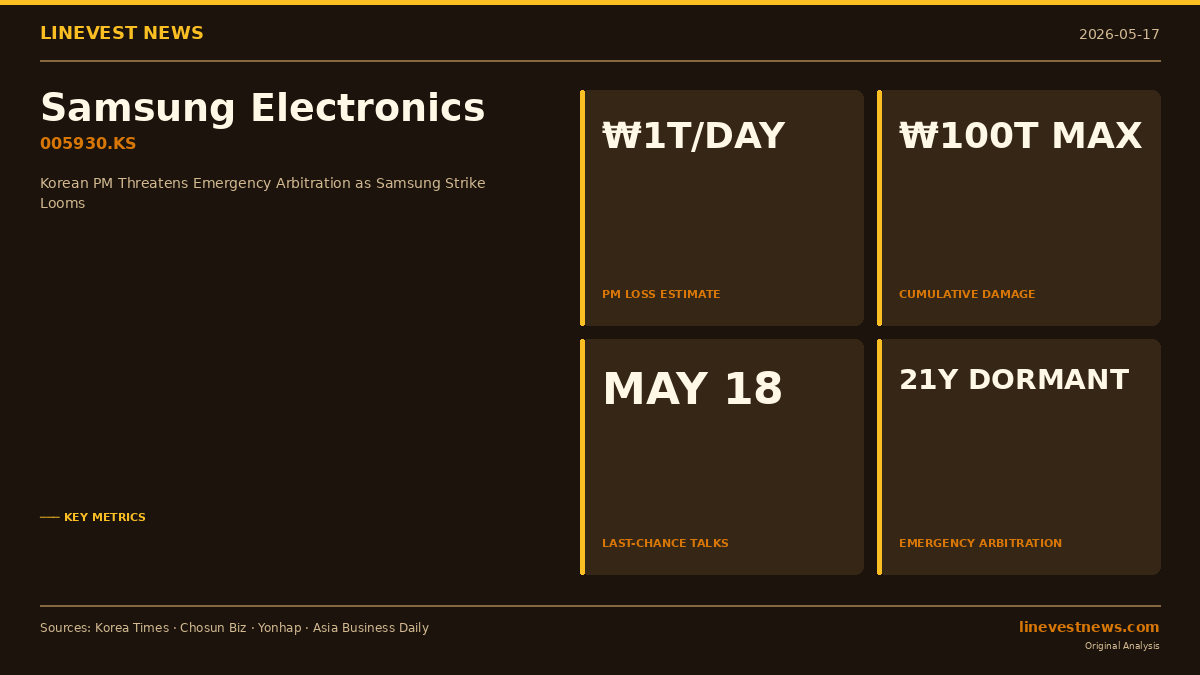
Professor Song Hun-jae of the University of Seoul put it even more starkly: production at the Pyeongtaek semiconductor complex could be cut roughly in half, with losses running at billions of won per minute and approximately ₩1 trillion per day. And here is the cruelest part — when the strike ends, the bleeding doesn't. Restarting automated semiconductor lines and recovering yield rates takes another 2 to 3 weeks. An 18-day strike effectively becomes a 40-day shutdown.
Beyond Pyeongtaek: 1,764 Suppliers and 30,000 Jobs at Risk
The damage will not stop at Samsung's factory gates. Samsung Electronics anchors a vast industrial ecosystem of 1,764 partner companies in materials, components, and equipment. A single production line at Pyeongtaek supports roughly 30,000 jobs when supplier headcount is included. The moment that line goes silent, those jobs disappear, and the local commercial districts of Pyeongtaek and Hwaseong freeze overnight.
While 76,000 union members demand an additional 15% of operating profit, who actually pays the bill for that demand? Partner-company employees, their families, and the small business owners who quietly serve them. They have no negotiating table, no microphone, no voice. They simply receive notice that the work has stopped.
The Global Chip Supply Shock: 3–4% of World D-RAM Vanishes Instantly
The damage doesn't stop at the border either. Samsung holds a 36% global D-RAM share and 32% of NAND flash. KB Securities estimates that an 18-day strike will instantly erase 3–4% of global D-RAM supply and 2–3% of NAND supply. D-RAM prices, already up more than tenfold over the past year, would surge again — a cost that ultimately flows through data center operators and cloud providers to ordinary consumers.
The international tech outlet Wccftech has projected that this single labor action could trigger roughly $20 billion in global economic losses and disrupt AI infrastructure plans at Google, Amazon, and Meta. The pace of the global AI build-out, in other words, may now hinge on a single Korean labor dispute.
The Invisible Cost: Customers Who Leave Don't Come Back
But ₩30 trillion is only the visible invoice. The true catastrophe lies in the costs that never appear on a balance sheet. NVIDIA evaluates its suppliers on a quarterly and semi-annual basis, allocating volume accordingly. AMD now treats supply chain resilience as an ESG metric. In semiconductors, switching suppliers requires enormous system integration costs and lengthy process qualification.
The flip side of that fact is brutal: once a customer leaves, they almost never return. The moment TSMC, SK Hynix, or Micron fills Samsung's gap, the "supply reliability" that Samsung spent decades building evaporates permanently. Professor Song warns that prolonged strike action could shave up to ₩10 trillion in additional operating profit from Samsung's semiconductor division.
4 Million Shareholders, Foreign Capital, and Korea's Sovereign Risk
Now we return to where we started. Samsung Electronics' foreign ownership stands at 50.96% — more than half of the company is held by overseas investors. This strike is not merely a stock-price event. It sends a global signal that Korean capital markets themselves are unstable. The consequences — foreign capital outflows, currency volatility, higher financing costs — eventually land in the wallets of ordinary citizens.
The retirement savings of 4 million retail shareholders shake. National Pension returns dip. Workers at 1,764 supplier companies lose their livelihoods. This is the real price tag of one line: "15% of operating profit as bonus."
The Math That Doesn't Add Up: Burning ₩30 Trillion to Win ₩45 Trillion
Consider the simplest arithmetic. The union demands roughly ₩45 trillion in performance bonuses. To extract that sum, the union itself acknowledges destroying ₩30 trillion in value. Two-thirds of the prize is sacrificed to obtain the prize — collateralized by the company's future, its suppliers' survival, 4 million shareholders' retirement, and the competitiveness of an entire national industry.
Do you believe the boom will last forever? Just three years ago, Samsung's semiconductor division posted a ₩15 trillion loss. The union returned not a single won. Profits are mine; losses are the company's. As long as this asymmetric logic prevails, sustainable labor relations will remain a fantasy.
Closing Thoughts
The opacity of bonus calculation methods and management's reliance on one-time settlements deserve scrutiny. Standardizing the system, formalizing calculation rules, and introducing independent verification — these are legitimate union demands. But pursuing those legitimate demands with a ₩30 trillion self-inflicted bomb is anything but legitimate.
If the union truly believes this is "a fight for Samsung Electronics' future," then the price of that future cannot be ₩30 trillion. At midnight on May 21, what should stop is not the Pyeongtaek production line — but the union's countdown clock.
The negotiating table is still empty. Four million shareholders, 1,764 supplier companies, and an entire nation are watching it.