
ConocoPhillipsCOP
About ConocoPhillips
ConocoPhillips is one of the world's largest independent exploration and production companies, focused exclusively on the upstream oil and gas business after divesting its refining and marketing arm in 2012. Its portfolio is organized around six operating segments defined largely by geography: the Lower 48 United States, Alaska, Canada, Europe and North Africa, Asia Pacific and Middle East, and Other International. Production is a roughly balanced mix of crude oil, natural gas, natural gas liquids, and bitumen, sold as unrefined commodities into wholesale energy markets. The Lower 48 unit, anchored by dense positions in the Permian, Eagle Ford, and Bakken shale plays, typically generates the largest share of production volumes and operating earnings.
Investors track ConocoPhillips as a pure-play upstream operator whose earnings move directly with global crude and Henry Hub gas benchmarks, making commodity price sensitivity the dominant variable. Reserve life, breakeven cost per barrel, and the pace of decline in shale wells are structural inputs, alongside Alaska's regulatory environment and the long-lived LNG commitments in Qatar and Australia. The company is a component of the S&P 500 and a heavyweight in energy indexes, drawing scrutiny from passive and ESG-oriented capital. Its stated capital return framework prioritizes a competitive ordinary dividend, a variable return of cash, and buybacks funded from free cash flow, alongside a stated discipline of reinvesting a limited share of operating cash flow.
The modern ConocoPhillips was formed in 2002 through the merger of Conoco Inc. and Phillips Petroleum Company, two firms whose roots reach back to the late nineteenth and early twentieth centuries in the U.S. mid-continent. In 2012 the company spun off its downstream refining, marketing, and chemicals businesses as Phillips 66, leaving a standalone upstream pure-play. Under a strategy emphasizing low-cost supply, it exited higher-cost frontier assets, including deepwater and most non-core international positions, and rebuilt around North American unconventionals. Acquisitions of Concho Resources in 2021 and Shell's Permian assets in 2021 sharply enlarged the Lower 48 footprint, followed by the 2024 combination with Marathon Oil.
Mechanically, ConocoPhillips earns money by producing hydrocarbons from wells it operates or holds interests in and selling that output at prevailing market prices, generally referenced to global and regional benchmarks such as Brent, WTI, Western Canadian Select, and Henry Hub. Crude and NGLs are typically lifted by trading counterparties and refiners under short-dated contracts, while a portion of gas is committed under long-term LNG offtake and equity arrangements tied to Asian and European buyers. Competitive position rests on scale, drilling inventory depth, and unit cost rather than branded products. Its principal peers are the integrated majors on one side and other large independents on the other, with North America generating the majority of production.
Company profile by LineVest editorial. Journalism, not investment advice.
Order a report on ConocoPhillips — $15ConocoPhillips coverage
3 articlesConocoPhillips (COP) Q2 2026: One Region, 53% of the Tax
ConocoPhillips earned $3,931 million in the second quarter, almost exactly double the $1,971 million of a year earlier, with price the dominant driver as realized prices rose 36% while production fell 6.0%. Europe, Middle East and North Africa generated 25.1% of first-half pretax profit and paid 52.8% of the group's tax, earning $198 million more before tax while paying $243 million more in tax — so its net income fell even in the best price environment in years.
ConocoPhillips Q2 2026: EPS Doubles to $3.23 on $104 Brent
Almost all of ConocoPhillips' second-quarter earnings surge came from price rather than volume: realized prices rose 36% per barrel of oil equivalent while prod
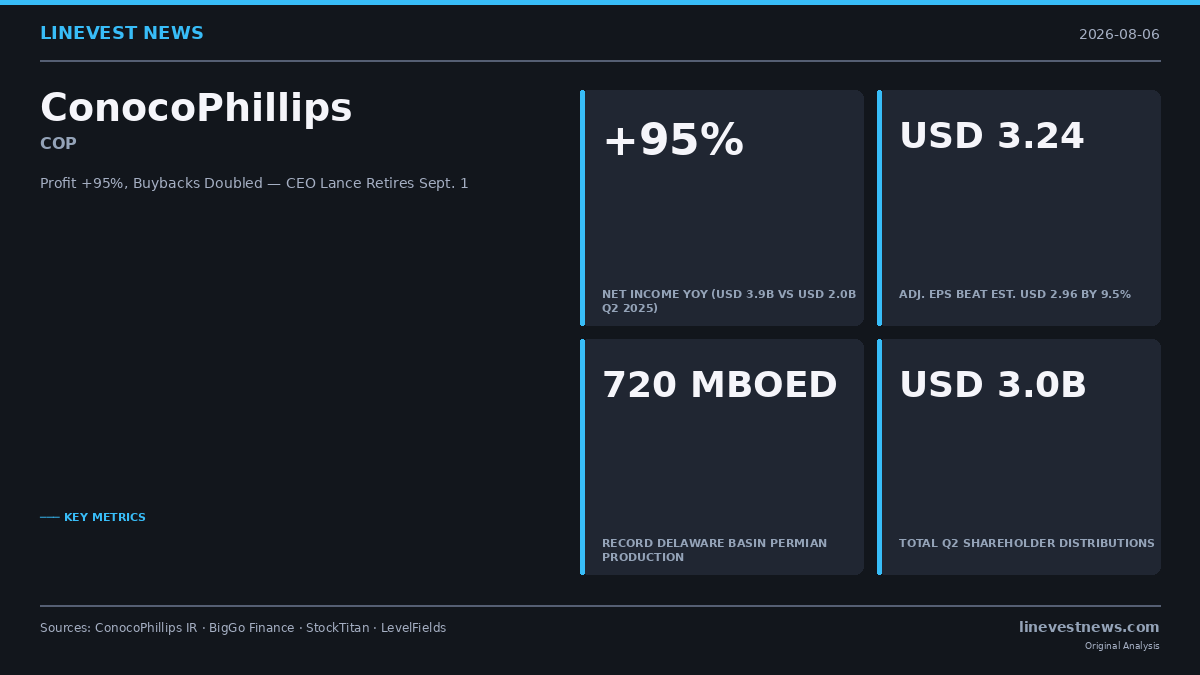
ConocoPhillips (COP) Q2 2026: Profit Nearly Doubles to USD 3.9B as CEO Lance Retires
COP Q2 adj. EPS USD 3.24 beat est. by 9.5%; net income +95% to USD 3.9B on record Permian output. CEO Lance retires Sept. 1; CFO O'Brien succeeds.
Go deeper than the headline
You just read what happened. Here's how to read what it means.
The day's reports, every morning — free
LineVest Daily lands in your inbox before the opening bell with the reports we published that day — what each company's latest 10-K or 10-Q actually says about the numbers, in plain English. Free, no card required.
This report, on any company you name
What you just read on ConocoPhillips is the format. Name any U.S.-listed company and we do the same for it — its latest SEC filing read in full, financials under US GAAP, governance, and what it means for the stock. PDF in your inbox within 3 hours.
Which company should we read?
$15 · one-time · PDF within 3 hours
Pick a company to continueIndependent journalism based on primary SEC filings — not investment advice. No brokerage affiliation.