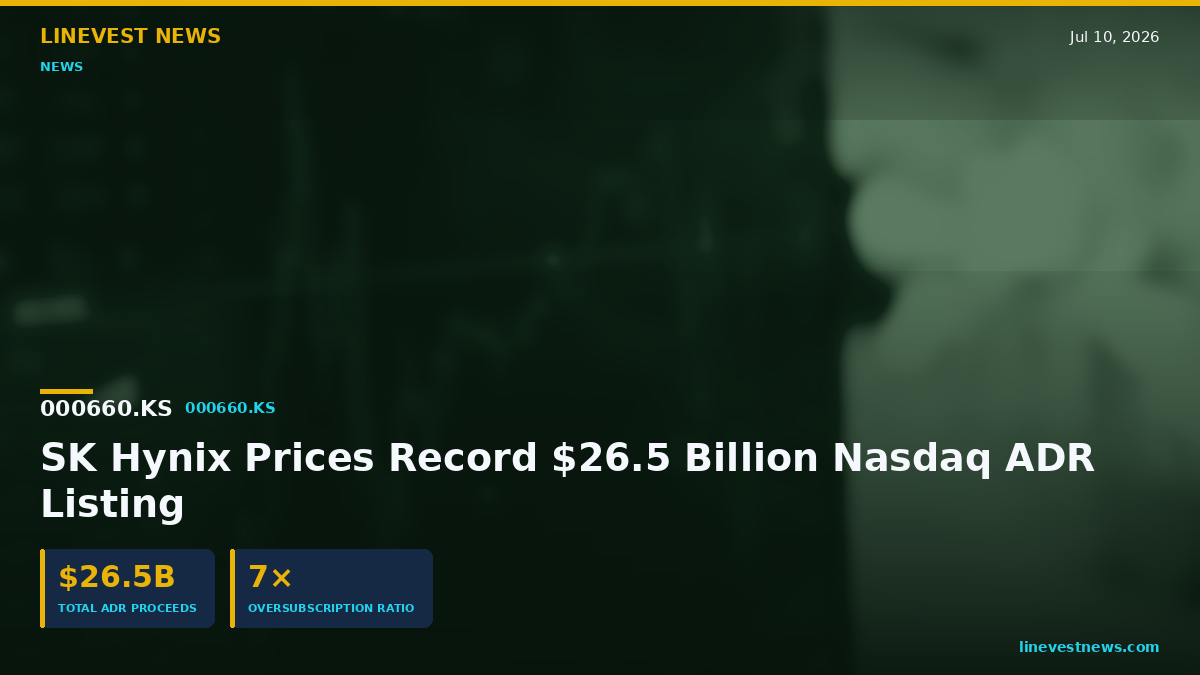
SK Hynix (000660.KS), the world's second-largest memory-chip maker and the dominant supplier of AI high-bandwidth memory, has priced its US share sale at $149 per American depositary receipt, raising about $26.5 billion in what its bankers call the largest-ever initial US stock sale by a foreign company. The ADRs are due to begin trading on the Nasdaq Global Select Market on July 10 under the ticker SKHY, according to the company's disclosure as reported by Maeil Business Newspaper and Hankyung. Chey Tae-won, chairman of SK Group (SK Hynix's parent conglomerate), and SK Hynix CEO Kwak No-jung traveled to the US to mark the debut, Yonhap reported.
For a global fund manager, the first question is obvious: why is a company already listed in Seoul selling $26.5 billion of new equity in New York, and is the ADR cheap or dear against its home line? The pricing answers part of it. At $149, the ADR came at roughly a 3% premium to SK Hynix's Seoul closing price the day before pricing — 2.9% in the company's won-based calculation (Maeil Business Newspaper) and 3.1% in dollar terms (Bloomberg via Reuters/Yahoo Finance). Rather than the discount that often accompanies a large equity raise, SK Hynix priced above the domestic market, a signal of demand corroborated by the book: the offering drew orders exceeding seven times the shares available, Reuters reported.
The mechanics
SK Hynix sold 177.9 million ADRs, with ten ADRs representing one common share, according to the company's disclosure (Chosun Biz) and Reuters. That translates to roughly 17.79 million common-share equivalents of new stock. At the offer price of $149 per ADR — equivalent to roughly $1,490 per common share — the transaction valued the offering near $26.5 billion (Reuters/Yahoo Finance), which Korean outlets framed as proceeds of around ₩40 trillion. SK Hynix's Thursday Seoul close was ₩2.186 million (about $1,445) per common share. Bank of America, Citigroup, Goldman Sachs and JPMorgan Chase led the deal alongside nine other institutions.
The size sets a record. The proceeds surpass Alibaba Group's roughly $25 billion New York flotation in 2014 — previously the benchmark for a foreign company's US listing — according to CNBC and Reuters coverage. Unlike a conventional IPO, this is a secondary US listing of a company already public on Korea's main index, the KOSPI, so the strategic point is access rather than a first sale: the ADR opens SK Hynix directly to US institutional pools without forcing them onto the Seoul exchange.
Where the money goes
SK Hynix earmarked the proceeds for expansion of its South Korean manufacturing facilities and equipment purchases, including extreme ultraviolet (EUV) lithography scanners, per Reuters. That capital plan sits directly on the AI thesis driving the stock: SK Hynix holds roughly 57% of global high-bandwidth memory revenue by Reuters' estimate (CNBC has cited about 60%), the stacked DRAM that Nvidia and other accelerator makers depend on. The raise is, in effect, a bet that funding more HBM and DRAM capacity now is worth the dilution.
The listing also lit up the home market. The day before the debut, SK Hynix surged as much as 8% in early Seoul trading and Samsung Electronics (005930.KS), Korea's largest listed company, rose about 4%, Maeil Business Newspaper reported, and Yonhap noted the KOSPI drew upward momentum from the US semiconductor rally and the ADR event.
What to watch
Two data points will test the demand the book-building implied. The first is the SKHY opening print on July 10 measured against the $149 offer price — the immediate read on whether the seven-times-oversubscribed order book converts into a sustained aftermarket premium or fades toward the Seoul line. The second is SK Hynix's next quarterly results, which will show whether HBM shipment and pricing trends justify the capacity expansion the proceeds are meant to fund. Because ten ADRs equal one common share, any durable gap between SKHY and the KOSPI stock is also an arbitrage signal worth tracking; UBS flagged a potential arbitrage opportunity around the pricing.
This article is journalism, not investment advice. LineVest is not a registered investment adviser. Figures are drawn from company disclosures as reported by Korean and international outlets and were accurate as of publication; readers should verify current data before making any decision.