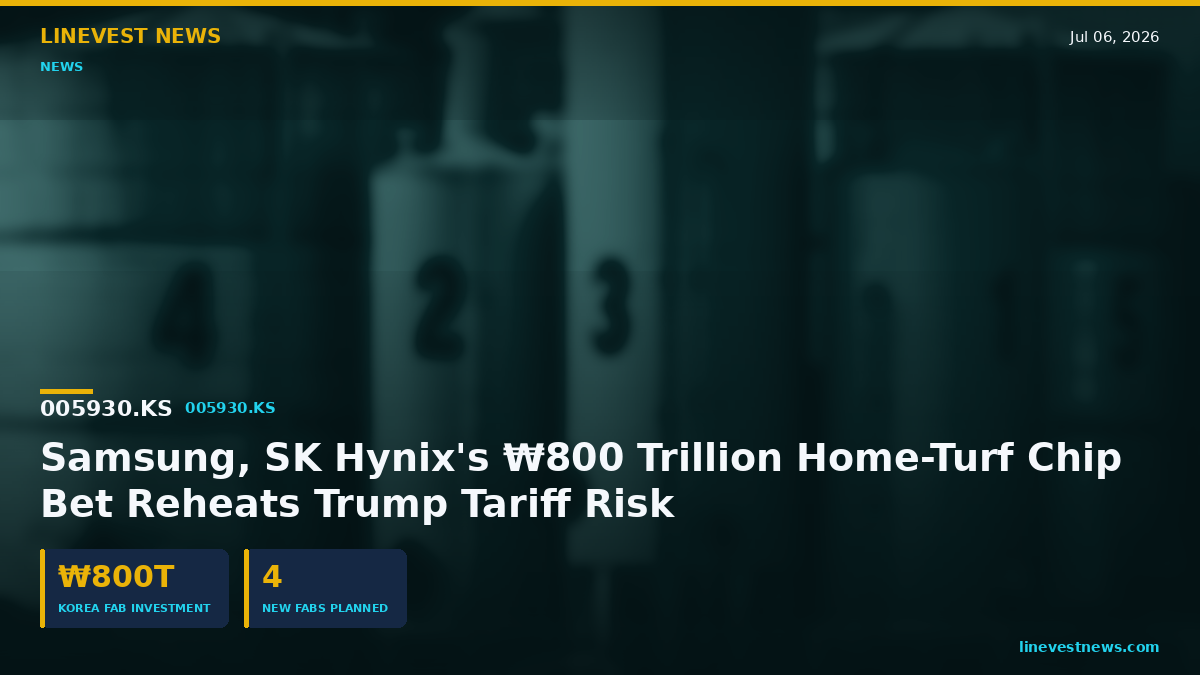
Samsung Electronics (005930.KS), the world's largest memory-chip maker, and SK hynix (000660.KS), Korea's second-biggest chipmaker and the leading supplier of high-bandwidth memory (HBM), have anchored a national plan to pour ₩800 trillion (about $584 billion, per The Korea Times) into new fabs across Korea's southwestern Jeolla region. The scale of that home-turf commitment is now the central variable in how hard Washington pushes the two companies to build on U.S. soil instead.
What was committed
The plan concentrates four new front-end fabrication plants — two apiece for Samsung and SK hynix — around Gwangju and the surrounding southwest, as part of a government-backed national semiconductor initiative, according to trade publication The Elec and Seoul Economic Daily. The combined home-market build-out is more than 12 times the roughly $41 billion the pair have so far committed to U.S. manufacturing: Samsung's Taylor, Texas complex ($37 billion) plus SK hynix's advanced-packaging plant for HBM in West Lafayette, Indiana ($3.87 billion).
Why the framing matters for a U.S. holder
The Trump administration has used tariffs to pull manufacturing onshore, and earlier this year the president warned that memory makers without U.S. fabs could face duties of up to 100 percent — a threat widely read as aimed at Samsung and SK hynix, The Korea Times reported. Those semiconductor tariffs have been put on hold and never implemented, but Seoul and Washington still treat them as live leverage in ongoing trade talks. A ₩800 trillion domestic commitment, unveiled while that leverage sits unused, hands U.S. negotiators a fresh talking point — exactly the concern industry officials flagged to The Korea Times.
The precedent argues pressure is real but slow to convert
Samsung's U.S. track record shows tariff threats have not yet forced faster American output. The company announced Taylor in November 2021 at $17 billion, later expanded it to about $37 billion (with up to $4.7 billion in CHIPS Act funding awarded in December 2024), yet the fab — originally due to open in the second half of 2024 — has been repeatedly delayed, with recent reports putting mass production in 2026–2027 amid a shortage of committed customers (Nikkei Asia; TrendForce). In other words, four years of U.S. incentives and tariff threats have coincided with slippage, not acceleration.
The analyst counterpoint
Domestic-focused analysts are treating the trade noise as separable from earnings. Samsung Securities (016360.KS), the Samsung group's brokerage arm, on July 6 reiterated a "buy" rating and a ₩500,000 ($365) price target — roughly 61 percent above the near ₩310,000 ($226) at which the stock traded in early July, per market data — arguing that stronger-than-expected DRAM prices are becoming a "new normal." The brokerage estimates second-quarter revenue of ₩82 trillion ($60 billion) and operating profit of ₩8.6 trillion ($6.3 billion), broadly in line with a market consensus near ₩8.5 trillion ($6.2 billion), and lifted its memory operating-profit estimate to ₩8.4 trillion ($6.1 billion) from ₩8.0 trillion ($5.8 billion), analyst Lee Jong-wook wrote (via Maeil Business Newspaper, a Korean financial daily; etoday; Newspim). At least one rival house has gone as high as ₩590,000 ($431), etoday reported on July 3.
The open question
The near-term test is Samsung's second-quarter earnings. Preliminary figures are due within days, with a detailed earnings conference later in July at which Samsung Securities expects management to spell out long-term supply agreements (LTAs), 2027 HBM pricing and shareholder-return plans. Whether Samsung uses that platform to reaffirm — or quietly re-pace — its U.S. commitments will show how much the tariff leverage is actually biting on a company that just placed its biggest bet at home.
This article is journalism, not investment advice. LineVest is not a registered investment adviser. Figures are attributed to the cited primary sources; readers should verify against company disclosures before making any decision.