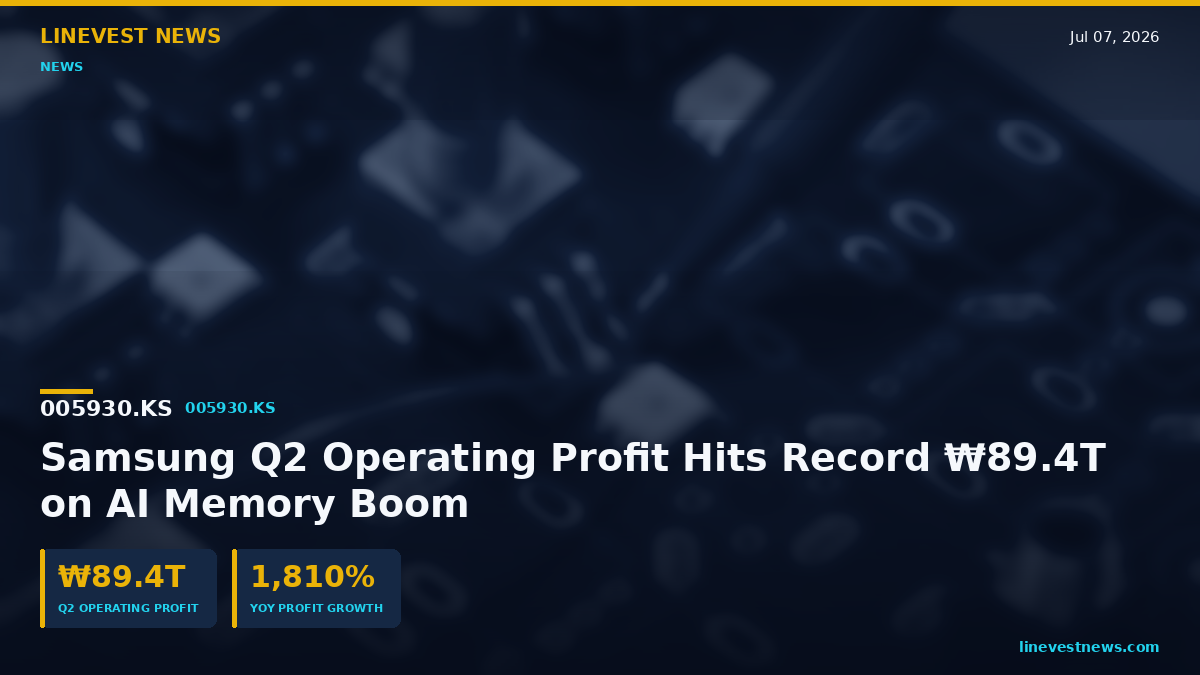
Samsung Electronics — South Korea's largest company and the single heaviest weight on the KOSPI, Korea's benchmark stock index — guided on July 7 to a record second-quarter operating profit of ₩89.4 trillion ($58.4 billion), a number large enough to reframe what one quarter of chip earnings can look like. Revenue came in at ₩171 trillion (about $112 billion). Both are preliminary, K-IFRS-basis (Korea's adopted international accounting standard) figures released ahead of full results. (USD conversions here use roughly ₩1,530 to the dollar, the rate implied by The Korea Times' own conversion of the guidance.)
The first thing a portfolio manager asks is how far past expectations this ran, and what is driving it. On the first point, the guidance topped the ₩84.8 trillion ($55.4 billion) FnGuide consensus — FnGuide is Korea's main financial-data aggregator — by roughly ₩4.6 trillion, as reported by The Korea Times. On the second, operating profit jumped 1,810.3% from a year earlier and 56.2% from the prior quarter, a swing that Samsung and multiple Korean outlets (Yonhap, etnews) tie to the recovery in memory-chip prices and what The Korea Times described as "a global boom in demand for artificial intelligence (AI) chips." Sales rose 129.3% year-on-year and 27.7% sequentially.
Sizing the number. The result eclipses Samsung's own previous record of ₩57.23 trillion ($37.4 billion) — set just one quarter earlier, in Q1 2026 (The Korea Times) — making this the third consecutive record quarter (Yonhap, etnews). It also dwarfs the year-ago trough of ₩4.68 trillion ($3.1 billion) in Q2 2025 (etnews), the depth of the prior memory downturn; that trough-to-peak move is the roughly 19-fold jump the company cited. For global scale, The Korea Times noted the quarterly operating profit exceeds Nvidia's record quarterly profit (around $35 billion) and Apple's peak (around $43 billion).
The caveat, and the open question. Preliminary guidance, per Samsung's long-standing practice, disclosed only group revenue and operating profit — no divisional split and no net profit. Detailed segment results are due later this month (The Korea Times), and that report is the confirming data point. It will show how much of the ₩89.4 trillion came from the DS division (Samsung's Device Solutions semiconductor arm) versus the DX consumer and mobile unit, and whether high-bandwidth-memory pricing carried the quarter. A leading indicator of management's own read arrived on July 6, when Samsung set first-half performance bonuses at up to 100% of base salary for DS semiconductor staff — versus lower rates for the consumer-products units — payable July 8 (etnews).
Market reaction ran ahead of the print. On July 6, Samsung shares rose 3.39% to ₩320,000 (about $209) intraday on memory super-cycle optimism, according to Maeil Business Newspaper (Maekyung), a Korean financial daily.
What to watch. The full Q2 report later this month will confirm or complicate the memory-led read by breaking out DS profitability and net income; beyond that, subsequent monthly memory-chip pricing will determine whether an ₩89 trillion quarterly run-rate marks a peak or a step. Until the segment detail lands, the guidance answers how big — not yet exactly why.
This article is journalism, not investment advice. LineVest is not a registered investment adviser. The figures above are preliminary and subject to revision in Samsung Electronics' final second-quarter 2026 results.