Samsung Electronics (005930.KS), the world's largest memory-chip maker, is expected to report a historic quarter when it publishes preliminary second-quarter results on Tuesday, July 7. Yet on Monday the market did the opposite of celebrate: the KOSPI (Korea's benchmark equity index) reversed an early rally and broke below the 8,000 line, dragged down by relentless foreign selling. The one question a portfolio manager has to answer before the print is simple — if the numbers are this good, why is the market heading the other way?
The selloff, in numbers
By late morning Monday, the KOSPI stood at 7,938.2, down 150.14 points or 1.86%, after opening higher and briefly clearing 8,100 before rolling over, according to Chosun Biz (the business title of Korean daily Chosun Ilbo). Foreign investors sold a net ₩550 billion ($355 million) and institutions a net ₩730 billion ($471 million), while retail investors alone soaked up ₩1.2 trillion ($774 million) of net buying (Chosun Biz). Crucially, Chosun Biz reported foreigners had been net sellers for 12 consecutive sessions — the selling pressure predates and outlasts any single earnings date. Figures are converted at roughly ₩1,550 to the dollar, the rate implied by the sources cited here.
The weakness ran deeper on the KOSDAQ (Korea's tech-heavy secondary bourse), which fell 35.56 points, or 4.09%, to 832.85. Chip-equipment names were among the hardest hit, with Wonik IPS and Jusung Engineering — both Korean semiconductor-tooling suppliers — down 9% and 7% respectively (Chosun Biz). Samsung Electronics and SK Hynix (000660.KS), the second-largest memory maker and lead high-bandwidth-memory (HBM) supplier to Nvidia, both slipped as well — Samsung near ₩300,000 ($194) per share and SK Hynix near ₩2,300,000 ($1,480) per share (Chosun Biz).
Why the print itself is the headline
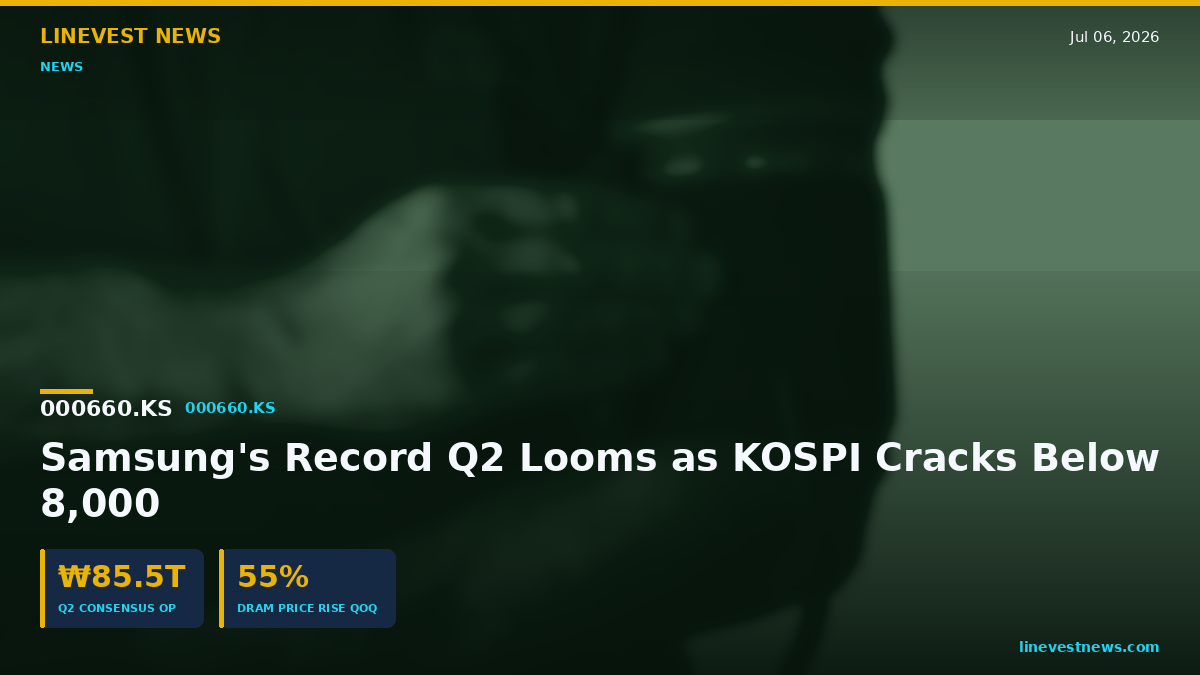
Brokerage consensus compiled by BigGo Finance puts Samsung's Q2 operating profit at roughly ₩85.5 trillion ($55.2 billion) on revenue of about ₩169.4 trillion ($109.3 billion). That would be a record and more than an 18-fold jump from the ₩4.7 trillion ($3.0 billion) Samsung earned in the second quarter of 2025 (BigGo Finance). It would also mark a roughly 49.5% sequential gain over the ₩57.2 trillion ($36.9 billion) reported in the first quarter of 2026 — which was itself an all-time high (BigGo Finance). Maeil Business Newspaper (a Korean financial daily) noted that some brokerage forecasts go further still, seeing operating profit top ₩90 trillion ($58 billion).
The engine behind the surge is memory pricing. BigGo Finance cited DRAM contract prices rising about 55% quarter-on-quarter and NAND flash roughly 60%, alongside Samsung's HBM4 ramp and expanded supply to Nvidia as additional profit drivers.
Buy the rumor, sell the news?
That backdrop reframes Monday's drop less as a verdict on the business and more as positioning ahead of a known catalyst. Chosun Biz reported that the market sees a broader semiconductor re-rating as possible only if the memory-price gains confirmed in the July 7 release exceed already-elevated expectations — a high bar when consensus already implies a record. With foreigners having sold for 12 straight sessions (Chosun Biz) and retail investors the lone buyers, the tape suggests institutional money is de-risking into the event rather than chasing it.
The near-term open question is therefore narrow and dated: whether the realized memory average selling prices embedded in Tuesday's preliminary figures validate the ₩85.5 trillion consensus, and how Samsung's detailed segment breakdown — due later in July — apportions the gains between DRAM, NAND and HBM. That data point, not Monday's index level, is what confirms or refutes the re-rating thesis.
The longer horizon: an ₩896 trillion bet at home
Beyond the quarter, Korea's chipmakers are anchoring an enormous domestic build-out. The Electronic Times (a Korean tech-industry daily) reported that the Jeonnam-Gwangju Integrated Special City — a newly merged administrative region in southwestern Korea — is fast-tracking permits and lining up power, water and talent for a ₩896 trillion ($578 billion) southwestern semiconductor megaproject, targeting a first ground-breaking in the second half of this year and completion within four years.
The scale breaks down as follows, per Korea JoongAng Daily: Samsung has pledged ₩425 trillion ($274 billion) for two memory fabs and a national AI computing center in the Honam region (southwestern Korea covering Gwangju and Jeolla provinces); SK has committed ₩470 trillion ($303 billion) for two fabs and a 1-gigawatt AI data center; and US-based packaging firm Amkor Technology added ₩1 trillion ($645 million) to expand its Gwangju facility. The memorandum of understanding was signed on June 30, with President Lee Jae Myung pledging to personally oversee the plan (Korea JoongAng Daily). For a manager weighing Monday's selloff, the megaproject is a reminder that the sector's domestic capacity story runs on a multi-year clock, separate from the single-quarter catalyst arriving Tuesday.
This article is journalism, not investment advice. LineVest is not a registered investment adviser. Figures are drawn from the cited Korean and international sources and were accurate as reported; currency conversions use an approximate rate of ₩1,550 per US dollar. Verify all data against primary disclosures before making any decision.