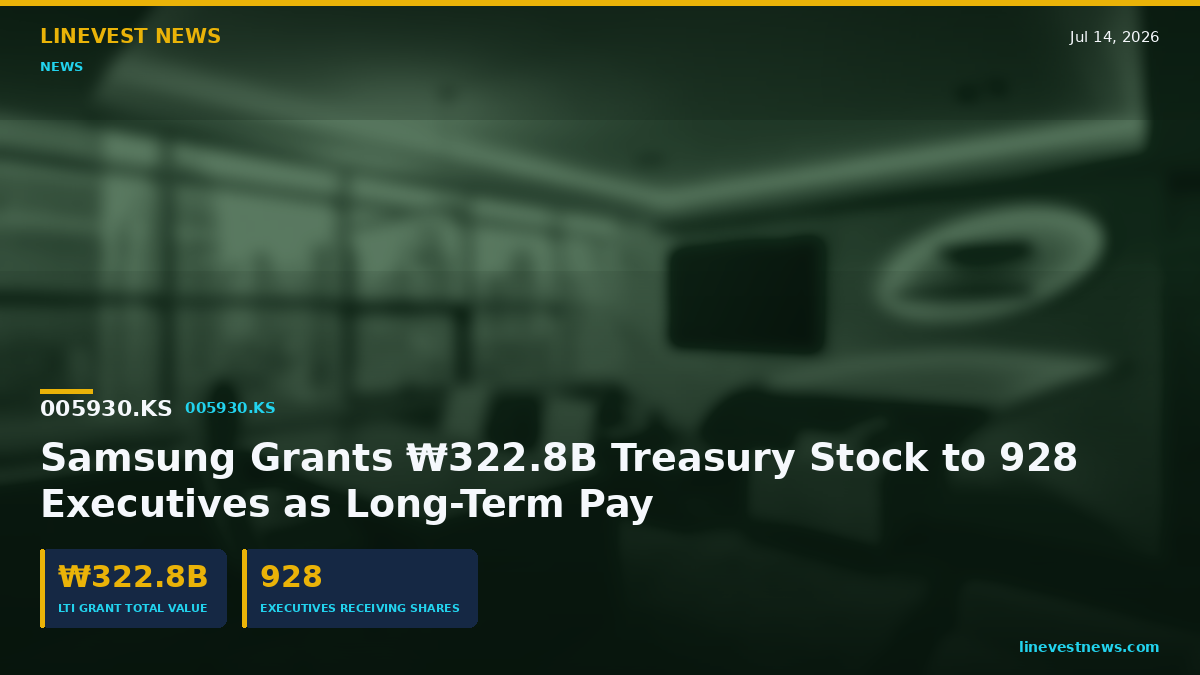
Samsung Electronics (005930.KS), the world's largest memory-chip and smartphone maker, disclosed on July 13 that it will dispose of 1,132,477 common treasury shares worth roughly ₩322.8 billion ($235.6 million) — not into the open market, but by handing them to 928 of its own executives as long-term performance pay, according to the company's regulatory filing as reported by Yonhap and ChosunBiz.
For a foreign fund manager, the headline "Samsung disposes of treasury stock" reads at first like a supply event or a cash-raising move. It is neither. The transaction is a compensation transfer under Samsung's Long-Term Incentive (LTI) plan, and its size relative to the company is negligible: the shares equal about 0.019% of Samsung's roughly 5.85 billion common shares outstanding, a level the company itself said in the filing would have a "minimal" dilution effect (ChosunBiz, July 13).
What was actually decided
The disposal price was set at ₩285,000 ($42) per share, Samsung's closing price on July 10, the trading day before the board resolution (ChosunBiz). On a simple average, the grant works out to about ₩347.8 million ($51,000) per executive, though the company said individual amounts vary with performance.
Under the LTI scheme, executives with at least three years of tenure are assessed on the company's business performance over the trailing three years, with awards paid out annually across the following three years. Payouts can reach up to 300% of average annual salary, and a portion is settled in Samsung shares rather than cash (ChosunBiz). Paying part of senior compensation in stock ties executive rewards to the share price that outside holders also depend on.
Not the first time this year
Stock-based executive pay has become a recurring feature at Samsung. In February 2026 the company distributed about ₩175.2 billion ($128 million) in treasury shares to executives under a separate Over-Profit Incentive (OPI) program, with DX Division head TM Roh — who also runs Samsung's Mobile eXperience business — receiving roughly $4.3 million, the largest single award, according to KED Global (Feb. 3, 2026). The July LTI grant is a distinct program but reflects the same shift toward equity-linked senior pay.
How it fits the bigger capital-return picture
The grant is a rounding error next to Samsung's shareholder-return moves. The company said it would cancel about ₩5.0 trillion (roughly $3.6 billion) of treasury stock — some 87 million shares, or about 1.5% of outstanding shares — in the first half of 2026, a follow-up to the ₩10 trillion (about $7.3 billion) buyback plan it announced in 2024 (The Korea Herald; Investing.com). Cancellations permanently shrink the share count and lift per-share value; grants like this one recycle a sliver of treasury stock back into circulation as pay. At 0.019%, the July transfer does not meaningfully offset the cancellation math.
The timing sits against a soft tape: Samsung traded at ₩254,500 on July 13 — a 10.7% single-day drop — leaving the stock well below the ₩285,000 disposal reference price struck on July 10 (Investing.com quote data), meaning the awards were priced off a level the stock had already dropped beneath.
The open question
The data point that matters for the capital-return thesis is execution, not this grant. Watch whether Samsung completes the full ₩5.0 trillion cancellation on schedule in the first half and signals its intentions on the far larger buyback speculation the market has floated — Samsung has publicly said no decision has been made on any such program, telling regulators on June 24 that the timing and scale of any repurchase for stock-based compensation remain undetermined (The Elec, June 24, 2026). That, not a 0.019% executive stock transfer, is what will move per-share value for outside holders.
This article is journalism, not investment advice. LineVest is not a registered investment adviser. Figures are drawn from Samsung Electronics' July 13 regulatory disclosure as reported by Korean media and from the cited external sources; currency conversions use an approximate rate of 1 USD = 1,370 KRW and are for reference only.
Sources: Chosun Biz · Hankyung · Yonhap · The Elec