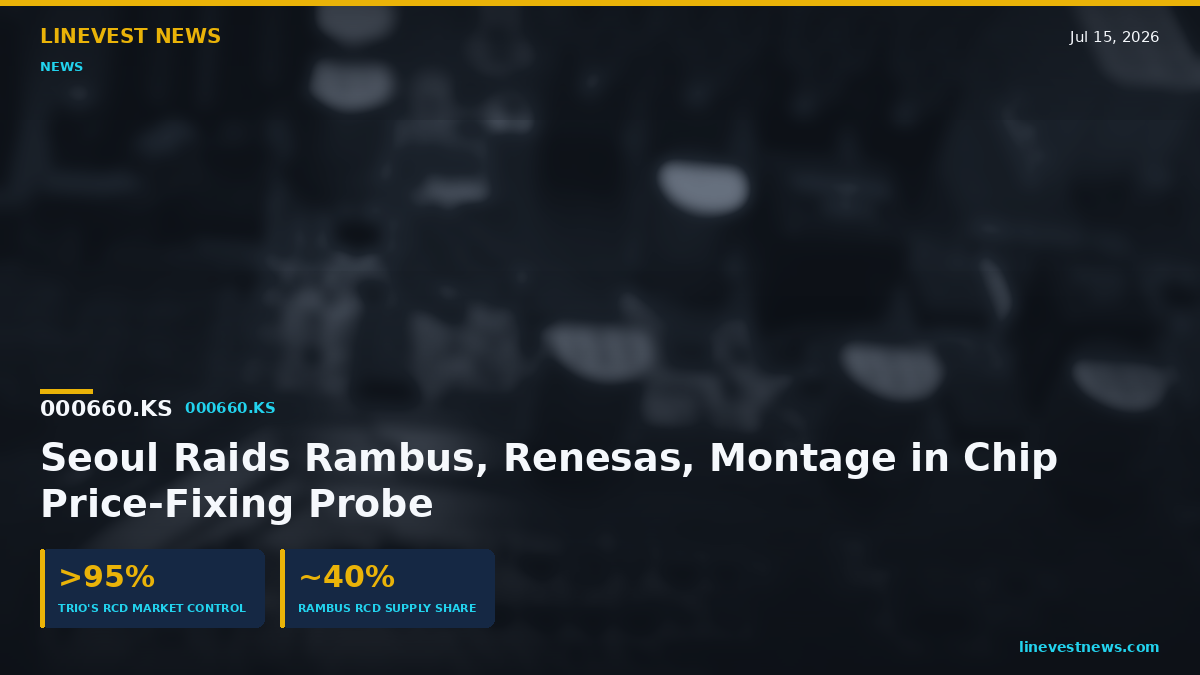
On July 15, the Seoul Central District Prosecutors' Office — Korea's lead body for major economic-crime prosecutions — searched the Korean offices of three global memory-chip component makers over suspected price collusion, according to Korea's Maeil Business Newspaper (MK) and Chosun Biz. The three firms are Montage Technology, a Shanghai-listed fabless chip designer; Renesas Electronics, a Japanese semiconductor maker; and Rambus, a US chip-interface company. The office's Fair Trade Investigation Division, led by chief prosecutor Na Hee-seok, is examining whether the trio fixed the prices of parts they supply to Samsung Electronics (005930.KS) and SK Hynix (000660.KS) in violation of Korea's Fair Trade Act, the country's core antitrust statute, Chosun Biz reported.
Crucially, Samsung and SK Hynix — the world's two largest memory chipmakers — are the customers in this probe, not the targets. If the allegation holds, the two Korean giants are among the buyers that would have overpaid for a component they cannot easily source elsewhere.
What the parts are, and why concentration invites scrutiny
The components at issue are memory interface chips — most importantly the Registering Clock Driver (RCD), a controller mounted on server memory modules that manages the flow of commands to the DRAM. Per Rambus, the RCD is the core of its DDR5 server-DIMM chipset for RDIMMs running at data rates up to 8,000 MT/s. It is a small but strategic part of the DDR5 server memory that underpins AI data-center demand.
What turns that part into an antitrust flashpoint is market concentration. Montage, Renesas and Rambus together control more than 95% of the DDR5 RCD market, according to market-research summaries; Rambus alone supplies roughly 40% of RCDs to memory-module makers, with Renesas and Montage splitting most of the remainder, per plaintiffs' firm Cotchett, Pitre & McCarthy (CPM), which is investigating the same market. Industry researchers size the RCD segment at roughly $800 million a year. That three-way structure is recent: in 2018 the market was effectively a duopoly, with IDT at 51% and Montage at 46% against Rambus's 3%, per EqualOcean; Renesas absorbed IDT's interface business through its 2019 acquisition, producing today's split.
The Korean node of a cross-border probe
The Seoul raid is the Korean front of a widening international investigation. In January 2026, the US Department of Justice's Antitrust Division executed search warrants at Montage and Renesas, and on April 28, 2026 Rambus disclosed in a Securities and Exchange Commission filing that a US federal grand jury had subpoenaed it as part of a criminal price-fixing probe, per CPM. Korean prosecutors say they detected signs of collusion independently and plan to analyze seized mobile phones to establish whether the firms exchanged pricing information, along with the timing, scope and actual price impact of any coordination, Chosun Biz reported.
A prosecutorial drive with political backing
The raid comes amid a broader anti-cartel push. The same Fair Trade Investigation Division recently indicted four major oil refiners and four executives over alleged collusion on refined-product prices following the US-Iran conflict, Chosun Biz noted. The campaign has top-level support: at a July 15 ministry briefing, President Lee Jae-myung singled out price collusion as a practice that must be corrected, citing the refiners' case, according to Newsis. Separately — and on the opposite side of the ledger — Samsung, SK Hynix and Micron were sued in the US in late June by consumers and small PC firms alleging DRAM price-fixing, according to Seoul Economic Daily, underscoring that the memory chain now faces antitrust scrutiny from both directions.
What to watch
The open question is whether prosecutors can show the alleged coordination actually moved delivery prices — the specific point Chosun Biz says investigators are probing — and whether the case advances to indictment as the refiners' did. No supply disruption to memory makers has been signaled. The near-term tells will be any referral to the Korea Fair Trade Commission (KFTC, the country's antitrust regulator) or an indictment decision, and how Rambus, Renesas and Montage characterize the Korean probe in their next quarterly disclosures.
This article is journalism, not investment advice. LineVest is not a registered investment adviser. Figures cited trace to the sources named inline; readers should verify against primary disclosures before making any decision.