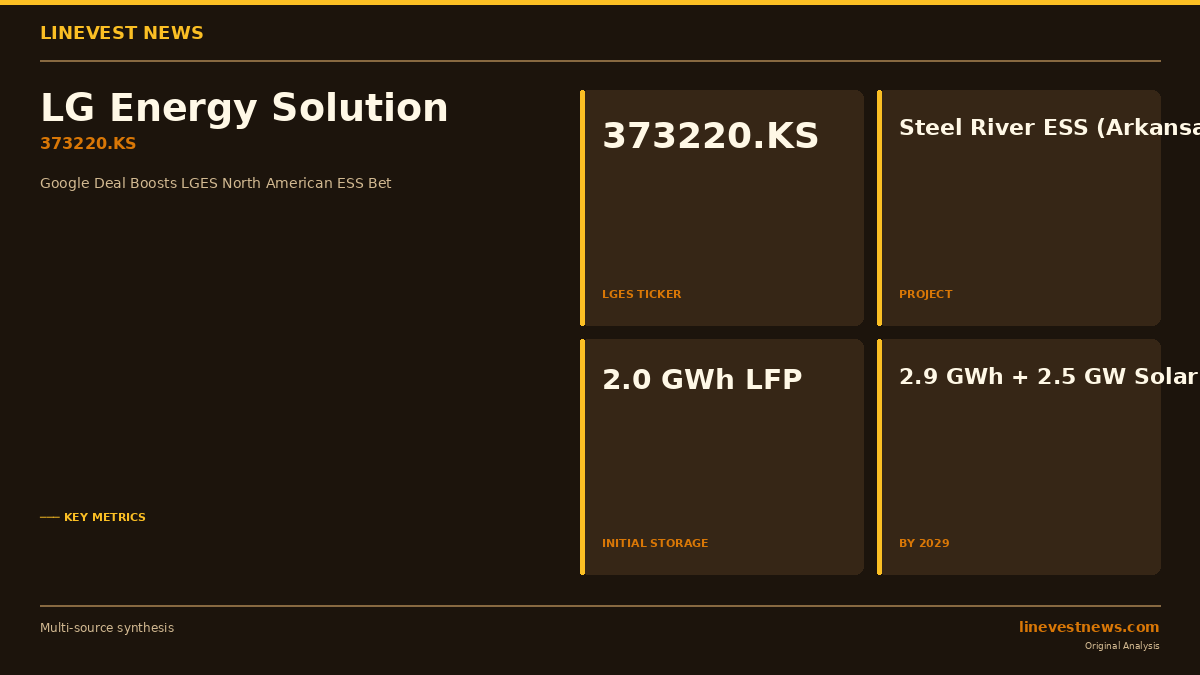
LG Energy Solution Wins Google's Steel River Battery Order, Largest U.S. Solar-Storage Project
TL;DR - LGES will supply LFP batteries for Google's Steel River Energy Center (Arkansas), the tech giant's largest-ever solar-storage project - Initial phase: 1.6 GW solar + 2 GWh storage → expanding to 2.5 GW + 2.9 GWh by 2029 - Manufacturing at LGES's Lansing, Michigan ESS plant, unlocking U.S. Inflation Reduction Act AMPC credits - Deal follows a May 2026 DTE Energy order; LGES targets 60+ GWh global ESS capacity by year-end
Part A: The Deal
LG Energy Solution (KOSPI: 373220.KS) has secured a multi-year battery supply agreement with Google for the Steel River Energy Center, a sprawling renewable complex in Arkansas developed by Cypress Creek Energy. The project, announced on July 15, 2026, is Google's single largest solar-and-storage investment to date.
Under the agreement, LGES will deliver its JF2 DC Link system — a rack-scale lithium iron phosphate (LFP) battery platform engineered for utility-scale stationary storage. The Lansing, Michigan facility, which begins ESS production later in 2026, will manufacture the units, qualifying for Advanced Manufacturing Production Credits (AMPC) under the U.S. Inflation Reduction Act.
| Phase | Solar Capacity | Battery Storage | Status |
|---|---|---|---|
| Initial | 1.6 GW | 2.0 GWh | 2026–2027 |
| Expansion | +0.9 GW (total 2.5 GW) | +0.9 GWh (total 2.9 GWh) | By 2029 |
The complex is projected to generate enough electricity annually to power more than 315,000 homes. Solar modules will be supplied by First Solar; structural steel is locally sourced. The contract value was not disclosed but described by industry sources as "several hundred billion won."
Part B: Korea Market Implications
ESS as LGES's Profitability Lifeline
LGES reported Q2 2026 preliminary results (July 7) with operating profit of ₩113.3 billion — a sharp improvement from the prior quarter, but still down 77.0% year-on-year. Crucially, the ₩241 billion in AMPC subsidies were the only reason LGES posted positive operating income at all: ex-AMPC operating profit stood at -₩127.7 billion.
The Steel River deal directly strengthens LGES's AMPC pipeline. Every GWh of LFP battery delivered from North American factories generates a fixed IRA subsidy per kWh shipped. At 2.9 GWh total capacity, the project adds meaningfully to LG's subsidy backlog, providing a revenue stream that is insulated from EV demand cycles.
Big Tech's Insatiable Power Appetite
The structural driver behind the order is well-documented: Google's electricity consumption surged 37% in 2025, while Microsoft's rose 24%. Collectively, Google, Meta, Amazon, and Microsoft accounted for 49% of all global corporate renewable-energy agreements last year. As AI model training and inference workloads compound, hyperscalers are competing for dedicated clean-power capacity — and utility-scale battery storage is now a prerequisite for reliable renewable delivery.
Steel River's combination of 2.5 GW solar and 2.9 GWh storage means Google can dispatch clean electrons around the clock, not just when the sun shines. This is increasingly the template for Big Tech energy deals.
North American Positioning: LGES vs. Samsung SDI vs. CATL
LGES is executing a deliberate strategy to build 50+ GWh of North American ESS capacity by the end of 2026, across four plants in Michigan, Ohio, Tennessee, and Ontario, Canada. The Steel River win reinforces this lead at a time when Chinese rival CATL faces intensifying U.S. regulatory pressure over supply-chain security.
Samsung SDI (006400.KS), the most direct domestic competitor, recently filled 66% of Korea's first AI grid-ESS pilot project (announced July 10). But Samsung SDI has limited North American manufacturing exposure for utility-scale ESS, leaving LGES better positioned to capture IRA-compliant hyperscaler orders.
| Metric | LG Energy Solution | Samsung SDI | CATL |
|---|---|---|---|
| North American ESS capacity target | 50+ GWh (2026) | Limited | Restricted (regulatory) |
| IRA AMPC eligibility | ✅ Full | Partial | ❌ |
| Q2 2026 ESS revenue trend | ₩7.56T (+24.8% YoY) | N/A | N/A |
Investor Takeaways
Bull case: The Steel River deal signals that hyperscalers are willing to commit multi-year, large-block battery orders to LGES, validating the company's pivot from flagging EV cell demand toward ESS. If AMPC income grows with each new North American order, LGES can plausibly reach ex-AMPC breakeven by late 2026 or early 2027.
Bear case: LGES's H1 2026 ex-AMPC operating loss of -₩94.5 billion illustrates that North American manufacturing subsidies alone cannot offset weak EV margins. The Ultium Cells JV (GM partnership) with plants in Ohio and Tennessee remained partially idled in early 2026. Full-capacity utilisation is essential to earn AMPC at scale.
What to watch: LGES will release full Q2 2026 financials on July 30, including ESS segment revenue, AMPC disbursements, and North American utilisation rates — the clearest gauge of whether the Steel River and DTE Energy orders are already moving the needle.
Sources: Korea Herald · LG Energy Solution Q2 2026 Preliminary Results (DART, July 7, 2026) · Korea Herald – Samsung SDI ESS