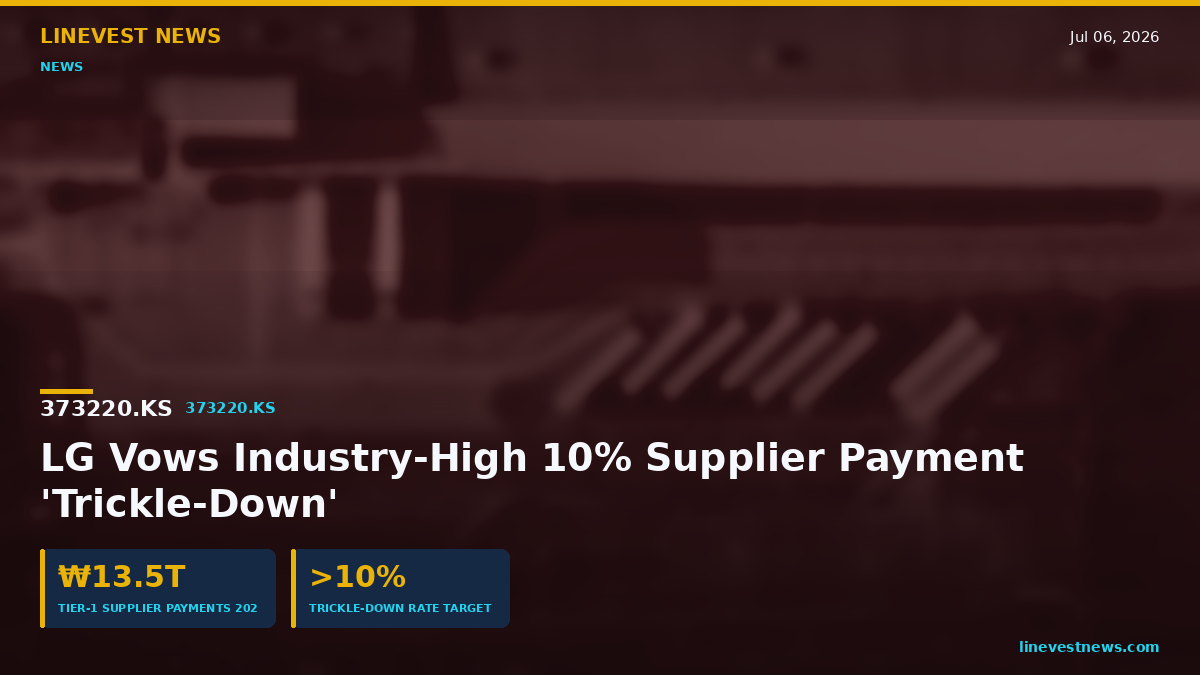
South Korea's LG Group (holding company LG Corp, 003550.KS), one of the country's largest family-controlled conglomerates, said on July 6 it will lift the share of its supplier payments that flow through to smaller sub-contractors to more than 10% — what it called the highest level among Korean business groups. The pledge was made at a signing ceremony at LG Science Park in the Magok district of Seoul's Gangseo-gu, attended by Joo Byung-ki, chairman of the Korea Fair Trade Commission (KFTC, the country's antitrust and subcontracting-fairness regulator), alongside the chief executives of seven LG affiliates and roughly 170 guests, per Seoul Economic Daily and LG's own disclosure carried by ChosunBiz.
For an overseas investor, the headline raises an obvious question: is this a material cash outlay for LG, or a governance and regulatory-relations gesture? The answer, on the numbers LG provided, is closer to the latter — but with a real working-capital benefit for the supply chain rather than new spending off LG's income statement.
What the 10% figure actually means
The metric LG is targeting is the "win-win payment trickle-down rate" (sangsaeng-gyeolje naksuyul) — the proportion of money a large buyer pays its first-tier suppliers that is passed further down to second- and third-tier firms using the buyer's credit standing. The win-win payment system itself is a government-backed supply-chain finance scheme, introduced in 2015, that lets lower-tier subcontractors convert receivables to cash early at the anchor company's borrowing rate; its annual transaction volume reached about ₩189 trillion ($138 billion) in 2025, according to figures cited by The Asia Business Daily.
LG said its seven participating affiliates paid roughly ₩13.5 trillion ($9.85 billion) to first-tier suppliers through the win-win system in 2025, while maintaining a 100% cash-based payment ratio to those tier-one partners. If a similar volume is disbursed this year, a 10% trickle-down rate implies about ₩1.35 trillion ($985 million) reaching second-tier suppliers on LG's credit — the arithmetic LG itself laid out. Crucially, that ₩1.35 trillion is a pass-through of payments LG's units already owe their suppliers, not incremental cost; the benefit to smaller firms is timing and financing cost. Seoul Economic Daily reported first-tier suppliers are paid within about 10 days on average, while second- and third-tier firms have historically faced delays of up to 100 days.
The pact covers roughly 1,300 first- and second-tier suppliers in LG's network, the company said.
The rest of the package
Beyond payment timing, LG said it will steer more than 10% of its roughly ₩900 billion ($657 million) shared-growth fund (dongban-seongjang fund) to second-tier suppliers and below, and open its employee welfare mall to suppliers' staff on the same terms as LG affiliate employees. On the technology side, LG Electronics said it has supported smart-factory conversion at more than 250 suppliers since 2019; LG Display (034220.KS) runs joint R&D and joint patent programs; LG Innotek (011070.KS) offers AI-readiness and production-technology training; and LG Chem (051910.KS) and LG Uplus provide technical education and certification support. Seoul Economic Daily also cited a ₩50 billion ($36.5 million) investment in an HVAC research center at Changwon National University.
"We will push forward the spread of win-win payment, expanded support for second-tier and lower suppliers, and a stronger fair-trade foundation, while continuing to widen the scope of cooperation to include local communities and young people," said Ha Beom-jong, president of LG Corp, in comments carried by ChosunBiz.
Why the regulator's presence matters
The most notable feature of the announcement is who stood next to LG's executives: the KFTC chairman. The regulator polices subcontracting fairness and payment terms in Korea, and its visible endorsement frames LG's move as alignment with a government shared-growth agenda rather than a purely voluntary program. That positioning carries reputational and regulatory value for a chaebol whose intra-group and supplier dealings sit under standing scrutiny.
The open question is verification. LG has stated a target of "more than 10%" but the trickle-down rate is a ratio that only becomes visible after payments cycle through the year; the next concrete data point will be actual disbursement figures for 2026 and whether the ₩1.35 trillion pass-through materializes at the pledged rate. Whether peers match the claimed industry-high level — SK Group's chairman made a comparable shared-growth pledge on July 2, per Seoul Economic Daily — will also indicate whether 10% becomes a competitive benchmark or stays an LG talking point.
This article is journalism, not investment advice. LineVest is not a registered investment adviser. Figures are drawn from LG's disclosure as reported by ChosunBiz, Seoul Economic Daily, and The Asia Business Daily; won-to-dollar conversions use an approximate rate of 1 USD = 1,370 KRW and are for reference only.