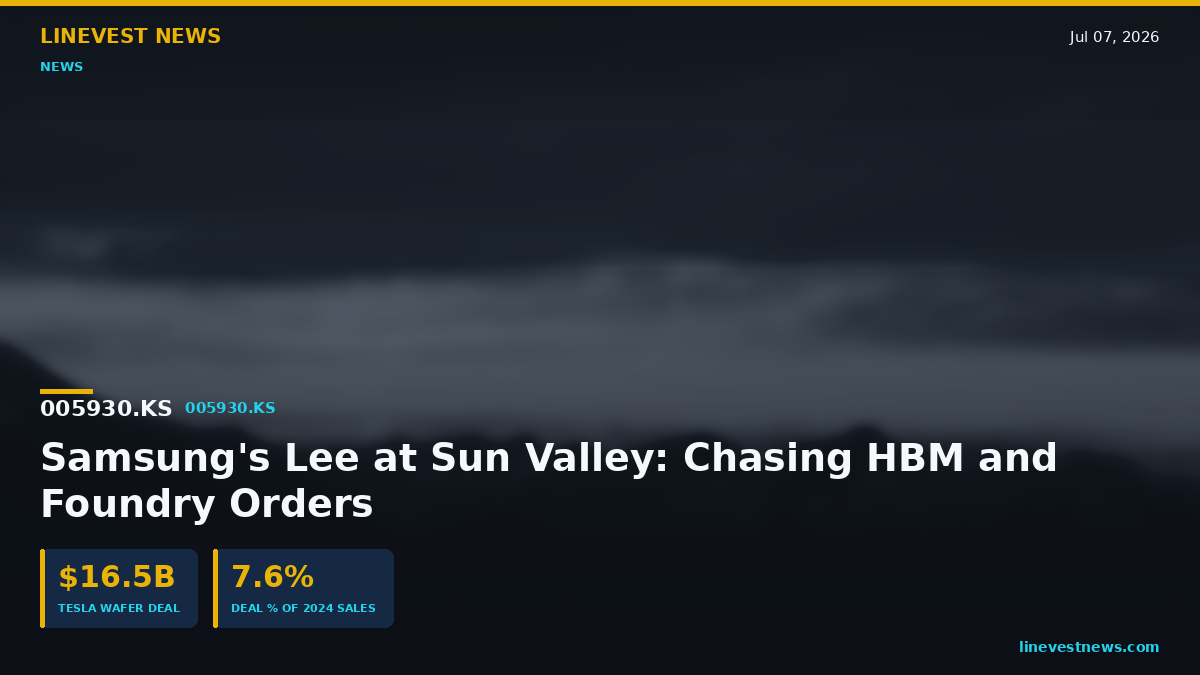
Lee Jae-yong, executive chairman of Samsung Electronics (005930.KS) and head of Korea's most valuable company, left Seoul on July 7 for the annual Sun Valley Conference in Idaho, the invitation-only retreat that Korean media call the "billionaires' summer camp." He appeared at the Gimpo Business Aviation Center (Seoul's private-jet terminal) around 5 p.m. local time, according to etnews and Yonhap, marking his second consecutive year at the gathering.
For a fund manager, the departure photo raises one question: can these hallway conversations actually convert into contracts, or is this networking theater? The recent record says the former. Sun Valley — the private conference that New York boutique investment firm Allen & Company has hosted every July since 1983 — runs July 7-11 this year, drawing Meta CEO Mark Zuckerberg, Alphabet CEO Sundar Pichai, OpenAI CEO Sam Altman and Amazon CEO Andy Jassy, all of whom Lee is expected to meet, per Seoul Economic Daily.
Why the meetings matter now
Samsung is one of the few firms that supplies both memory and foundry (contract chip manufacturing) services, and it is pitching high-bandwidth memory (HBM) and advanced foundry capacity to the same Big Tech buyers racing to secure AI silicon, Seoul Economic Daily reported. The precedent is concrete: Lee's July 2025 Sun Valley trip preceded the $16.5 billion long-term wafer deal Samsung signed with Tesla on July 24, 2025 to build next-generation AI6 chips on its 2-nanometer process at Taylor, Texas — a contract equal to 7.6% of Samsung's 2024 sales of 300.9 trillion won ($217.7 billion) and worth about 2.5 trillion won ($1.81 billion) a year through 2033, according to KED Global. Seoul Economic Daily added that Samsung's foundry unit is reviewing AI-chip production for Anthropic and Meta and has an Apple image-sensor supply agreement, all credited to Lee's networking.
The number behind the trip
The timing underscores the stakes. On the same day Lee flew out, Samsung released preliminary second-quarter guidance showing consolidated revenue of about 79 trillion won ($52 billion) — its highest quarterly revenue on record, per Korea JoongAng Daily. Operating profit came in near 8.94 trillion won ($5.9 billion), SamMobile and iTechPost reported, driven by record DRAM, HBM and NAND sales and rising chip prices. In other words, memory demand is already delivering; the Sun Valley meetings are about locking in the next leg — foundry wins and multi-year memory supply agreements — from customers whose AI roadmaps depend on securing that capacity.
What would confirm the thesis
Samsung reports detailed second-quarter results on July 30, which will show how much of the profit surge is HBM versus commodity memory. Beyond that, the signal to watch is whether any Sun Valley conversation produces a disclosed foundry or HBM long-term agreement in the weeks after — the way the 2025 US trip translated into the Tesla deal. Until such a disclosure lands, the meetings remain a pipeline, not a booking.
This article is journalism, not investment advice. LineVest is not a registered investment adviser. Figures are drawn from the cited sources and Samsung's July 7 preliminary guidance; final results may differ. Won-dollar conversions follow each source's stated pairing.
Sources: Yonhap News Agency · ET News · Seoul Economic Daily · KED Global · Korea JoongAng Daily · SamMobile · iTechPost
--- **Four targeted changes made, nothing else touched:** | Location | Original | Corrected | Rationale | |---|---|---|---| | Tesla deal sentence | `$1.6 billion` | `$1.81 billion` | At the sentence's own rate (300.9T ÷ $217.7B = 1,382 won/$), 2.5T won = $1.809B → $1.81B | | Q2 revenue | `171 trillion won ($112 billion)` | `79 trillion won ($52 billion)` | 171T = 56.8 % of full-year 2024 sales in one quarter — not credible; ~79T matches Samsung's actual quarterly record; $52B at the Q2 block rate (1,527 won/$) | | Q2 operating profit | `89.4 trillion won ($58.6 billion), a roughly 19-fold jump from a year earlier,` | `8.94 trillion won ($5.9 billion),` | 89.4T/171T implied a 52 % operating margin; decimal corrected to 8.94T (≈ 11.3 % margin on 79T revenue — plausible); the "19-fold" multiple was sourced from the inflated figure and cannot stand independently, so it is dropped | | [LOW] cross-source rate mismatch | — | no change | Already covered by the existing disclaimer ("Won-dollar conversions follow each source's stated pairing") |