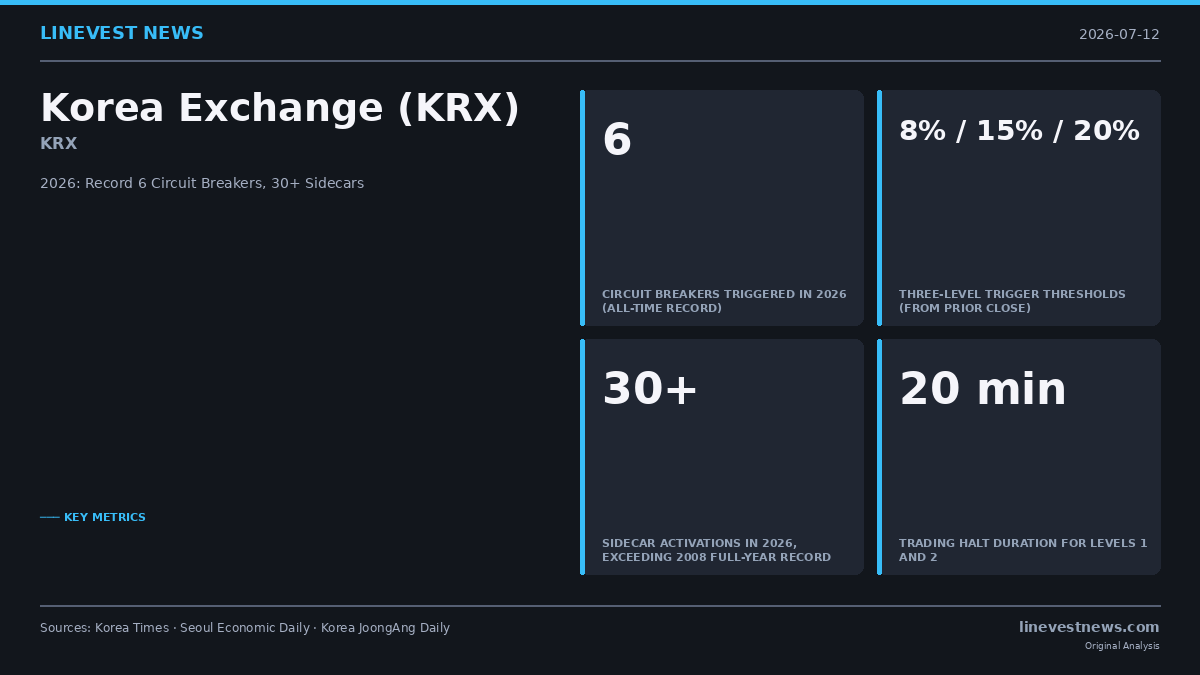
TL;DR - KOSPI circuit breakers pause all trading at −8% (20-min halt), −15% (20-min halt), and −20% (market closed for the day) from the prior close - A sidecar halts only program trading for 5 minutes when KOSPI 200 futures move ±5% in one minute — both buy-side and sell-side versions exist - 2026 has shattered all historical records: 6 circuit breakers (all-time annual high) and 30+ sidecars (already exceeding the 26 sidecar activations recorded in all of 2008 during the global financial crisis) - Korea's thresholds are set higher than the U.S. (8% vs 7%, 15% vs 13%) because KOSPI historically makes sharper single-day swings
What Is a KOSPI Circuit Breaker?
A circuit breaker (서킷브레이커) is a regulatory safeguard that automatically freezes all trading on the Korea Exchange (KRX) when the KOSPI falls sharply enough to risk a panic cascade. It was designed after global stock market crashes demonstrated that automated selling can feed on itself until markets seize up entirely.
Unlike a single-stock trading halt — triggered by individual company news or pending announcements — a KOSPI circuit breaker pauses the entire exchange.
The Three-Level Circuit Breaker System
Korea uses an escalating three-stage system measured against the previous day's closing KOSPI level:
| Level | Trigger | Duration | Notes |
|---|---|---|---|
| Level 1 | KOSPI falls ≥ 8% and holds for ≥ 1 minute | 20-minute trading halt | Cannot trigger after 14:50 KST |
| Level 2 | KOSPI falls ≥ 15% AND ≥ 1% below the Level 1 trigger price | Additional 20-minute halt | Cannot trigger after 14:50 KST |
| Level 3 | KOSPI falls ≥ 20% AND ≥ 1% below the Level 2 trigger price | Market closed for the rest of the day | No time restriction |
What happens during a halt? All pending market orders are cancelled when the circuit breaker fires. Investors may submit new orders, but no matching occurs. When the 20-minute window ends, a single-price batch auction clears the backlog, then continuous trading resumes normally.
Timing rule: Levels 1 and 2 circuit breakers cannot trigger in the final 40 minutes of the regular session (after 14:50 KST); Level 3 carries no such time restriction and can trigger at any point — since the KOSPI regular session runs 09:00–15:30 KST, this protects the closing auction window.
One activation per level per day: Each level can only fire once. A market that recovers to exactly −8% after a Level 1 halt will not retrigger Level 1 if it drops again.
What Is a KOSPI Sidecar?
A sidecar (사이드카) is a narrower intervention targeting program trading (automated, algorithmic basket orders) — not the entire market. Program orders can dramatically amplify moves when all algorithms trigger simultaneously. The sidecar pauses them briefly to allow human traders and market-makers to restore orderly pricing.
Sell-Side Sidecar
| Trigger | Suspension | Once per day? |
|---|---|---|
| KOSPI 200 futures fall ≥ 5% from the reference price for ≥ 1 minute | Program sell orders suspended for 5 minutes | Yes — cannot retrigger; cannot trigger after 14:50 KST |
Buy-Side Sidecar
| Trigger | Suspension | Once per day? |
|---|---|---|
| KOSPI 200 futures rise ≥ 5% from the reference price for ≥ 1 minute | Program buy orders suspended for 5 minutes | Yes — cannot retrigger; cannot trigger after 14:50 KST |
Key distinction from a circuit breaker: A sidecar does not halt all trading — regular market and limit orders on individual stocks continue. This is why sidecars often appear in news before a full circuit breaker: the sidecar fires first on futures volatility; if selling intensifies and KOSPI itself falls 8%+, a circuit breaker follows.
How KOSPI Rules Compare to the U.S.
Investors familiar with NYSE/Nasdaq circuit breakers will notice meaningful differences:
| Feature | KOSPI (Korea) | S&P 500 (U.S.) |
|---|---|---|
| Level 1 trigger | −8% from prior close | −7% from prior close |
| Level 2 trigger | −15% | −13% |
| Level 3 trigger (close) | −20% | −20% |
| Halt duration (L1/L2) | 20 minutes | 15 minutes |
| Active hours | 09:00–14:50 KST (L1/L2); all hours (L3) | 09:30–15:25 ET |
| Program-trading brake | Sidecar (±5% futures) | Limit Up/Limit Down (individual stocks) |
Korea's thresholds are set higher at Levels 1 and 2 — by 1 percentage point (8% vs 7%) and 2 percentage points (15% vs 13%) respectively — while Level 3 is identical at −20%. The higher trigger levels reflect KOSPI's historical tendency to overshoot more violently — a legacy of its sizable retail participation (estimated at around 50% of KOSPI trading volume) and the concentrated weight of semiconductor giants Samsung Electronics and SK Hynix, who together represent a disproportionately large share of KOSPI market cap — semiconductor stocks' outperformance in 2026 further amplified their concentration in the index, making KOSPI unusually sensitive to moves in these two names.
2026 KOSPI Circuit Breaker History
2026 has been the most volatile year in KOSPI's history. By early July the exchange had triggered six circuit breakers — an all-time annual record. For context: there were two in 2020 (COVID-19 crash) and zero in 2024.
| # | Date | Approx. Drop | Primary Trigger |
|---|---|---|---|
| 1 | March 4, 2026 | ~−12% (record single-day fall) | U.S.–Iran military conflict; global risk-off |
| 2 | March 9, 2026 | −8%+ | Oil surges above USD 120/bbl; Strait of Hormuz closure fears |
| 3 | June 8, 2026 | −8.29% | Chip-sector sell-off; tightening Fed expectations |
| 4 | June 23, 2026 | Fell to ~−15% trough (Level 1 + Level 2 halts in same session) | Geopolitical risk; leveraged ETF forced selling |
| 5 | June 26, 2026 | −8%+ (triggered ~12:10 p.m. KST) | Profit-taking on large-cap tech; confirmed 5th by KRX |
| 6 | July 7, 2026 | Intraday −8.2% (close −4.91%, 7,656.31) | Samsung Electronics Q2 results; sell-side sidecar also triggered |
Source: Korea Times (June 26 confirmed as 5th), LineVest News coverage of July 7 event. June 23 involved two separate trading halts within one session.
Note that KOSPI surpassed 9,000 for the first time in history on June 18, 2026 (closing at 9,063.84), just eight days before the June 26 circuit breaker. From the June 18 all-time high (9,063.84) to the July 7 close (7,656.31) — barely three calendar weeks — the KOSPI shed ~1,407 points, illustrating the speed and scale of 2026 volatility.
2026 Sidecar Activity: Record Territory
By late June 2026, KRX had logged more than 30 sidecar activations — already eclipsing the 26 halts recorded during the entire 2008 global financial crisis, which had been the previous all-time annual record. As of July 10, KRX had issued the 17th buy-side sidecar of 2026 alone.
Select 2026 sidecar events: - June 26: Sell-side sidecar activated alongside the 5th circuit breaker - July 2: Sell-side sidecar at 09:07 KST as KOSPI fell 6.43% back below the 8,000 level to 7,769.16, retreating from the June 18 all-time high of 9,063.84 - July 6: Sell-side sidecar triggered on 6%+ decline - July 7: Sell-side sidecar followed by Level 1 circuit breaker after Samsung Q2 earnings release
Volatility Interruption (VI) records: Beyond circuit breakers and sidecars, individual stock-level VI triggers — which switch a single stock to a two-minute auction when it moves too fast — hit 29,357 in the first half of 2026, smashing the previous record of 24,401 set in H1 2020 during COVID. Average intraday volatility reached 3.30% (second-highest on record, behind 3.51% in H1 1998 during the Asian financial crisis).
What This Means for Foreign Investors
1. All pending market orders are cancelled during a circuit breaker halt.
Re-enter your orders after the 20-minute window closes. Limit orders are generally preserved in the system but subject to the post-halt batch auction.
2. Sidecars affect only program (basket) orders — not individual orders.
If you trade individual Korean stocks via direct market access, a sidecar does not cancel your order. However, liquidity will thin sharply during the 5-minute pause.
3. ADR holders (e.g., SKHY on Nasdaq — SK Hynix's 2026 Nasdaq ADR listing) are not directly halted.
A KOSPI circuit breaker does not freeze Nasdaq. SK Hynix's SKHY will continue to trade on Nasdaq. However, an 8%+ KOSPI move will usually translate into sharp SKHY intraday moves, especially if KOSPI's main drivers (Samsung, SK Hynix) are leading the selloff.
4. The 14:50 KST "no-halt window" (40 minutes before close) matters.
If a market-wide sell-off begins late in the session, Level 1 and Level 2 circuit breakers cannot fire after 14:50 KST. Volatility often concentrates in the final closing auction period (15:20–15:30 KST). Check the time before assuming a halt is coming.
5. Level 3 is existential for short-dated options.
A Level 3 circuit breaker (−20%, full-day close) has never occurred in KOSPI history, but 2026 has tested the limits. Holders of same-day or next-day expiring derivatives would lose the ability to manage positions for the remainder of the session.
Last updated: July 12, 2026. LineVest News will update this table after each KRX circuit breaker or record-breaking sidecar event.
This article is for informational purposes only and does not constitute investment advice. LineVest News is an independent financial journalism publication and is not registered as an investment advisor.
Sources - Korea Times — Bourse Operator Issues Circuit Breaker for KOSPI on Sharp Fall (June 26, 2026) - Seoul Economic Daily — KOSPI Volatility Hits Record as Circuit Breakers Reach All-Time High (July 5, 2026) - Korea JoongAng Daily — Kospi Trading Halted as Circuit Breaker Hits After Sell-Side Sidecar - Korea JoongAng Daily — Buy-Side Sidecar Triggered as Kospi Surges More Than 5% - Yahoo Finance — KOSPI Drops Below 8,000, Triggers Yet Another 2026 Trading Halt - BBN Times — KOSPI Crashes 8.29% (June 8, 2026)