TL;DR
- South Korea, the United States, and Japan signed a memorandum of cooperation to deploy small modular reactors (SMRs) in third countries, with initial focus on the Indo-Pacific region.
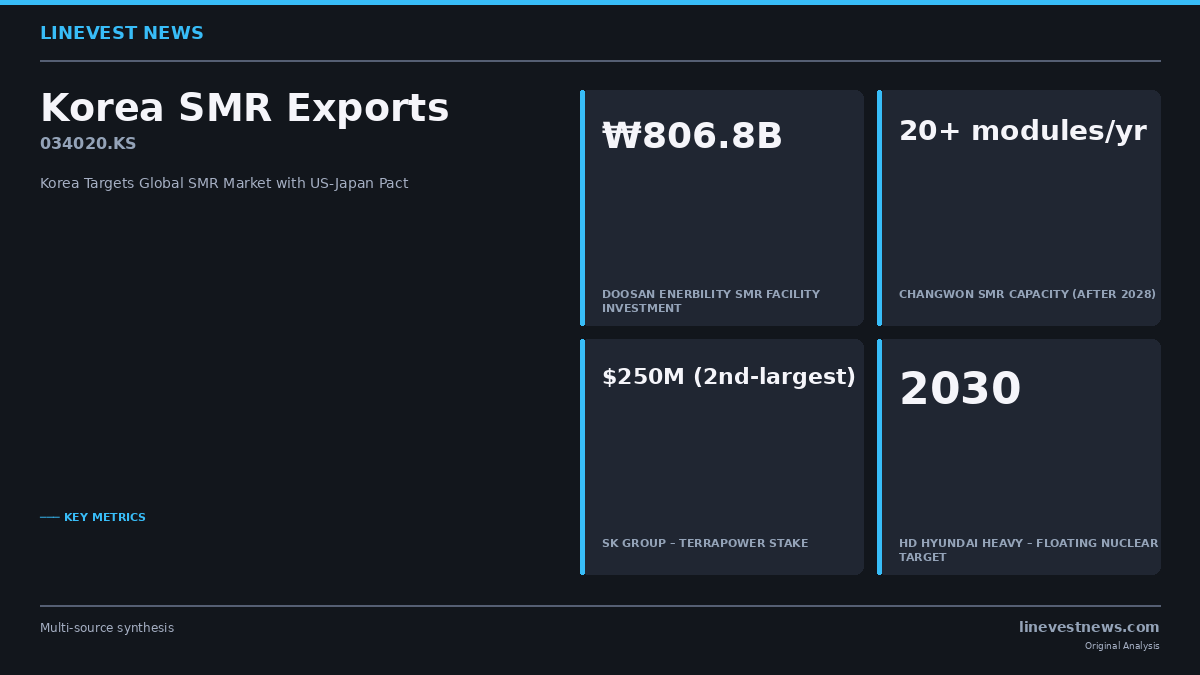
- Doosan Enerbility (034020.KS), Korea's largest nuclear equipment maker, is investing ₩806.8 billion to expand its Changwon SMR production facility (target: 20+ modules/year by 2028) and already manufactures components for NuScale Power, X-energy, and TerraPower.
- SK Group holds a USD 250 million stake in TerraPower — the second-largest shareholder — in a fourth-generation sodium-cooled reactor project targeting commercialisation by 2035.
- HD Hyundai Heavy Industries (329180.KS) is the primary component fabricator for TerraPower's Natrium reactor and is separately developing floating nuclear plants for 2030 commercial deployment.
- The agreement is a memorandum, not a procurement contract — regulatory, financing, and first-of-a-kind cost risks remain — but it consolidates Korea's position at the front of the emerging global SMR supply chain.
Part A — The Trilateral Framework
South Korea formalised a trilateral SMR cooperation pact with the United States and Japan on July 15, 2026, aligning three countries with complementary nuclear capabilities to pursue deployment projects in third countries, with the Indo-Pacific as the initial target market.
The memorandum divides labour along comparative advantage: the United States contributes reactor design intellectual property; Korea brings low-cost, high-quality manufacturing and proven EPC execution; Japan supplies advanced nuclear-grade materials. The structure mirrors the consortium model that secured Korea a USD 20 billion contract for four APR-1400 reactors in the UAE in 2009 — the largest nuclear export deal of that era — and Korean industry officials see SMRs as a similar platform for the next decade.
Why SMRs, and why now? Small modular reactors — generally defined as units with electric output up to 300 MW — have moved from the prototype stage to first-of-a-kind commercial construction across the US, UK, and Canada. Simultaneously, global electricity demand from AI data-centre buildout has renewed political appetite for baseload zero-carbon generation that intermittent renewables cannot provide. The Korea Atomic Energy Research Institute estimates the global SMR market could reach USD 392 billion by 2035. Export orders for reactor components and engineering services are expected to make up a significant share of that figure.
Part B — Korean KOSPI Implications
Doosan Enerbility (034020.KS): The Core Beneficiary
Doosan Enerbility is the most direct listed play on Korea's SMR ambitions. The Changwon-based company manufactures long-lead nuclear components — reactor pressure vessels, steam generators, reactor coolant pumps — for three US SMR developers under active development:
| Developer | Reactor Type | Doosan's Role |
|---|---|---|
| NuScale Power | Light-water SMR | Reactor module components |
| X-energy | Xe-100 pebble-bed | Pressure vessels |
| TerraPower | Natrium sodium-cooled fast reactor | Key nuclear island components |
To serve anticipated order flow, Doosan has committed ₩806.8 billion (approximately USD 589 million) to a dedicated SMR production facility in Changwon, scheduled for completion in 2028. The investment is designed to raise annual reactor-module capacity from 12 to more than 20 units — a scale that analysts say is necessary to capture meaningful market share before the first-mover window closes.
Doosan's nuclear division spent much of the 2017–2022 period absorbing the demand impact of Korea's domestic nuclear moratorium. The current government's reversal — including plans for 10 new domestic APR-1400 reactors by 2038 — has already restored domestic order flow. The SMR export programme adds a second, internationally diversified growth vector that is structurally decoupled from Korean domestic policy.
SK Group: TerraPower Stake
SK Group invested USD 250 million in TerraPower in 2022, securing a position as the second-largest shareholder in the company co-founded by Bill Gates. TerraPower's Natrium reactor — now under active construction at the Kemmerer, Wyoming coal-plant conversion site — combines sodium-cooled fast-reactor technology with molten-salt thermal storage, enabling flexible output scaling from 345 MW to 500 MW.
SK's strategic rationale is twofold: a direct financial return if TerraPower reaches commercial scale, and a preferential position for its energy affiliates in SMR power-purchase agreements across Asian markets. SK Inc. (034730.KS) and SK Innovation (096770.KS) are the listed vehicles through which the investment is held, though the TerraPower stake is a minority item in large diversified portfolios and will not materially affect quarterly earnings until the Kemmerer plant approaches first power around 2030.
HD Hyundai Heavy Industries (329180.KS): Natrium + Floating Nuclear
HD Hyundai Heavy Industries serves as the primary manufacturer of Natrium reactor critical components. The company's heavy-engineering background in large-scale pressure vessel fabrication for conventional nuclear plants made it a natural counterparty for TerraPower's procurement programme.
In parallel, HD Hyundai Heavy is developing a commercially distinct product: floating nuclear power plants — SMRs installed on marine platforms that can be moored at coastal sites unable to support land-based nuclear infrastructure. The group targets first commercial deployment by 2030, with early interest from Southeast Asian utilities facing acute power deficits. This programme is an organic extension of the group's offshore engineering capabilities and could differentiate HD Hyundai Heavy from pure component suppliers in export-market negotiations.
Risk Matrix
| Risk | Assessment |
|---|---|
| MOU vs. contracts | The agreement sets out a framework; individual project procurement is subject to separate competitive bids |
| Regulatory approval | Each target country must independently certify reactor designs, which can extend timelines by several years |
| Financing | Export credit support from Korea, US, and Japan has not been disclosed; emerging-market buyers typically require 80–90% debt coverage |
| First-of-a-kind cost | SMR levelised cost of electricity is not yet competitive with conventional nuclear at commercial scale — convergence expected in the early 2030s after serial production |
| Competition | China's CNNC ACP-100 completed its first unit in June 2026 and may price aggressively in markets where geopolitical alignment favours Beijing |
KOSPI Exposure at a Glance
| Company | Ticker | SMR Angle | Key Metric |
|---|---|---|---|
| Doosan Enerbility | 034020.KS | Component mfg for NuScale, X-energy, TerraPower | ₩806.8B facility investment; capacity 12→20+ modules/yr |
| HD Hyundai Heavy Industries | 329180.KS | Natrium primary manufacturer; floating nuclear 2030 | Offshore engineering + nuclear diversification |
| SK Inc. | 034730.KS | USD 250M TerraPower stake (2nd-largest shareholder) | Holding company; SMR = minority portfolio item |
This article is journalistic analysis, not investment advice. LineVest News is not a registered investment adviser. Past performance of any referenced company's stock is not indicative of future results.
Sources: Korea Herald – Korea eyes slice of global SMR market after pact with US, Japan · Doosan Enerbility public IR disclosures · TerraPower Kemmerer project information