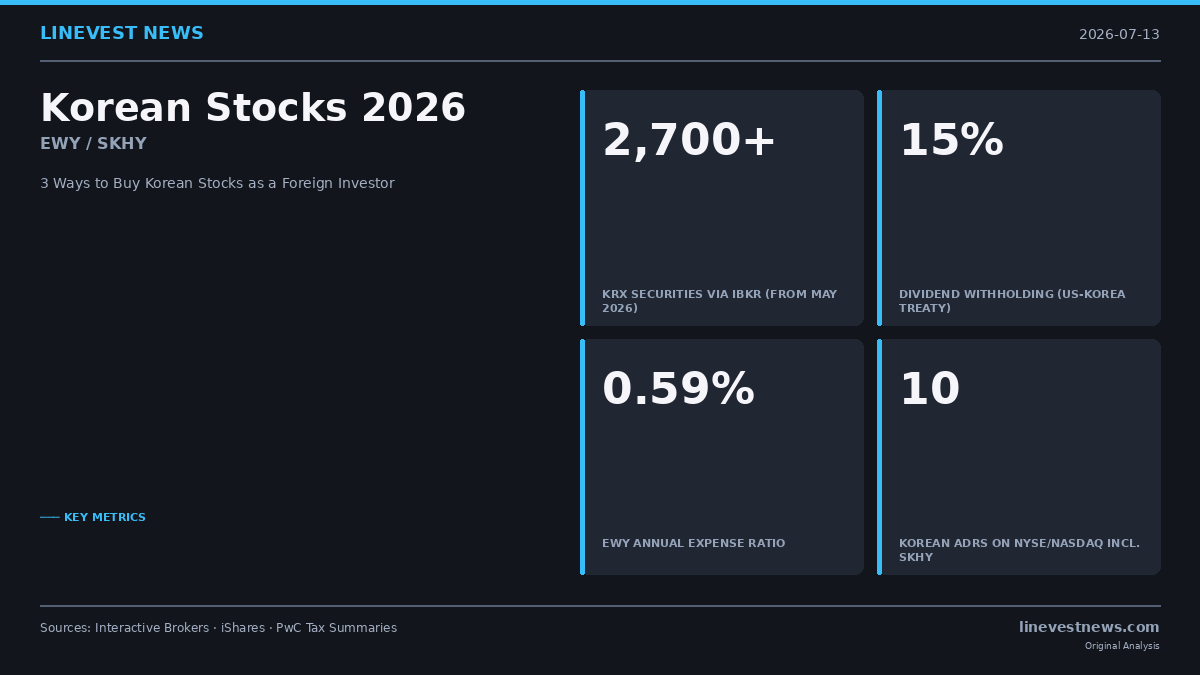
TL;DR - As of May 7, 2026, US investors can trade 2,700+ Korean stocks directly through Interactive Brokers — the first major US broker to offer seamless KRX access. - Three routes: Korea ETF (EWY), US-exchange ADRs (SKHY, PKX, KB…), or direct KRX/Nextrade via IBKR. Samsung has no liquid major-exchange ADR — EWY or direct KRX is the cleaner path. - US-Korea tax treaty caps dividend withholding at 15% (vs. Korea's domestic 22%); claim the credit on IRS Form 1116. - Samsung Electronics has no liquid ADR on a major US exchange — use EWY or open a KRX account for direct access.
Last updated: July 2026
Why Korean Stocks? Context for 2026
Korea's equity market has rarely been more visible to global investors. SK Hynix debuted its Nasdaq ADR (SKHY) on July 10, 2026 — one of the most significant Korean listings on a US exchange in recent years — following Samsung Electronics' record Q2 2026 earnings announcement. Foreign ownership of KOSPI-listed shares stands at roughly 32% of market capitalisation, a figure that rises every time a major Korean company improves investor-relations access.
Yet for most non-Korean investors, how to participate has been opaque. This guide maps every practical route available as of July 2026.
The Three Routes at a Glance
| Route | Best for | Coverage | Effort | Approx. Annual Cost |
|---|---|---|---|---|
| Korea ETF | Beginners, broad exposure | ~83 stocks | Minimal | 0.59% (EWY expense ratio) |
| US-listed ADR | Specific large-caps | 10 names on NYSE/Nasdaq | Low | Standard brokerage commission |
| Direct KRX via IBKR | Active traders, full universe | 2,700+ securities | Moderate | Low commissions + 0.20 bps FX |
Route 1 — Korea ETF (Lowest Barrier)
The iShares MSCI South Korea ETF (ticker: EWY) is the most widely used instrument for US investors seeking broad Korean exposure. It tracks the MSCI Korea 25/50 Index.
| Feature | Detail |
|---|---|
| Ticker | EWY (NYSE Arca) |
| Expense ratio | 0.59% per year |
| Holdings | ~83 securities (as of Q1 2026) |
| Top sector | Information Technology (47.4%) |
| Top holdings | Samsung Electronics, SK Hynix, Hyundai Motor, KB Financial, Samsung Biologics |
| Dividend treatment | Korean withholding already deducted at fund level; Form 1116 credit still possible |
Pros: Available in any US brokerage account with zero extra paperwork. Instant diversification.
Cons: 47.4% of assets in the Information Technology sector, dominated by Samsung Electronics and SK Hynix, making EWY highly concentrated in the memory-chip cycle. The 0.59% fee compounds over time. Coverage is primarily KOSPI large-caps; most mid/small-cap KOSDAQ growth companies are excluded. ETF structure introduces tracking error and does not reflect after-hours Korean moves in real time.
Route 2 — US-Listed ADRs
An American Depositary Receipt (ADR) represents a fixed number of foreign shares held by a US custodian bank. It trades on US exchanges in US dollars during US market hours.
NYSE-Listed Korean ADRs
| Company | Ticker | Sector | ADR Ratio |
|---|---|---|---|
| KB Financial Group | KB | Banking | 1:1 |
| Shinhan Financial Group | SHG | Banking | — |
| Woori Financial Group | WF | Banking | — |
| POSCO Holdings | PKX | Steel / Materials | — |
| SK Telecom | SKM | Telecom | — |
| KT Corporation | KT | Telecom | — |
| Korea Electric Power (KEPCO) | KEP | Utilities | — |
| LG Display | LPL | Display / Electronics | 2:1 |
ADR ratios vary by company and custodian. Always verify the specific ratio in your brokerage's ADR fact sheet before trading — the ratio directly determines the ADR's price relative to the Korean-listed share.
Nasdaq-Listed Korean ADRs
| Company | Ticker | Notes |
|---|---|---|
| SK Hynix | SKHY | Debuted July 10, 2026. Level-II ADR, 1 ADR = 1 KRX share. |
| Gravity Co. | GRVY | Online game publisher (Ragnarök Online) |
OTC / Pink-Sheet ADRs
Several major Korean companies trade lightly on the OTC market. These are not listed on NYSE or Nasdaq and are subject to much lower liquidity and wider bid-ask spreads.
| Company | Ticker | Caution |
|---|---|---|
| Samsung Electronics | SSNLF | Unofficial OTC; 1 ADR = 1 share. Very thin. Not a sponsored ADR. |
| Samsung Electronics (London) | SMSN.L | LSE-listed, Rule 144A restricted to institutional buyers in the US |
Practical note on Samsung: SSNLF trades in tiny volumes on OTC Markets and the price can stray from the underlying KRX price. For retail investors who want Samsung exposure without a KRX brokerage account, EWY (where Samsung typically represents 20–25% of the portfolio) or direct KRX via IBKR (see Route 3) is a sounder approach.
Route 3 — Direct KRX Trading via Interactive Brokers (New in 2026)
On May 7, 2026, Interactive Brokers (IBKR) became the first major US-based broker to offer direct access to the Korea Exchange (KRX). On June 30, 2026, IBKR added Nextrade (NXT) — South Korea's first Alternative Trading System — extending the combined KRX+NXT span to 13 hours (07:00–20:00 KST) versus the KRX regular session alone (09:00–15:30 KST).
What You Can Trade
- 2,700+ securities across KOSPI and KOSDAQ
- Korean ETFs listed on KRX
- Korean derivatives (available to eligible clients)
- Access is not available to Korea residents, IBKR Japan clients, or IBKR India clients
Step-by-Step Account Setup
Step 1 — Open or use an existing IBKR account. New accounts are typically approved within one business day. Online application at interactivebrokers.com.
Step 2 — Enable KRX trading permissions. Existing clients: log in to IBKR Client Portal → Settings → Trading Permissions → Add Korea (KRX). Same-day enablement is standard for eligible accounts.
Step 3 — Fund the account and handle FX. Korean stocks trade in Korean Won (KRW). IBKR handles the currency conversion automatically at FX commissions as low as 0.20 basis points (0.0020% of trade value) — competitive with institutional FX rates.
Step 4 — Place a trade. Search for the ticker (e.g., 005930 for Samsung Electronics, 000660 for SK Hynix) in the Trader Workstation (TWS) or mobile app. IBKR SmartRouting routes orders across both KRX and Nextrade to seek best execution.
Documents You Will Need
- Valid passport (≥6 months remaining validity)
- Proof of residential address (utility bill or bank statement dated within 90 days)
- US Social Security Number or ITIN (required for US tax reporting, including Form 1099 and W-9 documentation)
- No separate Korean investor registration is needed — IBKR handles compliance on the Korean side.
KRX Trading Hours (KST)
| Session | Time (KST) | US Eastern equiv. (EDT) |
|---|---|---|
| Pre-market (NXT) | 07:00 – 08:30 | Prev. evening 18:00 – 19:30 |
| Regular session | 09:00 – 15:30 | 20:00 – 02:30 |
| After-hours (NXT) | 16:00 – 20:00 | 03:00 – 07:00 |
For US-based investors on Eastern time, the regular KRX session runs in the evening — roughly 8 PM to 2:30 AM EDT. The NXT pre-market opens at 6 PM EDT and the after-hours session closes at 7 AM EDT, providing more overlap with US waking hours than the regular session alone.
Part B — Tax, Currency, and Investment Considerations
Dividend Withholding Tax
Korea applies a withholding tax on dividends paid to non-resident investors. The rate depends on whether a tax treaty applies:
| Scenario | Rate |
|---|---|
| No tax treaty (domestic non-resident rate) | 22.0% (including local surtax) |
| US investors — US-Korea Income Tax Treaty (1979, amended) | 15.0% (portfolio dividends) |
| US investors — qualifying corporate ownership ≥10% voting stock | 10.0% |
How to recover over-withheld tax: If the Korean payer withholds at the 22% domestic rate (sometimes occurs when treaty documentation is not submitted in time), US taxpayers can claim a foreign tax credit on IRS Form 1116. The 15% treaty rate is treated as a creditable foreign tax.
2026 documentation rule: Effective January 1, 2026, Korea requires that non-resident investors or their withholding agents submit substantive beneficial-ownership documentation to the competent Korean tax office to apply reduced treaty rates at source. Without this filing, the payer must withhold at the domestic 22% rate. IBKR handles this documentation automatically for KRX accounts; ADR custodians (e.g., Citibank, Deutsche Bank) typically handle it for ADR holders.
Capital Gains Tax
For most non-resident investors, Korea does not impose capital gains tax on stock sales on the KRX (as of 2026). The main exceptions are: - Shareholders owning ≥ 25% of a single Korean company (large-block rules may apply) - Shares of unlisted companies
US investors should report gains in the standard way on their US federal return (Schedule D / Form 8949); the Korean-side CGT exemption for non-residents means no foreign tax credit calculation is needed for capital gains.
Currency Risk: Korean Won (KRW) vs. US Dollar
When you hold Korean stocks directly (Route 3), your returns are affected by the KRW/USD exchange rate. ADR investors are exposed to this indirectly as well, since the ADR custodian periodically converts Korean dividends from KRW to USD.
Historical context: The Korean Won logged its second-worst first half since 1998 in H1 2026, weakening substantially against the dollar as foreign institutional investors became net sellers of KOSPI equities at historically elevated rates. A weakening Won erodes returns for USD-based investors even when Korean stock prices rise in local terms.
Hedging options: - KRW/USD forward or options contracts are available through IBKR for qualifying accounts - EWY is unhedged by default — its USD returns fall when KRW weakens against the dollar - Some investors accept this unhedged exposure deliberately, noting that a weak Won can boost Korean exporters' earnings over time (an indirect, lagged offset rather than a currency hedge)
The Korea Discount — and Why It May Be Narrowing
Korean equities have historically traded at a significant discount to global peers on a price-to-earnings basis — a phenomenon known as the Korea discount (코리아 디스카운트). As of July 2026, KOSPI trades at approximately 6.8× forward P/E, versus a 10-year average of 10.2× and near 2008 GFC lows.
Key structural reasons for the discount: 1. Complex holding-company structures that obscure true asset values 2. Minority shareholder rights historically weaker than in the US or Japan 3. Low dividend payout ratios — cash has often stayed inside conglomerates (chaebols) 4. Geopolitical risk premium from proximity to North Korea
Government response — the Value-Up Program: The Korean Financial Services Commission and Ministry of Finance launched a voluntary Value-Up initiative in 2024, expanded in 2025, aimed at incentivising listed companies to improve ROE, increase buybacks, and cancel treasury shares. As of 2026, several KOSPI 200 companies (including KB Financial, Shinhan, and Hyundai Motor) have published multi-year Value-Up commitments. The mandatory buyback-cancellation law (2026) also requires companies that repurchase shares to formally cancel them rather than re-issue them as compensation — a structural improvement for minority holders.
For investors, the persistent discount can represent value: if Korean governance norms converge toward Japan's post-2013 trajectory, there is scope for multiple expansion even with flat earnings.
Key Sectors to Understand
| Sector | Representative Names | What to Watch |
|---|---|---|
| Semiconductors | Samsung Electronics (005930), SK Hynix (000660 / SKHY) | Memory-cycle upturn, HBM AI demand, TSMC foundry competition |
| Financials | KB Financial (KB), Shinhan (SHG), KakaoBank (323410) | NIM expansion, Value-Up dividends, NPL ratios |
| Automotive | Hyundai Motor (005380), Kia (000270) | EV mix, US tariff risk, imported-vehicle market share |
| Battery/EV Materials | LG Energy Solution (373220), Samsung SDI (006400) | EV demand, ESS pivot, US IRA AMPC credits |
| Shipbuilding | HD Hyundai Heavy (329180), Hanwha Ocean (042660) | US Navy contracts, LNG tanker order book |
| Defence | Hanwha Aerospace, KAI (047810) | NATO procurement, K2/FA-50/K9 export cycles |
Frequently Asked Questions
Can I buy Samsung Electronics stock from the US? Not on a major exchange. Samsung (005930.KS) trades only on the KRX and does not have a sponsored NYSE or Nasdaq ADR. Your options are: (a) buy the OTC pink-sheet ADR SSNLF — but expect very thin markets and potential for stale prices; (b) buy EWY, where Samsung typically represents 20–25% of the portfolio; or (c) open a KRX account via IBKR (Route 3) and buy 005930 directly.
Can I buy SK Hynix from the US? Yes, as of July 10, 2026. SK Hynix lists under ticker SKHY on the Nasdaq. One SKHY ADR equals one KRX share (000660.KS). You can trade it in any US brokerage account that offers Nasdaq access. Note that ADR holders pay an ADR custody fee (typically USD 0.01–0.03 per share annually) in addition to standard commissions.
Do I need a Korean brokerage or Korean bank account? No. Via IBKR's direct KRX access, all currency conversion and investor-registration compliance is handled by IBKR on your behalf. You fund the account in USD and IBKR converts to KRW for each trade.
Is my investment protected by SIPC? IBKR US accounts are SIPC members (up to USD 500,000, of which USD 250,000 in cash). The Korean-side custody of your KRX shares is held via the Korea Securities Depository (KSD). For foreign investors using IBKR's US entity, SIPC coverage applies to the account as a whole (up to USD 500,000, of which USD 250,000 in cash). Korean securities law does not provide a direct SIPC-equivalent for brokerage custody losses.
What is the KOSPI? What is KOSDAQ? The KOSPI (Korea Composite Stock Price Index) is Korea's main board — large-caps like Samsung, SK Hynix, Hyundai Motor, and the major banks. The KOSDAQ (Korea Securities Dealers Automated Quotation) is the growth board — smaller, often tech and biotech companies. EWY tracks KOSPI-focused large caps only. Direct KRX access via IBKR covers both exchanges plus Nextrade.
This article is for informational purposes only and does not constitute investment advice. LineVest News is an independent publication and is not a registered investment adviser. Past performance of Korean equities is not indicative of future results. Currency movements and geopolitical events can substantially affect the value of investments denominated in Korean Won.
Sources: Interactive Brokers KRX Launch (BusinessWire, May 7 2026) · IBKR KRX Exchange Page · Complete South Korean ADR List — TopForeignStocks · South Korean Stocks on US Exchanges — InvestSnips · Korea Withholding Tax — PwC Tax Summaries · US-Korea Income Tax Treaty — IRS · iShares EWY Fact Sheet (Q1 2026) · SK Hynix Nasdaq ADR Analysis — GraniteShares