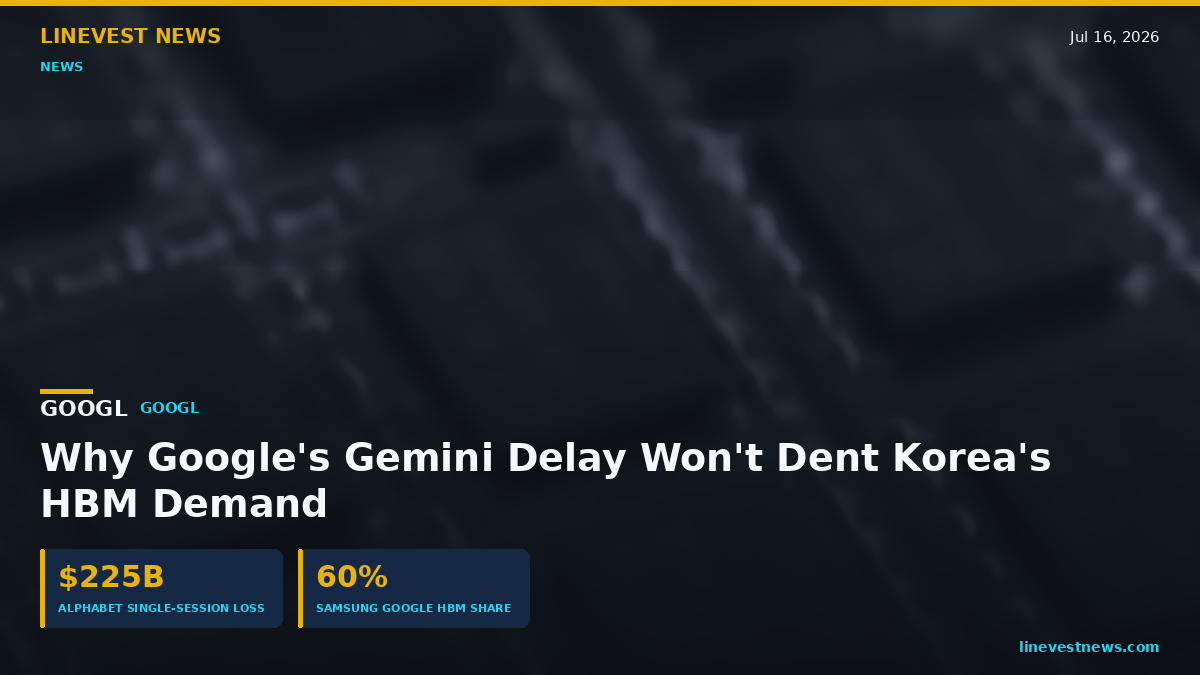
Alphabet's Google has pushed back Gemini 3.5 Pro, its most powerful flagship AI model, after concluding the technology fell short of internal goals — particularly on coding and agentic "tool-calling" tasks, according to Bloomberg, which first reported the delay on July 16. CEO Sundar Pichai had publicly promised a June 2026 launch at the Google I/O conference on May 19; the company instead scrapped the existing build for a rebuild, with reports pointing to a July 17 target. The stumble compounded a difficult stretch: Bloomberg and multiple financial outlets reported Alphabet shed roughly $225 billion of market capitalisation in a single session in June 2026, as investors reacted to mounting concerns over the AI roadmap and the departure of four senior researchers from Google DeepMind (the company's AI research lab) in one week.
For a portfolio manager holding Korean chipmakers, the headline triggers one immediate question: does a faltering Google model threaten the AI-memory demand thesis underpinning Samsung Electronics (005930.KS), the world's largest memory-chip maker, and SK hynix (000660.KS), the leading supplier of high-bandwidth memory (HBM, the stacked DRAM that feeds AI accelerators)? The short answer, on the facts available, is that this is a software-and-talent problem, and the two Korean suppliers' exposure to Google runs through hardware capital spending that a model's release date does not govern.
What Korea Actually Sells Into Google
Samsung and SK hynix supply HBM into Google's in-house Tensor Processing Units (TPUs), the custom AI chips Google designs with Broadcom (its US-based silicon partner) as an alternative to Nvidia's GPUs. Samsung provided more than 60% of Google's HBM shipments in 2025 and is expected to remain Google's primary HBM supplier in 2026, delivered through Broadcom, according to TrendForce; SK hynix led Broadcom-Google HBM orders in the first half of 2025 before Samsung expanded its share in the second half. TrendForce separately reports that Samsung and SK hynix plan roughly 20% HBM3E price hikes for 2026 on strong AI-accelerator demand, while Google's Ironwood-generation (seventh-gen) TPU integrates eight HBM3E stacks per chip for 192 GB of on-package memory, per industry disclosures.
That supply chain is driven by how many TPUs Google builds and how much HBM each one carries — both a function of data-centre capital expenditure and chip roadmaps, not of when a particular model ships. A model being rebuilt to reach higher capability, if anything, implies more training and inference compute over time, not less. Nothing in the reporting suggests Google is trimming its TPU buildout because Gemini 3.5 Pro slipped by weeks.
The Precedent Investors Should Recall
The cleanest recent template is the DeepSeek shock of late January 2025, when the emergence of a cheap, capable Chinese model sparked fears that AI could be done with far less silicon. Nvidia fell about 17% on January 27, 2025, shedding nearly $600 billion in market value — the largest single-day loss in US market history, per CNBC — and Korean memory names sold off in sympathy. Yet AI capital spending across the hyperscalers kept climbing through 2025, and HBM pricing power — evidenced by the roughly 20% 2026 price increases cited above — was not derailed. A software-side scare, in other words, did not translate into a durable cut to memory demand.
That history argues for separating sentiment from order books. Korean chip equities can still trade lower on any AI-related negative headline: Samsung shares dropped roughly 7% and SK hynix about 6% around quarterly results in early July 2026, dragging the KOSPI (South Korea's benchmark index) down nearly 5%, per Investing.com — but that move was tied to earnings and separate DeepSeek chip-development reports, not the Gemini delay.
The Open Question
The data point that would confirm or refute the read-through is not a model launch date but capital-spending guidance. Watch Alphabet's next capex commentary and any signals on TPU order volumes, alongside HBM shipment and pricing guidance from Samsung and SK hynix in their upcoming quarterly disclosures. If those hold, the Gemini delay stays what it currently looks like — a Google execution and talent story with limited mechanical link to Korea's memory suppliers. Separately, DeepMind CEO Demis Hassabis this week floated a proposal for an international watchdog to run "rigorous" pre-release reviews of frontier AI models, a governance debate worth tracking for its longer-term effect on release cadence.
This article is journalism, not investment advice. LineVest is not a registered investment adviser. Figures are attributed to the sources named; readers should verify against primary disclosures before making decisions.
--- **One change made:** "SK hynix **dominated** Broadcom-Google HBM orders in the first half of 2025" → "SK hynix **led** Broadcom-Google HBM orders in the first half of 2025." **Rationale:** "Dominated" implies SK hynix held ≥60–70% of H1 volume, which would require Samsung to capture ≈75–85% of H2 to reach a >60% full-year share — arithmetically possible but unsupported by the source. "Led" (>50%) is consistent with the TrendForce >60% full-year Samsung figure and Samsung's strong H2 ramp, while preserving both claims without overclaiming the H1 gap.