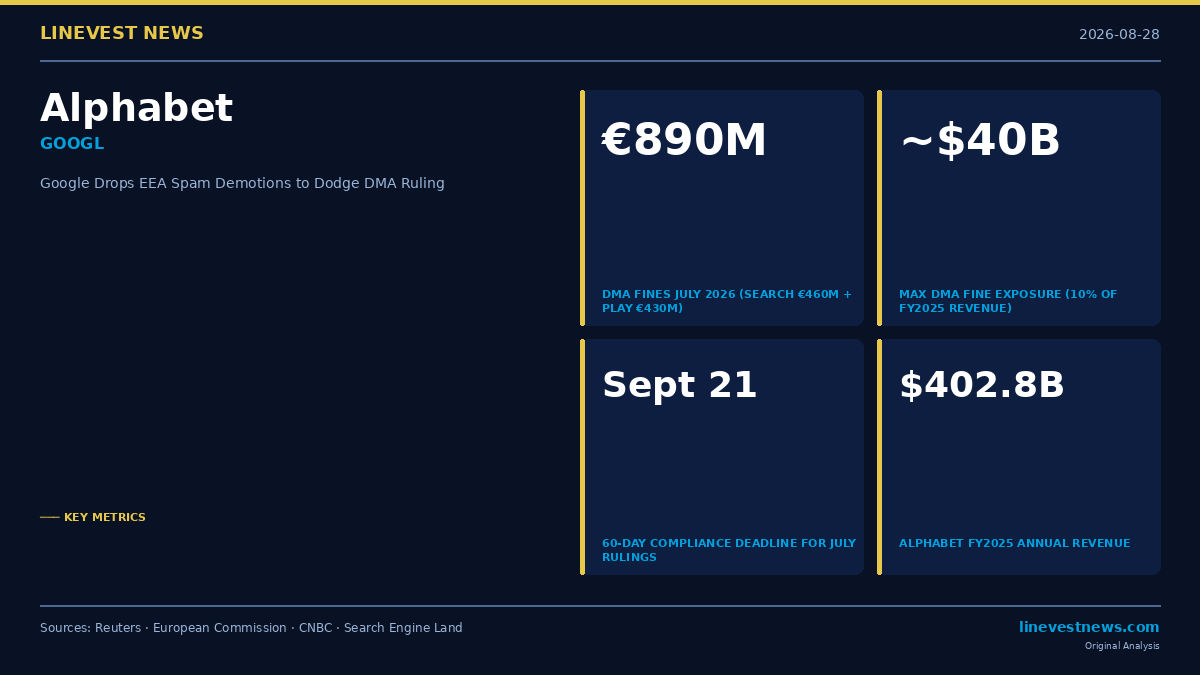
The European Commission (the EU's executive arm and top antitrust enforcer) on July 16, 2026 issued two binding orders requiring Alphabet's Google to open its Android operating system to rival artificial-intelligence assistants and to share Google Search data with competing search providers. Both decisions were adopted under the DMA (Digital Markets Act, the EU's gatekeeper competition law) and, according to Bloomberg and The Verge, are designed to weaken Google's grip over two of the tech industry's most important platforms.
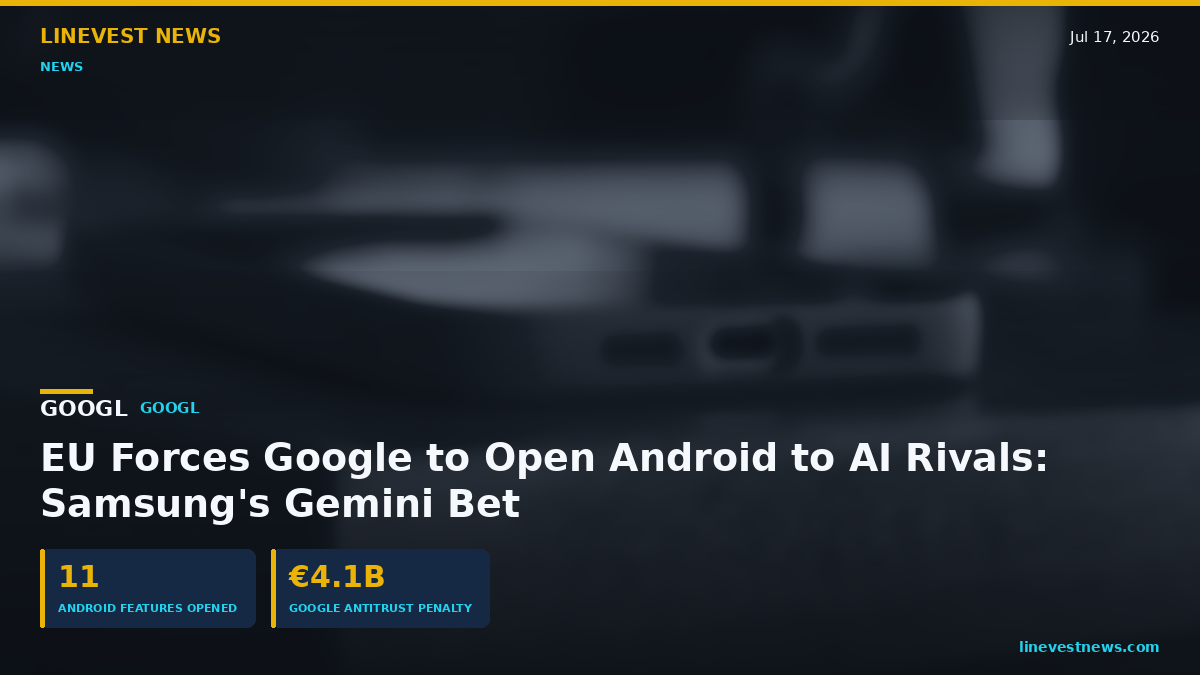
Under the first order, Google must open 11 Android features — covering how an assistant is invoked, how it reads on-screen context, how it takes actions in apps, and how it reaches device resources — to competitors so that rivals such as OpenAI's ChatGPT and Anthropic's Claude can match capabilities Google reserved for Gemini, its own AI assistant. The European Commission said users will be able to summon a third-party assistant by voice, similar to the "Hey Google" wake phrase. Google must build the changes into its next major release, Android 18, by August 1, 2027 at the latest. The second order requires Google to share anonymised Search data with rival search engines and AI chatbots on a "fair" pricing formula, starting January 2027, per the Commission's decision summary reported by CNBC. Google's president of global affairs Kent Walker said the rulings "risk undermining vital privacy and security guardrails for millions of Europeans."
Why this lands on Seoul's desk
The order names Google, but its sharpest commercial edge points at Samsung Electronics (005930.KS), the world's largest smartphone maker. Samsung built its 2026 flagship, the Galaxy S26, around Gemini as the default AI assistant for agentic tasks — booking rides, acting across apps — alongside Perplexity for web queries and an upgraded version of Bixby, Samsung's in-house voice assistant, according to CNBC and WebProNews. Making Gemini the on-device brain gave Google access to hundreds of millions of Galaxy users; the EU order now lets rivals register the same system-level wake words and entry points on those same phones inside Europe.
That matters because Europe is core Galaxy territory. Samsung was the region's biggest smartphone brand in Q1 2026 with a 38% share versus Apple's 26%, per Omdia data cited by SamMobile, and Samsung held 21.7% of global shipments in the quarter, per IDC's Q1 2026 Worldwide Quarterly Mobile Phone Tracker. Crucially, the obligation falls on Google, not Samsung: KED Global has reported that Samsung Electronics was left off the EU's final gatekeeper list, so Seoul's champion carries none of the compliance burden directly. The open question for the Samsung-Google AI partnership is softer — whether forcing Android to let European users pick ChatGPT or Claude over Gemini dilutes the value Google is paying Samsung to feature Gemini so prominently.
The precedent, and who in Korea might gain
Brussels has pried Android open before. The 2018 EU antitrust case over Google bundling Search and Chrome on Android ended in a multi-billion-euro penalty that an EU court sealed at €4.1 billion (about $4.4 billion) in July 2026, per Tech Times — a reminder that these interoperability fights run for years and that Google has historically absorbed the hit rather than abandon Android's economics.
For Korean challengers, the direct benefit is thin. Naver (035420.KS), Korea's dominant search engine, and Kakao (035720.KS), Korea's top messaging and mobile-services group, both run AI and search products that could in theory claim the newly mandated Search data or Android hooks — but the remedies apply inside the EU, where neither has meaningful share. The clearer read is strategic: the ruling signals that regulators will keep unbundling default-AI arrangements, the exact model on which Samsung's Gemini-centric Galaxy is built.
What to watch
The first hard checkpoints are the January 2027 start of Search-data sharing and the Android 18 rollout by August 1, 2027 — the moments when European Galaxy users first see rival assistants offered on equal footing. Samsung's own commentary at its next earnings call and at the Galaxy S27 cycle will show whether Seoul treats the EU carve-out as a contained regional cost or a template that could spread to other markets.
This article is journalism, not investment advice. LineVest is not a registered investment adviser. Figures are sourced to the European Commission, Bloomberg, The Verge, CNBC, Omdia (via SamMobile), IDC, KED Global and Tech Times as cited; euro-to-dollar conversions are approximate.