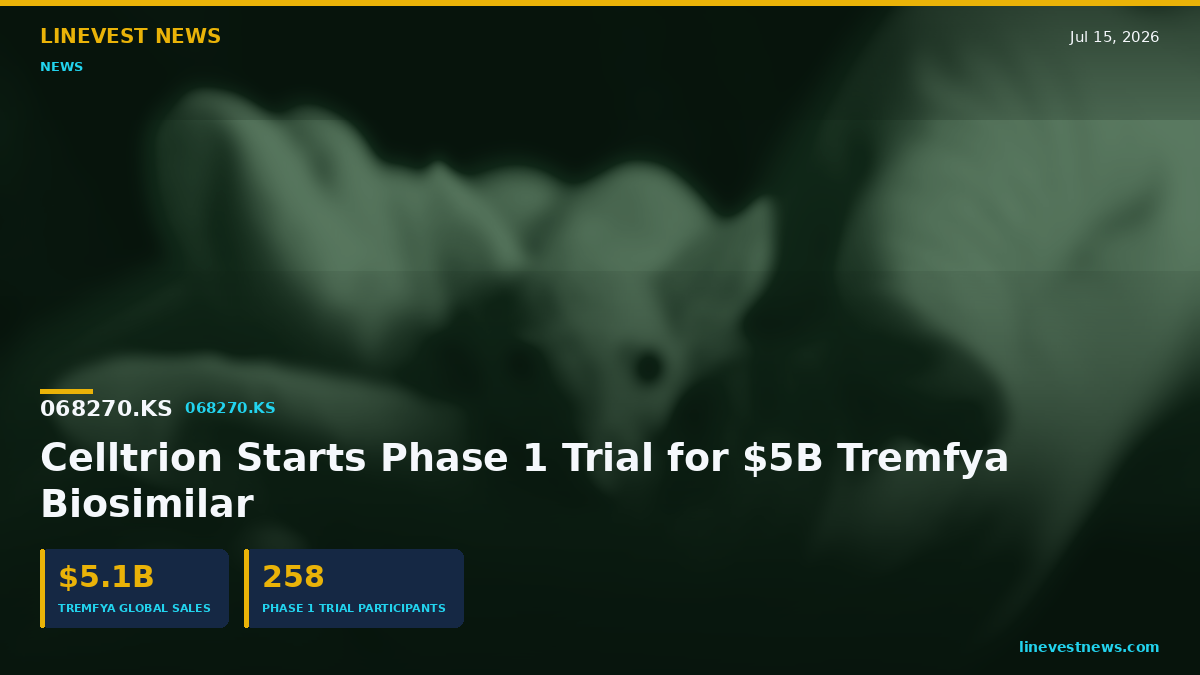
Celltrion, one of South Korea's leading biosimilar developers (068270.KS), said on July 15 it has won approval from the MFDS — South Korea's Ministry of Food and Drug Safety, the country's drug regulator — to begin a Phase 1 trial of CT-P68, a proposed biosimilar of Johnson & Johnson's autoimmune drug Tremfya (guselkumab). The study will enroll 258 healthy adults to compare the safety and pharmacokinetics of CT-P68 against the reference product, according to statements the company issued to Chosun Biz and Electronic Times (etnews) on the same day.
The strategic prize is large, but the timeline is not near. Tremfya, an interleukin-23 (IL-23) inhibitor cleared for plaque psoriasis, psoriatic arthritis, Crohn's disease and ulcerative colitis, generated roughly $5.1 billion (about ₩7.7 trillion) in global sales last year, per figures Celltrion cited to Chosun Biz. That scale is corroborated externally: Tremfya made up about 5.5% of J&J's fiscal 2025 revenue, rising from $3.7 billion in sales in 2024, and grew 74% year-over-year in the first quarter of 2026, according to Fierce Pharma and BioPharma Dive. In other words, Celltrion is aiming at a fast-growing blockbuster — one whose sales are still accelerating, not eroding.
That is precisely why the question for anyone sizing this news is when, not whether. A Phase 1 pharmacokinetic study is the opening step of a multi-year development path that typically runs through a larger Phase 3 equivalence trial before any regulatory filing. The reference drug's core patents are not imminently expiring — J&J has been positioning Tremfya as the growth engine to replace its off-patent Stelara, whose first U.S. biosimilars only entered the market at the start of 2025, per Fierce Pharma. Celltrion's move today is a bet on a market opening that is still several years out.
It is also a crowded early race. No guselkumab biosimilar has yet been approved in any major market, but Celltrion is not alone at the starting line: Samsung Bioepis — Samsung Biologics' wholly-owned biosimilar subsidiary — disclosed a guselkumab program at the J.P. Morgan Healthcare Conference on January 14, 2026, while Alvotech and Polpharma Biologics are also developing candidates, according to company pipeline disclosures and Pearce IP coverage (Samsung Bioepis' January 14, 2026 JPMorgan announcement; Polpharma Biologics' September 2025 MS Pharma licensing deal for PB019; and Alvotech's public pipeline listing). Being early confers advantage in biosimilars, where launch order shapes market share, but the field suggests pricing pressure will be intense whenever the class arrives.
CT-P68 fits a stated portfolio-expansion plan rather than standing alone. Celltrion currently sells 11 biosimilars — including the autoimmune products Remsima, Yuflyma and Steqeyma — and aims to reach 18 by 2030, a target confirmed by law firm Pearce IP's February 2026 pipeline note, which also cited a longer-range goal of 41 biosimilars by 2038. The company recently secured Phase 1 approvals for CT-P45, a biosimilar of Takeda's Entyvio (vedolizumab), in both South Korea and the United States, per Chosun Biz — signaling that its autoimmune and inflammatory-bowel pipeline is broadening in parallel.
The next concrete markers to watch are whether Celltrion follows the Korean IND with a U.S. or European filing for CT-P68 — as it did with CT-P45 — and the readout and timing of any subsequent Phase 3 equivalence study, which would be the first real test of interchangeability with Tremfya. Until then, today's approval confirms intent and direction, not near-term revenue.
This article is journalism, not investment advice. LineVest is not a registered investment adviser. Figures are drawn from the cited primary sources and company statements as of July 15, 2026.