TL;DR
- Q2 revenue: $570.6M (+1.7% YoY), beat $545M consensus
- Adjusted EPS: $0.18, beat $0.17 estimate; Diluted EPS collapsed to $0.17 from $0.29
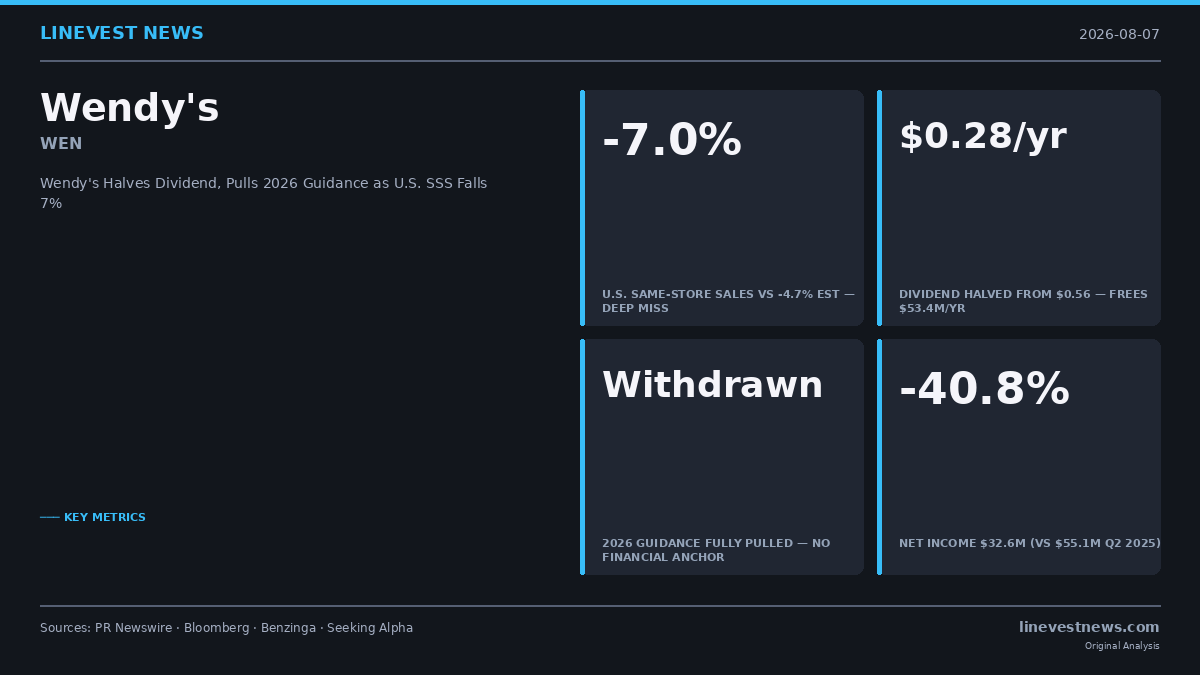
- U.S. same-store sales: -7.0% vs. -4.7% expected -- deep miss
- Dividend: Cut in half to $0.07/quarter ($0.28/year) from $0.14; frees ~$53.4M annually
- 2026 guidance: Fully withdrawn
- New CEO: Bob Wright targeting 5.0x net leverage and a menu-led turnaround
- Stock: Down ~2.6% in Friday premarket; WEN had already fallen ~7.5% on Thursday (the session before results) on broad sector weakness and investor caution ahead of the print
Part A -- What Wendy's Reported
Wendy's Company (NASDAQ: WEN) delivered a paradoxical Q2 2026 result on August 7: a top-line and adjusted EPS beat paired with the most aggressive downside signals the company has sent in years.
Income Statement Summary
| Metric | Q2 2026 | Q2 2025 | Change |
|---|---|---|---|
| Total Revenue | $570.6M | $560.9M | +1.7% |
| Adjusted Revenue | $443.2M | $449.6M | -1.4% |
| Net Income | $32.6M | $55.1M | -40.8% |
| Operating Profit | $79.3M | $104.3M | -24.0% |
| Adjusted EBITDA | $124.1M | $146.6M | -15.3% |
| Diluted EPS | $0.17 | $0.29 | -41.4% |
| Adjusted EPS | $0.18 | $0.29 | -37.9% |
Systemwide Sales
| Geography | Systemwide Sales Change | Same-Store Sales Change |
|---|---|---|
| U.S. | -8.2% | -7.0% |
| International | +3.4% | -2.3% |
| Global | -6.5% | -6.3% |
U.S. same-store sales declined 7.0% versus a consensus estimate of approximately -4.7%, a meaningful miss. Global systemwide sales fell to $3.42 billion. Year-to-date free cash flow of $120.3M (vs. $109.5M prior year) was the one metric pointing in the right direction.
Dividend and Capital Allocation
Wendy's cut its quarterly dividend from $0.14 to $0.07 per share, reducing the annualized payout from $0.56 to $0.28. Management framed the roughly $53M in annual savings as firepower for the turnaround -- reinvestment in marketing, operations, and franchisee support. The company simultaneously withdrew all 2026 financial guidance.
CEO Bob Wright -- who returned to Wendy's for a second stint to lead the recovery -- made his diagnosis explicit: "Today we are clearly not performing at our potential. Our traffic, our value proposition and franchisee economics are not meeting our expectations."
Part B -- What This Means for Investors
A Beat That Was Not a Beat
On paper, Wendy's beat. Adjusted EPS of $0.18 cleared the $0.17 consensus by a penny; revenue of $570.6M topped the $545M estimate. But both numbers require context. The adjusted EPS comparison strips out real charges, and the revenue beat reflects franchise and licensing fee structures rather than stronger guest traffic -- total adjusted revenue, which strips out pass-through items, actually fell 1.4%.
The headline that matters is the U.S. same-store sales miss: -7% against an expected -4.7%. For a restaurant chain, same-store sales are the purest read on brand health. A miss this wide, in a domestic market where McDonald's and Burger King have been aggressively promoting value, signals that Wendy's has ceded pricing and traffic share simultaneously.
The Dividend Cut Changes the Investor Thesis
Before today, WEN traded partly as a yield story. At recent prices near $10.50–$11, the $0.56 annualized dividend offered a yield above 5%. The dividend halving resets that calculus. At a $0.28 annualized payout, yield-oriented investors who bought for income now hold a materially different security. Expect institutional selling pressure among income-focused mandates in the near term.
However, the roughly $53M freed annually is not trivial. If directed into brand investment and franchisee economics, it could accelerate the turnaround timeline. Wright is betting that sacrificing income investors now preserves long-term equity value.
Net Leverage at 5.0x -- The Guardrail
Wright's stated target of trending net leverage toward 5.0x is noteworthy. Restaurant chains often operate with elevated leverage due to franchise royalty cash flows, but 5.0x is toward the upper end of comfort, particularly in an environment where interest rates remain elevated. The dividend cut reduces cash outflow and provides flexibility — whether that means reinvesting in operations or reducing debt service pressure. Investors should monitor whether operational cash generation grows faster than debt costs.
International as the Bright Spot
International systemwide sales grew 3.4%, reflecting net restaurant expansion rather than underlying comp strength — international same-store sales were also negative at -2.3%. If Wendy's can sustain and grow its international business while stabilizing domestic traffic, the brand's global diversification becomes more valuable. However, international still represents a minority of the total base, and the U.S. is the core economic driver.
Turnaround Probability: Three Fronts
Successful restaurant turnarounds require execution simultaneously on: (1) menu relevance -- Wright is targeting a rebuild focused on quality and value, competing directly with McDonald's $5 Meal Deal and Burger King promotions; (2) franchisee health -- franchisee economics "not meeting expectations" is a red flag because under-earning franchisees under-invest in stores, creating a quality spiral; (3) marketing -- elevated spend is only effective if the core product improves first.
The withdrawn guidance removes any near-term earnings anchor, making WEN a story stock rather than a valuation stock until management restores credibility. Q3 same-store sales will be the clearest early signal of whether Wright's plan is gaining traction.
Bottom Line for Investors
Wendy's management has made a clear choice: accept short-term pain -- lower dividend, no guidance, acknowledged underperformance -- in exchange for rebuilding with a clean slate. That honesty is a positive signal relative to managements that issue optimistic guidance during deterioration. But honesty alone does not reverse same-store traffic trends. U.S. quick-service restaurant peers continue to compete aggressively on value, and Wendy's must re-earn customers, not wait for them to return.
WEN shares declined roughly 10% across Thursday's pre-result session and Friday's post-earnings premarket. At current levels, the market is pricing a slow recovery, not a failure -- leaving room for upside if Wright's turnaround shows early evidence, and limited downside buffer if Q3 trends do not improve.
This article is journalistic analysis and not investment advice. LineVest News is editorially independent.
Sources: The Wendy's Company Q2 2026 Earnings Release (PR Newswire, August 7, 2026); Bloomberg; Benzinga; StockTitan; Seeking Alpha