TL;DR
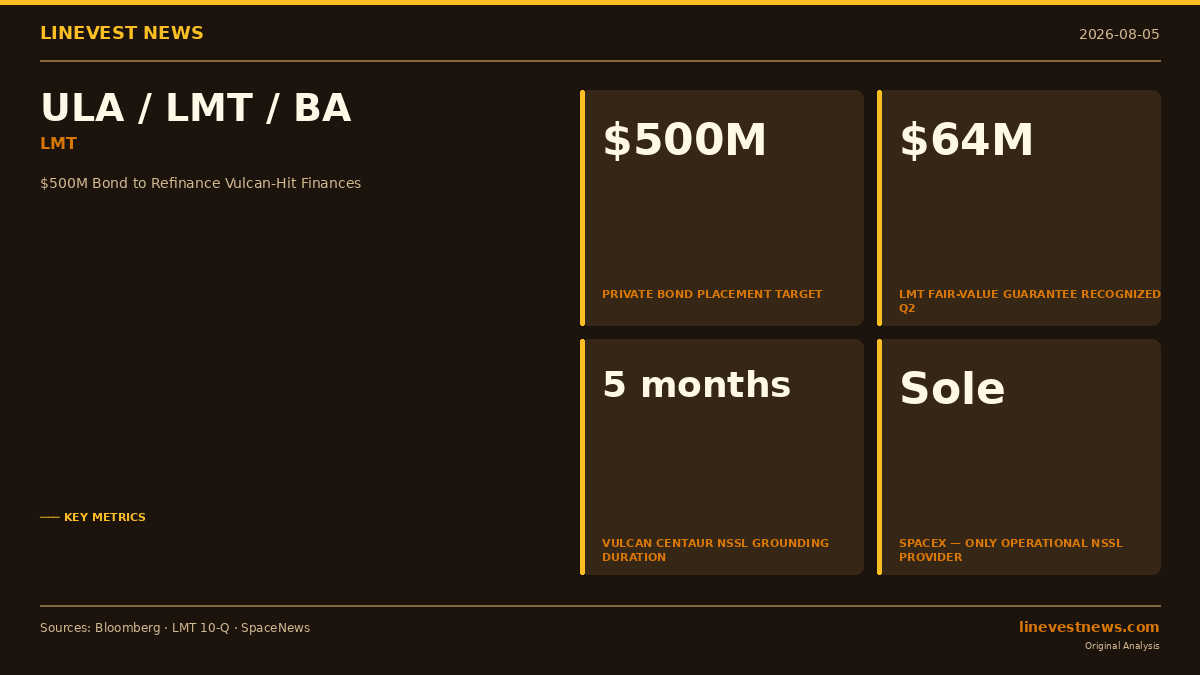
- United Launch Alliance (ULA), Boeing and Lockheed Martin's 50/50 rocket joint venture, is raising ~$500 million via a true private placement bond to refinance existing debt.
- The fundraising follows Vulcan Centaur's NSSL grounding since February 25, 2026 after a solid-rocket-motor anomaly, which Lockheed Martin flagged as causing "financial challenges" in its Q2 2026 SEC filing.
- Lockheed Martin (LMT) guaranteed up to $500M of ULA borrowings (recognized $64M fair-value guarantee liability in Q2 2026); Boeing (BA) also holds a contingent guarantee through July 30, 2027.
- With both ULA's Vulcan and Blue Origin's New Glenn grounded, SpaceX is the sole operational National Security Space Launch provider — a structural advantage with no clear end date.
Part A — What Happened
ULA Goes to the Private Bond Market
United Launch Alliance, the 50/50 rocket joint venture between Boeing (NYSE: BA) and Lockheed Martin (NYSE: LMT), is tapping the private debt market for roughly $500 million, according to Bloomberg reporting on August 5, 2026. The deal is structured as a true private placement — meaning the bonds will not be registered with the SEC and will be sold directly to institutional investors — arranged by US Bancorp, Mizuho Financial Group, and Wells Fargo.
The proceeds are earmarked to refinance existing ULA debt, not fund new capital expenditures.
The Trigger: Vulcan Centaur's Five-Month Grounding
ULA's financial stress traces directly to its flagship Vulcan Centaur rocket, which has been suspended from National Security Space Launch (NSSL) missions since February 25, 2026. The anomaly emerged during the USSF-87 mission on February 12, when an irregular plume was observed from one of the rocket's four Northrop Grumman GEM-63XL solid rocket motors (SRMs) — a recurring issue tied to a manufacturing defect that had also caused a booster nozzle failure during an October 2024 flight.
The U.S. Space Force launched an investigation and suspended Vulcan from NSSL-certified missions. As of August 2026, no return-to-flight date has been confirmed.
In its Q2 2026 10-Q filing (period ended June 28, 2026), Lockheed Martin stated that the grounding had created "financial challenges" for ULA and disclosed a formal bank loan guarantee of up to $500 million, recognizing a $64 million fair-value obligation for that guarantee in the quarter. Boeing also carries a contingent guarantee on ULA borrowings valid through July 30, 2027.
| Item | Detail |
|---|---|
| Bond size | ~$500 million (private placement) |
| Arrangers | US Bancorp, Mizuho, Wells Fargo |
| Purpose | Debt refinancing |
| LMT guarantee (max) | $500 million |
| LMT fair-value liability recognized | $64 million (Q2 2026) |
| BA contingent guarantee expiry | July 30, 2027 |
| Vulcan grounded since | February 25, 2026 |
| Anomaly flight | USSF-87 (Feb 12, 2026) — GEM-63XL SRM |
Part B — What It Means for Investors
LMT's Balance Sheet Can Absorb the Risk — But It's Not Free
Lockheed Martin's Q2 2026 results provide important context for the ULA guarantee:
| LMT Q2 2026 | Result |
|---|---|
| Revenue | $20.1B (+11% YoY) |
| EPS (diluted) | $7.94 (beat estimate by $0.74) |
| Order backlog | $230B (record) |
| Free cash flow guidance (FY2026) | ~$7.0–$7.2B |
| FY2026 revenue guidance | $79.75–$81.75B |
A $500M guarantee against a $7B+ annual free cash flow base is meaningful but manageable — especially since ULA continues to hold a significant pipeline of U.S. Space Force NSSL Phase 3 missions worth billions over the program lifetime. The $64M fair-value charge is a non-cash item that hit Q2 reported earnings but did not affect adjusted figures.
LMT stock rose more than 5% after its July 23 Q2 earnings release, suggesting investors were not spooked by the ULA disclosure. Separately, Lockheed also disclosed a $3.45B acquisition of Ultra Maritime, adding another integration variable for the balance sheet.
Risk for LMT shareholders: if Vulcan does not return to flight and ULA's debt cannot be serviced, Lockheed would be on the hook for the full $500M guarantee — roughly equivalent to 7% of annual free cash flow. The company said it "could incur impairment and operating losses if the Vulcan Centaur rocket does not perform consistent with ULA's assumptions."
Boeing's Exposure: A Secondary Headline Risk
Boeing's ULA contingent guarantee runs through July 30, 2027. Boeing remains in the midst of its own financial recovery following its 737 MAX crisis and production quality issues. Any additional call on ULA guarantees would add to Boeing's already elevated debt load, though neither company has indicated the guarantee is currently expected to be drawn. Boeing's Q2 2026 results showed a narrowing loss and rising revenue — still an early-stage recovery.
The Strategic Winner: SpaceX — and Why That Matters
With Vulcan Centaur grounded and Blue Origin's New Glenn suspended after a launchpad explosion on May 28, 2026, SpaceX is effectively the only company with operational NSSL certification. The Space Force has already awarded SpaceX all 18 missions under the SBST (Strategic Ballistic Shield Targeting) program, reinforcing SpaceX's NSSL monopoly.
For defense contractors, the NSSL Phase 3 Lane 2 contract pool totals $13.7 billion:
| Provider | Phase 3 Missions (FY2026) | Value |
|---|---|---|
| SpaceX | ~28 missions | $714M (FY2026 tranche) |
| ULA | ~19 missions | $428M (FY2026 tranche) |
| Blue Origin | ~7 missions | $2.4B (total lane) |
ULA's mission backlog provides a long-term floor for revenue if Vulcan returns — ULA has 19 NSSL missions allocated, representing roughly $2B+ in contract value over the coming years. But delayed missions mean delayed cash flows, which is precisely why the $500M refinancing was needed.
Additionally, ULA CEO Tory Bruno's departure — he is reportedly joining a competitor — adds management continuity risk at a critical inflection point for the joint venture.
Three Watch Points for Investors
Vulcan return-to-flight date: Any confirmed timeline from ULA or Space Force would be the single most important catalyst for resolving ULA's financial uncertainty. No date has been set as of August 2026.
LMT/BA Q3 disclosures: Watch for updated language on ULA guarantee exposure in Q3 2026 10-Q filings. If the bond deal closes, ULA's liquidity should stabilize; if it struggles to price the private placement, parents may need to step up.
SpaceX NSSL monopoly duration: Blue Origin has not disclosed a New Glenn return-to-flight date either. An extended dual-grounding scenario cements SpaceX's position and weakens the argument for ULA as a strategic diversification asset — potentially accelerating parent-company exit discussions.
This article is based on Bloomberg reporting, Lockheed Martin's Q2 2026 10-Q SEC filing, SpaceNews, Space.com, and DefenseScoop. All figures cited are sourced from public disclosures. This content is for informational purposes only and does not constitute investment advice. LineVest is not a registered investment adviser.
Sources: - Bloomberg: Boeing-Lockheed Rocket Joint Venture Taps Private Bond Market - SpaceNews: ULA deals with financial challenges caused by Vulcan grounding - Lockheed Martin Q2 2026 Results – PR Newswire - DefenseScoop: Space Force mitigating impacts amid Vulcan grounding - Space.com: US Space Force pauses national security launches on ULA Vulcan - Spaceflight Now: Space Force awards $13.7B NSSL contracts - StockTitan: LMT Form 10-Q Q2 2026