TL;DR - FDA approved Moderna's mFLUSIVA (mRNA-1010) on August 5, 2026 — the first mRNA-based influenza vaccine ever cleared in the United States - Full approval for adults 50–64 (based on Phase 3 efficacy data); accelerated approval for 65+ pending a postmarketing confirmatory efficacy trial - Phase 3 (40,805 adults 50+, 11 countries) showed 26.6% relative vaccine efficacy (rVE) vs. a standard-dose comparator — a relative comparison against vaccinated controls, not absolute efficacy vs. unvaccinated adults (~20–60%) - MRNA closed -1.3% at USD 56.26 on August 5; reversed to +4.3% after-hours to approximately USD 58.68 - Key near-term risk: ACIP (whose votes trigger ACA-mandated zero-cost-sharing for private insurers) is blocked by a federal court; however, Medicare Part B flu coverage is statutory, giving the 65+ cohort a reimbursement floor
Part A: What the FDA Approved
The U.S. Food and Drug Administration on August 5, 2026 granted approval for mFLUSIVA® (mRNA-1010), making it the first mRNA-based influenza vaccine to clear U.S. regulators. The product is approved for the prevention of influenza A and influenza B in adults aged 50 and older — Moderna's fourth U.S.-approved product, joining Spikevax (COVID-19 primary), mNEXSPIKE (COVID-19 updated), and mRESVIA (RSV).
Two-Track Approval Structure
| Age Group | Approval Type | Supporting Data |
|---|---|---|
| 50–64 years | Full approval | Phase 3 efficacy trial (40,805 participants, 11 countries) |
| 65+ years | Accelerated approval | Immunogenicity trial (2,992 participants); confirmatory clinical-benefit study required postmarket |
For adults 65 and older, the FDA accepted immunogenicity as a surrogate endpoint rather than direct efficacy data — reflecting the concern that the Phase 3 trial's standard-dose comparator was not the recommended high-dose option for seniors. Moderna must complete a postmarketing confirmatory trial to retain the 65+ label.
Efficacy Data — What the Numbers Mean
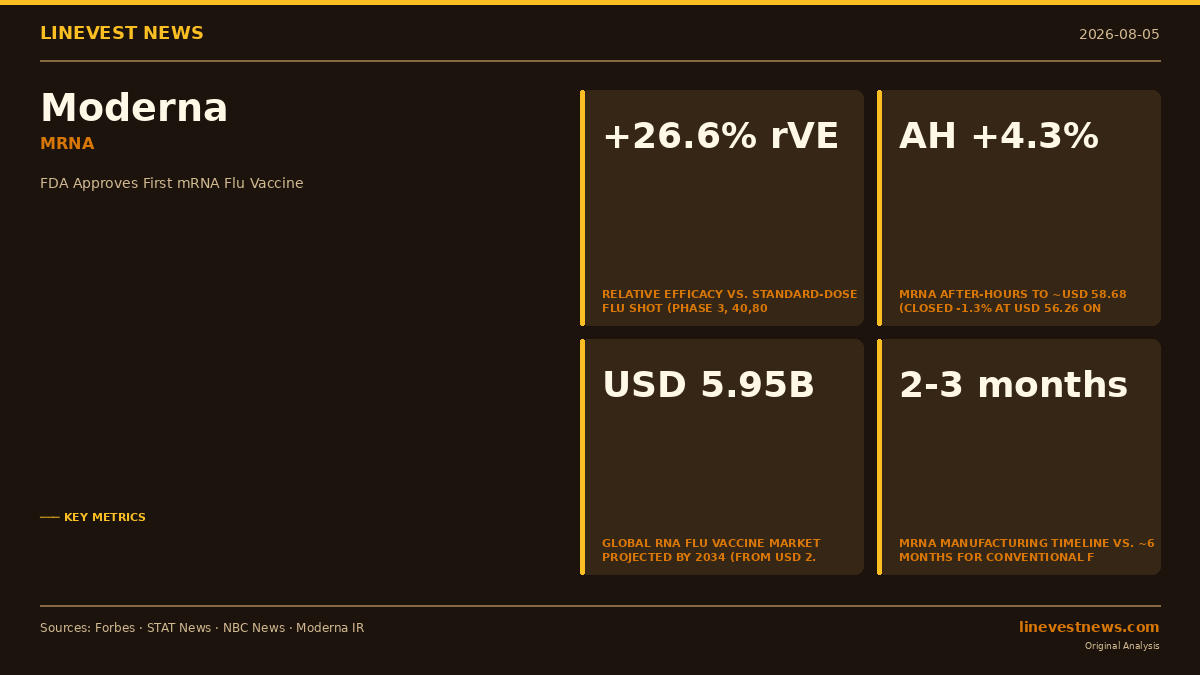
mFLUSIVA's Phase 3 trial enrolled 40,805 adults aged 50 and older and demonstrated 26.6% relative vaccine efficacy (rVE) versus a standard-dose flu shot comparator. Importantly:
- This 26.6% figure is a relative measurement: mFLUSIVA produced 26.6% fewer RT-PCR-confirmed influenza-like illness cases than adults who received a standard-dose shot
- It underlies the full approval for ages 50–64; the 65+ accelerated approval uses separate immunogenicity data (2,992-person trial), not this efficacy figure
- It is not the same as absolute vaccine efficacy (~20–60%, varying by season), which measures protection against unvaccinated controls
Sanofi's Fluzone High-Dose has shown approximately 24% relative efficacy improvement over standard-dose shots in adults 65+, measured in a different trial with a different age population. A direct mFLUSIVA vs. Fluzone HD head-to-head trial does not exist.
The February Refusal-to-File — and the Reversal
Approval came after an unusual regulatory detour. In early February 2026, the FDA issued a refusal to file (RTF) — a determination that Moderna's application could not be accepted for formal review — citing concerns that the Phase 3 comparator for the 65+ cohort was a standard-dose rather than high-dose vaccine, contrary to guidance issued before the trial began.
The FDA reversed course on February 18, 2026, agreeing to accept an amended submission structured as a two-track filing: full approval for 50–64 (efficacy basis) and accelerated approval for 65+ (immunogenicity basis). The episode drew public attention given HHS Secretary Robert F. Kennedy Jr.'s documented skepticism of mRNA technology, though the approval proceeded through normal regulatory channels.
CEO Stéphane Bancel said: "Flu remains a significant public health challenge, and mFLUSIVA provides an important new option for America's seniors. This approval also reflects the ongoing potential of our mRNA platform to help address important public health challenges through continued scientific innovation."
Moderna plans to have supply available in select U.S. retailers for the 2026–2027 respiratory season. International submissions are pending in the European Union, Canada, and Australia.
Part B: The Investor Equation
Immediate Market Reaction
MRNA closed at USD 56.26, down 1.3% on August 5 — a "sell-the-news" pattern as the approval had been widely anticipated. The stock recovered to approximately USD 58.68 in after-hours trading, a gain of roughly 4.3%. MRNA's 52-week range is USD 22.28–USD 85.60, nearly a quadrupling from low to high, and illustrates how sensitive the stock has been to regulatory milestones. At USD 56.26, MRNA was trading at roughly 2.5x its 52-week low.
The Coverage Picture: Who Benefits and Who Faces Barriers
Insurance reimbursement is the most important first-season constraint — and the impact differs significantly by cohort:
Adults 65+ (Medicare Part B): Influenza vaccine coverage under Medicare Part B is mandated by statute (Social Security Act §1861(s)(10)) and does not require an ACIP vote. The 65+ population has a coverage floor regardless of the court-ordered ACIP blockage.
Adults 50–64 (ACA private insurance): The Affordable Care Act requires zero-cost-sharing coverage for ACIP-recommended preventive vaccines. Because ACIP — blocked from convening by a federal court — has not voted on mFLUSIVA, private insurers are not legally required to cover it at no cost. Adults in this cohort may face out-of-pocket expenses, limiting first-season penetration.
Lower-income and uninsured adults: Face the greatest access barriers without ACIP guidance and Medicaid program directives.
Analyst consensus reflects these near-term constraints: the consensus Hold rating on MRNA carries an average price target of approximately USD 50.84, below the current market price. The primary concern is that meaningful flu revenue will be deferred until the coverage environment normalizes.
Market Opportunity: The Long-Term Horizon
The global RNA influenza vaccine market was valued at approximately USD 2.78 billion in 2025 and is projected to reach approximately USD 5.95 billion by 2034 — more than a doubling from the 2025 base over nine years. Moderna's addressable U.S. population — adults aged 50 and older — numbers approximately 120 million people. The broader U.S. flu market distributes roughly 170 million doses per year.
Moderna has not provided specific mFLUSIVA revenue guidance.
Platform Significance
mFLUSIVA's approval demonstrates that the mRNA platform can deliver a licensed vaccine in a second non-COVID respiratory indication (after mRESVIA for RSV), expanding Moderna's commercial disease-area footprint.
Manufacturing speed. mRNA strain-to-dose timelines run two to three months vs. approximately six months for conventional flu vaccines — a structural advantage if avian influenza or novel pandemic strains require rapid reformulation.
mRNA-1083 pipeline. Moderna's combination COVID + flu vaccine (mRNA-1083) recorded positive Phase 3 data in 2024. The company subsequently submitted a BLA, which was withdrawn from FDA review in May 2025. Investors should monitor when Moderna refiles or provides an update on the regulatory path for mRNA-1083 — an eventual approval would unlock a single-shot product targeting the same 50+ population.
Three Investor Watch Points
| Watch Point | What to Monitor | Timing |
|---|---|---|
| ACIP court resolution | Court action restoring ACIP ability to convene → ACA zero-cost coverage for 50–64 triggered | Uncertain; Q4 2026 possible |
| First-season uptake | Retail pharmacy sell-through for the 2026–2027 flu season, especially 50–64 cohort | September–October 2026 |
| mRNA-1083 re-filing | Moderna's next regulatory submission for the COVID + flu combination vaccine | Timeline not yet disclosed |
Competitive Landscape Snapshot
Note: The figures below come from separate, non-head-to-head trials and should not be read as a direct comparison.
| Product | Maker | Mechanism | Efficacy vs. Standard-Dose Comparator |
|---|---|---|---|
| Fluzone High-Dose | Sanofi | Egg-based (high-dose) | ~24% rVE in adults 65+ (separate trial) |
| Fluarix Quadrivalent | GSK | Egg-based | Standard-dose; reference comparator |
| mFLUSIVA | Moderna | mRNA | 26.6% rVE in adults 50–64 full-approval cohort (50+trial, standard-dose comparator) |
mFLUSIVA enters a market where Sanofi and GSK hold entrenched ACIP recommendations and Medicare Part B formulary positions. First-season volume is expected to concentrate in the 65+ Medicare cohort, where reimbursement is guaranteed by statute.
The Bottom Line
mFLUSIVA's August 5 approval is a genuine regulatory milestone — the first mRNA flu vaccine to clear the FDA, expanding Moderna's approved respiratory platform to three disease areas. For investors, 2026 is a market-infrastructure year: the 65+ Medicare Part B cohort provides a near-term volume floor, while the 50–64 private-pay story hinges on when ACIP can reconvene. Key signals to watch: (1) ACIP court resolution, (2) September–October first-season uptake data, and (3) the mRNA-1083 re-filing timeline.
This article is for informational purposes only and does not constitute investment advice.
Sources 1. Forbes — FDA Approves First mRNA Flu Vaccine For Older Adults (Aug. 6, 2026) 2. STAT News — FDA approves Moderna's mRNA flu vaccine, the first to use the technology (Aug. 5, 2026) 3. NBC News — FDA approves 1st mRNA flu shot, from Moderna 4. Newswire — Moderna Official Press Release: mFLUSIVA U.S. FDA Approval 5. Investing.com — Moderna wins U.S. FDA approval for first mRNA-based flu vaccine