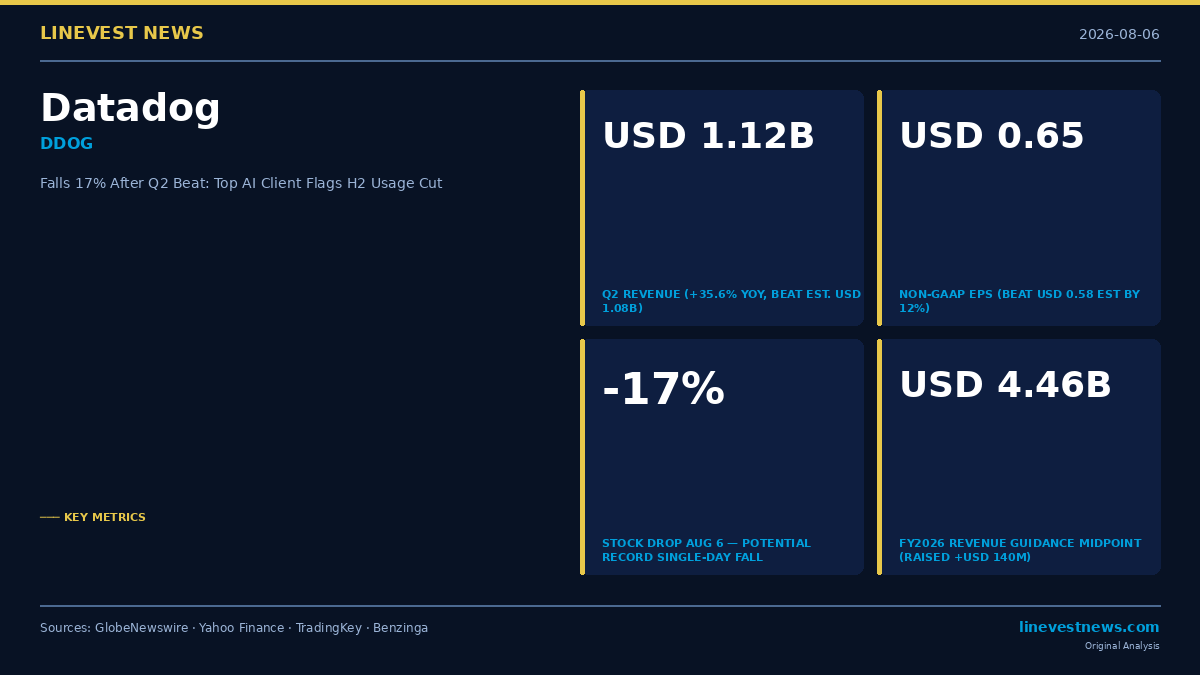
TL;DR - Q2 revenue USD 1.12B (+35.6% YoY), beat consensus USD 1.08B by 3.8%; Non-GAAP EPS USD 0.65 vs est. USD 0.58 (+12%) - FY2026 revenue guidance raised to USD 4.45–4.47B (from USD 4.30–4.34B); midpoint-to-midpoint raise of USD 140M - Largest AI customer — a nine-figure account spanning 17 Datadog products — disclosed it will cut platform usage starting Q3 2026 - Q3 guidance midpoint USD 1.14B implies only +1.7% sequential growth, down sharply from +11% in Q2 - DDOG fell 16.96% at the close on August 6 (TradingKey data), with intraday losses reaching as much as 21%
Part A: Q2 2026 Results — A Beat on Every Line
Datadog (NASDAQ: DDOG) reported second-quarter 2026 financial results that, taken in isolation, were nearly flawless. Revenue came in at USD 1.121 billion, a 35.6% year-over-year gain and USD 41 million ahead of the Wall Street consensus estimate of USD 1.08 billion. Non-GAAP earnings per share of USD 0.65 cleared the USD 0.58 consensus by 12%, while non-GAAP gross margin came in at 78.6%, reflecting the pricing power embedded in Datadog's cloud-native observability platform.
GAAP operating income was USD 5 million (less than 1% margin), reflecting the significant stock-based compensation load typical of enterprise software. Non-GAAP operating income reached USD 257 million, representing a 23% non-GAAP operating margin. Free cash flow came in at USD 279 million, representing a free cash flow margin of approximately 25%, down from 29% in the prior-year period — a compression that became a secondary talking point during the post-earnings selloff.
Enterprise momentum remained robust. Customers generating at least USD 100,000 in annual recurring revenue rose to 4,720 — up 22.6% year-over-year from the 3,850 counted a year earlier. The company ended the quarter with USD 5.0 billion in cash, cash equivalents, and marketable securities.
| Metric | Q2 2026 Actual | Consensus Estimate | Beat vs. Estimate |
|---|---|---|---|
| Revenue | USD 1.121B | USD 1.08B | +3.8% |
| Non-GAAP EPS | USD 0.65 | USD 0.58 | +12.1% |
| GAAP EPS | USD 0.12 | — | — |
| Non-GAAP Gross Margin | 78.6% | — | — |
| Non-GAAP Operating Income | USD 257M (23% margin) | — | — |
| Free Cash Flow | USD 279M (~25% margin) | — | — |
| USD 100K+ ARR Customers | 4,720 (+22.6% YoY) | — | — |
Part B: Why the Stock Fell Despite a Textbook Beat
One Customer, One Disclosure — and a Historic Selloff
The earnings beat was almost immediately overshadowed by a single sentence in management's commentary: Datadog's largest customer, an unnamed AI company that deploys the platform across 17 product lines under a nine-figure contract, informed management that it intends to reduce actual platform usage beginning in the third quarter of 2026.
The name was never disclosed. But the market had little difficulty interpreting the significance. By the August 6 close, DDOG had fallen 16.96% (TradingKey data), with intraday losses at one point reaching 21%. Stocktwits market participants were tracking the move in real time as a potential record single-day decline since the company's September 2019 IPO.
The Sequential Growth Math
The usage-cut disclosure translates directly into forward guidance, and the numbers are jarring:
| Period | Revenue | Sequential Change | YoY Growth |
|---|---|---|---|
| Q2 2026 (actual) | USD 1.121B | +11.0% vs Q1 | +35.6% |
| Q3 2026 (guidance midpoint) | USD 1.140B | +1.7% vs Q2 | ~28% |
| FY2026 (guidance midpoint) | USD 4.46B | — | ~31% |
The abrupt shift from +11% sequential in Q2 to +1.7% in Q3 is the crux of the selloff. Even with a raised full-year guidance range, the forward growth trajectory implies material deceleration in the second half of 2026. For a stock that has historically commanded a significant premium multiple on expectations of durable high-growth, that kind of shift in trajectory triggers an immediate re-rating.
AI Customer Concentration Risk: The Double-Edged Sword of the Platform Era
Datadog's rise as the dominant observability platform for cloud-native and AI-native companies created an unusual dynamic: the same hyperscale AI builders whose rapid scaling drove Datadog's expansion now represent concentrated single-name exposure.
The model is partly usage-based. As AI companies scale inference workloads, log volumes, and data pipelines, the monitoring bill grows proportionally. That mechanism worked powerfully in Datadog's favor during the 2023–2025 AI infrastructure buildout. When one of those builders decides to throttle spend — whether through model distillation, caching improvements, or internal efficiency initiatives — the impact on Datadog's variable revenue is direct and immediate.
The counterintuitive reality surfaced in Q2: the largest client renewed its contract (a nine-figure commitment, no less) while simultaneously signaling it would use less of the platform in the near term. This is not a customer exit — it is a customer optimizing. But for investors accustomed to modeling Datadog on the assumption that AI usage only accelerates, the nuance matters little in the short term.
Cyclical Pause or Structural Shift?
The critical interpretive question for investors is whether this usage reduction is temporary (cyclical cost optimization by an AI lab between model generations) or the leading edge of a structural trend (large AI builders migrating to in-house observability tooling).
Arguments for the cyclical camp: 1. The client renewed its contract. A structural exit typically begins with non-renewal, not mid-cycle usage reduction. 2. Across the broader enterprise base of 4,720 customers, no systemic deterioration is visible — the cohort grew nearly 23% year-over-year. 3. Historical AI infrastructure spend patterns show compression during periods of model consolidation before re-accelerating as new architectures and use cases mature. 4. Datadog's USD 5.0 billion cash balance provides ample runway to invest in next-generation AI observability capabilities.
Arguments that deserve monitoring: 1. The world's largest AI labs increasingly build custom internal tooling. If Datadog's telemetry layer gets absorbed into proprietary AI observability stacks at hyperscale, the tailwind that inflated DDOG's growth from 2023 to 2025 could structurally mean-revert. 2. FCF margin compression from 29% to 25% — even as revenue grew 35.6% — signals rising costs, and any further deceleration in revenue without corresponding cost reduction could pressure margins further. 3. Datadog's concentration in a single nine-figure customer is itself a governance and disclosure risk that analysts will scrutinize more closely in future quarters.
Raised Guidance Still Implies Second-Half Deceleration
It is worth underscoring that management's decision to raise full-year guidance — even amid the customer headwind — reflects genuine confidence in the rest of the book. The USD 4.45–4.47 billion FY2026 revenue range represents a midpoint increase of USD 140 million from the prior USD 4.30–4.34 billion band (midpoint USD 4.32 billion). Non-GAAP EPS guidance moved to USD 2.50–2.54 (midpoint USD 2.52), up from USD 2.36–2.44 (midpoint USD 2.40) — a midpoint increase of USD 0.12.
| Guidance | Old Range | New Range | Midpoint Change |
|---|---|---|---|
| FY2026 Revenue | USD 4.30–4.34B | USD 4.45–4.47B | +USD 140M |
| FY2026 Non-GAAP EPS | USD 2.36–2.44 | USD 2.50–2.54 | +USD 0.12 |
| Q3 Revenue | — | USD 1.135–1.145B | — |
| Q3 Non-GAAP EPS | — | USD 0.63–0.65 | — |
The raise reflects the strength of the non-AI, non-concentrated parts of the customer base — the thousands of mid-market and enterprise software companies that use Datadog for cloud infrastructure monitoring and security. That base is healthy. The problem is that it cannot fully absorb the deceleration at the very top of the book in a single quarter.
What to Watch in Coming Quarters
Q3 2026 earnings (est. November 2026): This is the definitive test. If the largest customer's usage stabilizes or re-accelerates, the narrative shifts from "concentration risk" to "temporary digestion," and the August 6 selloff looks like an overreaction. If usage drawdowns spread to other top-10 customers, the structural thesis gains traction.
AI workload efficiency trends: Companies building large language models have publicly discussed model distillation, prompt caching, and inference optimization as paths to dramatically lower compute costs. These techniques also reduce the volume of real-time telemetry data that Datadog processes and bills for. Investors should track inference cost trends at the industry level as a leading indicator for Datadog's AI-native revenue.
AI Observability as a new revenue layer: Datadog launched AI Observability as a dedicated product category in 2025, designed to monitor model performance, hallucination rates, and token consumption. Early adoption metrics and net revenue retention within this cohort will indicate whether new AI use cases can offset efficiency-driven usage contraction in existing customers.
FCF margin recovery: At 25%, free cash flow margin remains robust in absolute terms. But the directional compression from 29% matters to valuation models that price Datadog on FCF multiples. Recovery here — driven by operating leverage as the revenue base expands — will be essential to re-establishing the premium multiple the stock once commanded.
This article is for informational purposes only and does not constitute investment advice or a recommendation to buy, sell, or hold any security. All financial data is based on Datadog's Q2 2026 earnings press release and publicly available analyst reports. Investors should conduct their own due diligence and consult a registered investment advisor before making investment decisions.
Sources - Datadog Q2 2026 Earnings Press Release (GlobeNewswire via Manila Times, August 6, 2026) - TradingKey: "Datadog Inc Stock (DDOG) Moved Down by 16.96% on Aug 6" - Yahoo Finance: "Datadog sinks 21% despite raised guidance, Q2 beat" - TS2 Space Tech: "Datadog stock tumbles as leading AI client flags weaker second-half outlook" - Stocktwits: "DDOG Stock Heads For Record Single-Day Drop Despite Q2 Earnings Beat, Raised Guidance" - Benzinga: "Datadog Stock Is Sinking Thursday: What's Going On?" - Investing.com: "Datadog stock drops 14% after earnings despite 36% revenue growth"