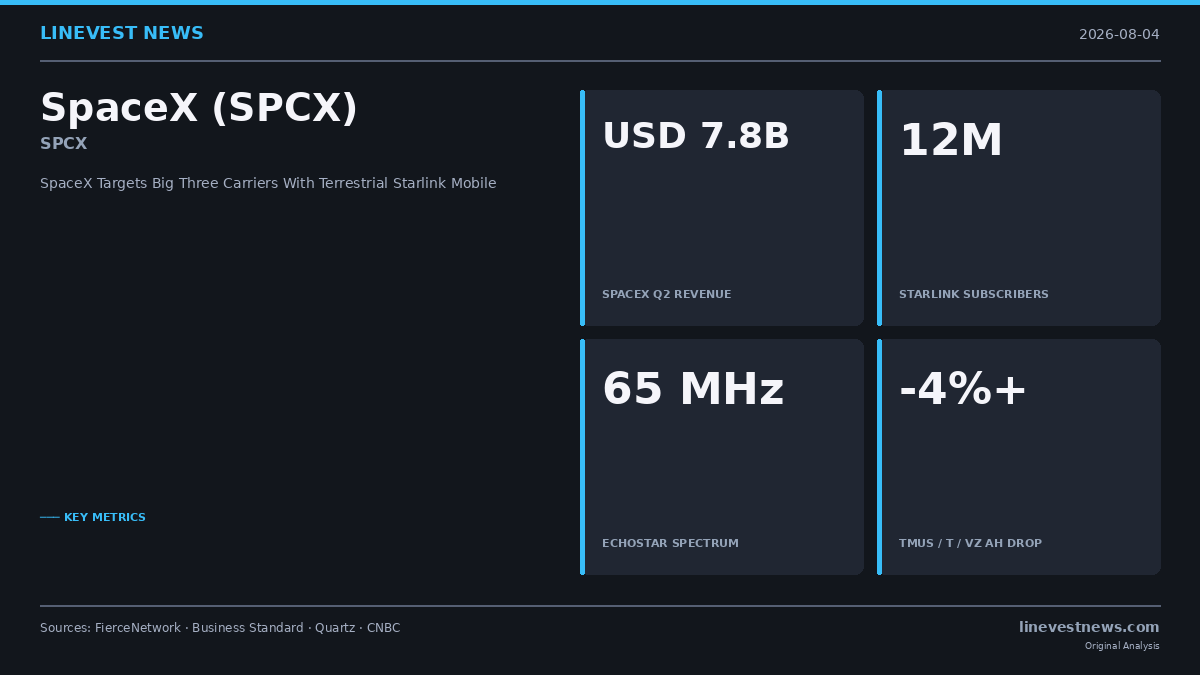
SpaceX (NASDAQ: SPCX) used its first public earnings call since June's landmark IPO to declare war on U.S. wireless — and shares of AT&T (NYSE: T), Verizon (NYSE: VZ), and T-Mobile (NASDAQ: TMUS) each fell more than 4% in after-hours trading as investors absorbed the news.
TL;DR - SpaceX President Gwynne Shotwell revealed that the company will build a full terrestrial mobile network to compete directly with T-Mobile, AT&T, and Verizon - SpaceX holds 65 MHz of EchoStar spectrum with terrestrial rights (USD 19.6B total, FCC-approved May 2026) - Next-gen Starlink Mobile satellites target 2027 launch; consumer service targeted end of 2027 - TMUS, T, VZ each fell 4%+ in after-hours trading on August 4 - SpaceX Q2 revenue: USD 7.8B (+92% YoY), Starlink subscribers hit 12M; USD 18.4B quarterly CapEx alarmed SpaceX investors
Part A: SpaceX's Terrestrial Ambition Goes Public
For the first time since its June 12 Nasdaq IPO, SpaceX held a public earnings call on August 4. The most consequential moment came not from the financial results but from a single answer in the Q&A session.
SpaceX President and COO Gwynne Shotwell confirmed that the company will use its 65 megahertz of EchoStar spectrum — which carries terrestrial rights — to build a land-based mobile network that would compete head-on with the Big Three U.S. carriers.
"The spectrum that we purchased from EchoStar does have terrestrial components, so we definitely intend to build out terrestrial," Shotwell told analysts. "I anticipate us being able to acquire quite a few of their customers, because I think our service will be better."
CEO Elon Musk also participated in the call. Shotwell's comments on wireless competition attracted the most market attention.
The Spectrum Foundation
SpaceX acquired 65 MHz of spectrum licenses from EchoStar across two deals totaling approximately USD 19.6 billion — among the largest spectrum transactions in U.S. history. The FCC approved the transfer in May 2026, with full license transfer completing in late 2027. The timeline aligns with SpaceX's plan to launch next-generation Starlink Mobile satellites in 2027 and begin delivering upgraded mobile service by year-end 2027.
| Spectrum Block | Bandwidth | Primary Use |
|---|---|---|
| AWS-4 | 40 MHz | Terrestrial + satellite (paired) |
| AWS-3 (unpaired) | 15 MHz | Terrestrial supplemental |
| H-Block | 10 MHz | Satellite downlink |
Q2 2026 Financial Highlights
SpaceX's second-quarter results — the first reported as a public company — showed strong operational momentum, though USD 18.4 billion in quarterly capital expenditure alarmed investors:
| Metric | Q2 2026 | Year-over-Year |
|---|---|---|
| Revenue | USD 7.8B | +92% |
| Net Loss | -USD 541M | Improved from -USD 1.0B |
| Adj. EBITDA | USD 3.5B | +191% |
| CapEx | USD 18.4B | Up from USD 10.1B in Q1 |
| Starlink Subscribers | 12M | Doubled YoY |
| Connectivity Revenue | USD 4.3B | +66% |
The company guided for a USD 100 billion annualized revenue run rate by end of 2026. SPCX, which IPO'd at USD 135 (closing Day 1 at USD 161), was trading near USD 125 ahead of the call.
Part B: What This Means for Telecom Investors
The Immediate Market Reaction
Shares of AT&T, Verizon, and T-Mobile each fell more than 4% in post-market trading following Shotwell's comments — a swift re-pricing of competitive risk for the three companies that together account for roughly 95% of U.S. wireless subscribers.
The timing is notable. The Big Three had formed a defensive satellite communications joint venture in May 2026, pointedly excluding SpaceX, in an attempt to build satellite connectivity on their own terms. Shotwell's announcement signals that the preemptive move arrived too late.
Stranded Infrastructure Risk for AT&T and Verizon
The most immediate concern for AT&T and Verizon investors is their large fixed-infrastructure cost bases. Both carriers have spent hundreds of billions constructing nationwide networks whose economic value depends on network effects and pricing power — the very attributes Shotwell suggested SpaceX plans to erode.
T-Mobile faces a more nuanced threat. TMUS has long marketed itself on nationwide coverage including rural areas; a satellite-terrestrial hybrid would directly encroach on that selling point. T-Mobile previously entered a Starlink direct-to-cell partnership arrangement, but the companies have since pursued independent paths. SpaceX's decision to build its own terrestrial network, rather than operate through an MVNO arrangement, was accelerated in part by the Big Three's refusal to grant SpaceX access to resell their network capacity.
What SpaceX Still Needs
Even with spectrum in hand, the buildout required before SpaceX can deliver a commercially competitive service is substantial:
- Tower access: SpaceX needs access to thousands of cell towers and small cell nodes. Unlike spectrum, tower access cannot be acquired through a single government-approved transaction.
- New satellite generation: The 2027 Starlink Mobile satellite architecture is new; manufacturing and launch timelines carry execution risk.
- Spectrum depth: At 65 MHz, SpaceX enters below carriers that hold 200+ MHz in major markets — sufficient for initial deployment, not for a full-capacity nationwide network at launch.
- Charter partnership: SpaceX reportedly engaged Charter Communications in discussions about routing terrestrial traffic over Charter's cable network. No agreement has been announced.
Analysts generally view a full nationwide launch in 2027 as aggressive. An initial rollout in suburban and rural markets — where SpaceX's satellite coverage provides the greatest differentiation — is a more plausible near-term scenario.
Dead Zone as a Durable Differentiator
SpaceX's structural advantage remains what no terrestrial carrier can easily replicate: eliminating dead zones. With 12 million global Starlink subscribers and satellites already providing connectivity in areas unreachable by ground networks, SpaceX enters the carrier competition with a baseline customer relationship.
Rural users who have historically accepted lower-quality service from legacy carriers for lack of alternatives represent the earliest addressable market — and the one where SpaceX faces minimal incumbent resistance. If dead-zone coverage drives early adoption at scale, SpaceX's subscriber economics could improve faster than the buildout timeline alone would suggest.
Investor Takeaways
For holders of T, VZ, and TMUS, the SpaceX earnings call represents a material competitive development. It is not yet a near-term revenue headwind — 2027 is still over a year away — but it is a credible long-range threat that warrants monitoring across several milestones:
- Late 2027: Starlink Mobile spectrum licenses fully transfer; first consumer service launch
- 2027: Next-generation satellites deploy; initial terrestrial coverage zones announced
- Charter discussions: Any announced roaming partnership would significantly accelerate competitive pressure
- FCC spectrum auctions: Any new spectrum available to SpaceX would widen its capacity advantage
For SPCX investors, the wireless ambition is strategically compelling but capital-intensive: USD 18.4 billion in Q2 CapEx alone signals that the terrestrial buildout is already consuming capital at an accelerating pace, well before wireless revenue materializes. SpaceX's path to profitability in the wireless segment remains a multi-year proposition.
This article is for informational purposes only and does not constitute investment advice. LineVest is an independent financial news publication not affiliated with any brokerage.
Sources: FierceNetwork · Quartz · Business Standard · CNBC · EchoStar IR · Yahoo Finance · Android Authority