TL;DR
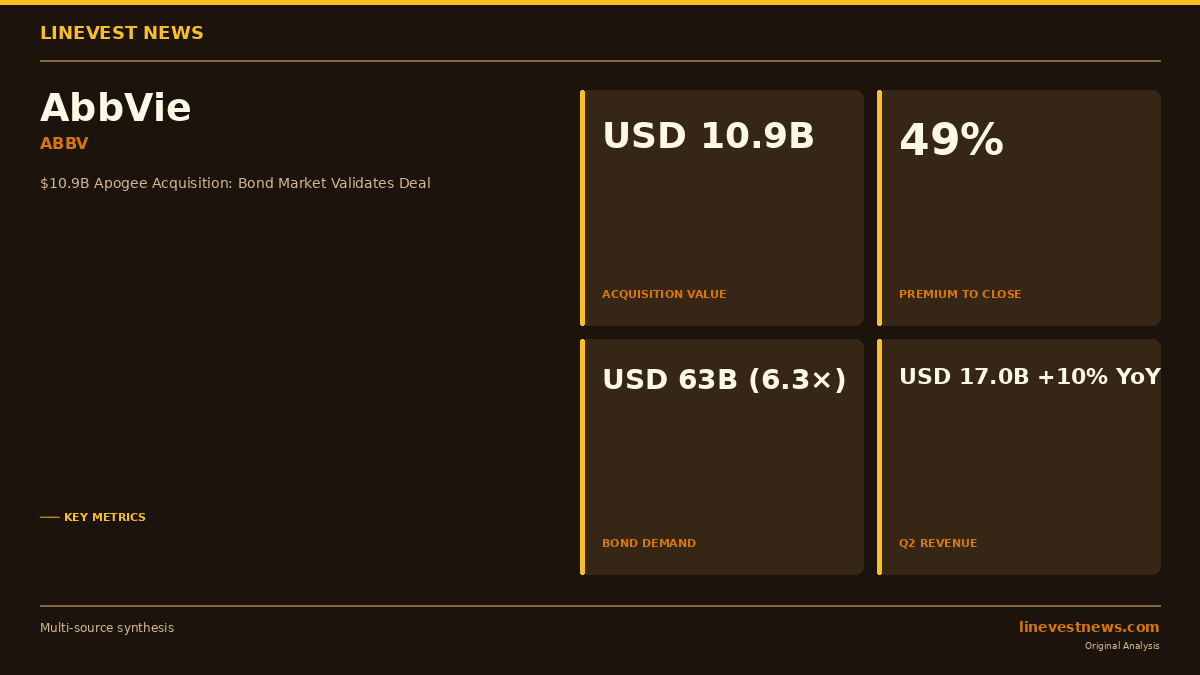
- AbbVie agreed to acquire Apogee Therapeutics for USD 10.9 billion (USD 135.11/share, 49% premium), targeted to close Q3 2026
- On August 4, AbbVie launched a USD 10 billion investment-grade bond offering that attracted peak demand of USD 63 billion — a 6.3x oversubscription ratio
- Q2 2026 results (reported July 31): Revenue USD 17.0B (+10.2% YoY), Adj EPS USD 3.65 (beat guidance by USD 0.06)
- Skyrizi: USD 5.5B (+24% YoY) / Rinvoq: USD 2.5B (+23.7% YoY); Humira: USD 756M (-36% YoY)
- FY2026 guidance raised to approximately USD 67.6B revenue; Adj EPS USD 13.87-14.07
Part A: The Deal and the Bond Offering
Acquisition of Apogee Therapeutics
On June 22, 2026, AbbVie (NYSE: ABBV) announced a definitive agreement to acquire Apogee Therapeutics Inc. in an all-cash transaction valued at approximately USD 10.9 billion, or USD 135.11 per share. The acquisition price represents a 49% premium to Apogee's closing share price on June 18, 2026, and is expected to close in Q3 2026 pending regulatory and shareholder approvals.
Apogee is a clinical-stage biotech focused on half-life extension (HLE) biologics for inflammatory and immunological diseases. Its lead asset is zumilokibart (APG777), a monoclonal antibody targeting interleukin-13 (IL-13), currently in Phase 2 trials for atopic dermatitis and Phase 1b for asthma. The pipeline also includes APG273, a potential best-in-class long-acting combination therapy targeting both IL-13 and thymic stromal lymphopoietin (TSLP) for asthma (Phase 1b), and APG333 (Phase 1).
AbbVie describes the deal as deepening its immunology leadership and creating peak sales potential across dermatology and respiratory conditions.
USD 10 Billion Bond Offering Draws USD 63 Billion in Demand
On August 4, 2026, AbbVie launched a USD 10 billion investment-grade bond offering to help finance the Apogee acquisition. The sale drew approximately USD 63 billion in peak demand, a 6.3x oversubscription ratio, according to Bloomberg. The outsized response signals strong bond-market confidence in AbbVie's credit profile and deal strategy.
Per Bloomberg, AbbVie's demand was slightly stronger than Amazon's USD 25 billion bond offering earlier in 2026. AbbVie also filed a Form 424B5 prospectus supplement with the SEC confirming the offering terms.
Part B: Investment Analysis
Q2 2026: A Clean Beat Before the Deal Closes
AbbVie's Q2 2026 results (reported July 31, 2026) give important context for how the deal is being funded. The company remains in strong operational shape:
| Metric | Q2 2026 | Change YoY |
|---|---|---|
| Net Revenue | USD 17.0B | +10.2% |
| Adj. EPS | USD 3.65 | Beat by USD 0.06 |
| Skyrizi | USD 5.51B | +24.4% |
| Rinvoq | USD 2.53B | +24.5% |
| Humira | USD 756M | -35.9% |
The combined Skyrizi+Rinvoq revenue of USD 8.04 billion now represents roughly 47% of total revenue, completing AbbVie's transition away from Humira. Humira's U.S. decline accelerated to -47% year-over-year in Q2 as biosimilar competition intensifies.
FY2026 guidance raised: Revenue approximately USD 67.6 billion (up USD 300 million from prior guidance); Adj EPS USD 13.87-14.07. The EPS range already reflects a USD 0.14 dilution impact from the partial-year Apogee acquisition cost.
The Strategic Logic: Building Beyond Humira
AbbVie's acquisition of Apogee fits a well-established playbook: identify next-generation immunology assets before they reach late-stage value inflection. Zumilokibart targets IL-13, the same pathway as Dupixent (dupilumab, Sanofi/Regeneron), which generated approximately USD 14 billion in 2025 sales. If APG777 demonstrates superior half-life extension — allowing monthly or bimonthly dosing versus Dupixent's biweekly schedule — it could be highly competitive in atopic dermatitis, with an estimated addressable market exceeding USD 15 billion globally by 2030.
APG273's dual IL-13/TSLP mechanism in asthma could differentiate it from Tezspire (AstraZeneca/Amgen) and Dupixent's asthma indication.
EPS Dilution: Timeline to Accretion
| Period | Adj EPS Impact |
|---|---|
| 2026 (partial year) | -USD 0.14 |
| 2027 | -USD 0.46 |
| 2028-2031 | Dilutive |
| From 2032 | Accretive |
The 6-year dilution window is long by pharma M&A standards, implying AbbVie is betting on zumilokibart's late-stage development success. Skyrizi and Rinvoq's combined growth trajectory (approximately +24% each) is large enough to offset dilution at the operating income level in the near term.
Analyst Consensus and Valuation
Among 31 sell-side analysts covering ABBV: - 20 Strong Buy / 2 Moderate Buy / 9 Hold - Consensus 12-month price target: USD 265.79 (approximately 8.2% upside) - Street-high target: USD 300 (approximately +22% upside) - Cantor Fitzgerald raised target to USD 285; Piper Sandler raised to USD 289 post-Q2
Key risks for investors: 1. Pipeline execution: Zumilokibart must succeed in late-stage trials to justify the USD 10.9B price. Phase 1b/2 data does not guarantee regulatory approval. 2. Bond leverage: USD 10B in new debt increases balance sheet load, though AbbVie's strong free cash flow provides ample coverage. 3. Biosimilar erosion: Humira's decline continues. If Skyrizi growth moderates before Apogee assets contribute revenue, the dilution window could weigh on the stock.
Bottom Line for Investors
The USD 63 billion bond demand is a strong institutional vote of confidence. AbbVie's Q2 beat and raised guidance show the core business is healthy enough to absorb the acquisition costs. For investors with a 5-7 year horizon, AbbVie's immunology pipeline - anchored by Skyrizi, Rinvoq, and incoming Apogee assets - represents a credible path to sustained growth well beyond the Humira era.
Sources: AbbVie IR (June 22 press release); Bloomberg (August 4 bond offering); Crain's Chicago Business; BioPharm International; BigGo Finance; GuruFocus; SEC EDGAR (Form 424B5, Form 8-K). This article is for informational purposes only and does not constitute investment advice.