TL;DR
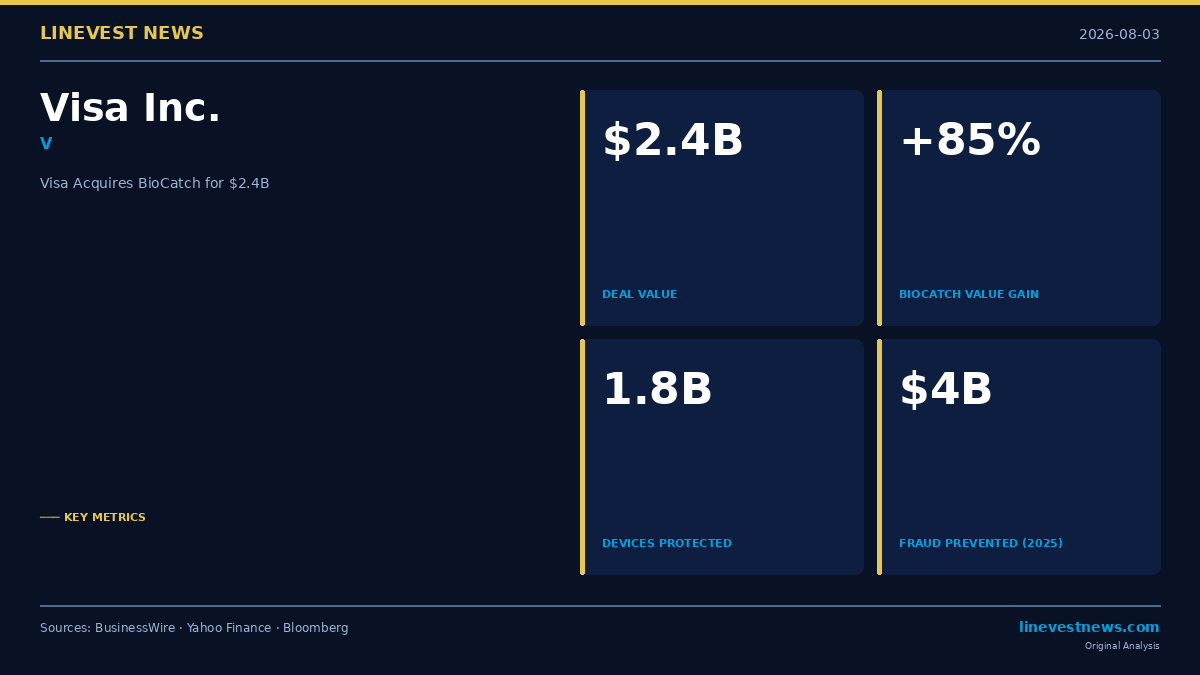
- Visa (NYSE: V) has agreed to acquire BioCatch, an AI-powered behavioral biometrics firm, for $2.4 billion in cash
- BioCatch's value surged ~85% from the $1.3 billion Permira buyout in September 2024
- BioCatch protects 1.8 billion devices and 760 million users across 350+ banks in 21 countries
- Deal expected to close by end of Visa's fiscal Q2 2027, pending regulatory approval
- Visa shares rose +1.9% in pre-market trading on the announcement
Part A — The Deal
Visa announced on August 3, 2026 that it has signed a definitive agreement to acquire BioCatch, an Israeli-headquartered company specializing in AI-driven behavioral intelligence for fraud detection. The all-cash transaction values BioCatch at $2.4 billion, with sellers including funds advised by private equity firm Permira and other shareholders.
The deal is subject to customary regulatory approvals and is targeted for completion no later than the final weeks of Visa's fiscal second quarter of 2027 (approximately January 2027).
What Is BioCatch?
Founded over a decade ago, BioCatch operates at the intersection of behavioral science and machine learning. Rather than relying solely on transaction data or static credentials, the firm analyzes more than 3,000 anonymized data points per session — including typing cadence, swipe patterns, device-holding angle, and touchscreen pressure — to distinguish legitimate users from fraudsters in real time.
| BioCatch Scale (as of 2026) | Metric |
|---|---|
| Devices protected | 1.8 billion |
| Users covered | 760 million |
| Banking clients | 350+ across 21 countries |
| Monthly sessions analyzed | 19 billion |
| Transactions analyzed (2025) | USD 17.2 trillion |
| Fraud prevented (2025) | USD 4 billion |
BioCatch's client base includes more than 100 of the world's largest financial institutions, giving the company entrenched relationships that would be difficult and expensive to replicate.
Pricing Context
Permira's Growth Opportunities fund acquired a majority stake in BioCatch in September 2024 at a $1.3 billion valuation. Visa's $2.4 billion acquisition price represents an approximately 85% increase in enterprise value in under two years — a premium that reflects both BioCatch's rapid revenue growth and the escalating strategic value of proprietary fraud-detection infrastructure.
Part B — Investment Analysis
Why Now? The AI Fraud Arms Race
The strategic timing of this acquisition is driven by an accelerating threat environment. According to Visa's own data, account takeovers and scams cost the global economy over $1 trillion annually — and generative AI is dramatically lowering the barrier to launching sophisticated fraud attacks.
Andrew Torre, Visa's President of Value-Added Services, stated: "AI is enabling these attacks at unprecedented scale." Traditional rule-based fraud detection — which flags transactions based on predefined patterns — is increasingly inadequate against AI-generated synthetic identities and deepfake-assisted social engineering.
Behavioral biometrics offers a structural advantage: because it monitors how a person interacts with a device rather than who they claim to be, it detects fraud even when an attacker has obtained legitimate credentials. BioCatch CEO Gadi Mazor noted: "For more than a decade, we've demonstrated behavior's unique ability to distinguish the criminal from the legitimate."
Competitive Strategic Logic
Visa faces mounting pressure from Mastercard, PayPal, and fintech challengers all investing heavily in fraud and security infrastructure. Several of these competitors have historically licensed BioCatch's technology.
By acquiring BioCatch outright rather than maintaining a partnership arrangement, Visa achieves a critical competitive advantage: exclusivity. Competitors who previously accessed BioCatch's platform may need to seek alternative solutions, widening Visa's proprietary moat.
This is particularly significant for real-time payment systems (such as FedNow and RTP in the United States), where transactions are irreversible and fraud windows are measured in milliseconds rather than hours. The shift toward real-time payments globally removes the post-authorization safety net that traditional payment rails provided, making upstream behavioral fraud detection no longer optional but essential.
Financial Framing: Acquisition Cost vs. Fraud Economics
At $2.4 billion, the deal represents:
| Financial Metric | Value |
|---|---|
| Visa market cap (Aug 3, 2026) | ~USD 683 billion |
| Deal as % of market cap | ~0.35% |
| BioCatch fraud prevented (2025) | USD 4 billion |
| Visa Q3 FY2026 revenue | USD 11.6 billion |
| Deal vs. one quarter of revenue | ~20.7% |
The $2.4 billion price tag, while material, represents less than 0.4% of Visa's total market capitalization — small enough to be digested without meaningful balance sheet stress, yet large enough to signal genuine strategic commitment.
Visa has invested $13 billion in technology and infrastructure over the past five years to combat fraud. The BioCatch acquisition is effectively the next phase of that investment strategy. Visa's recent 7% workforce reduction is reportedly freeing capital that the company is redeploying toward value-added services — of which BioCatch is the largest announced example.
Regulatory Risk
The acquisition faces standard antitrust review. BioCatch currently serves approximately 350 banks across 21 countries, which may draw scrutiny from regulators assessing market concentration in fraud-detection services — particularly in the EU. However, behavioral biometrics remains a fragmented, competitive market with multiple vendors (including NuData Security, which Mastercard acquired in 2017, and ThreatMetrix, acquired by LexisNexis in 2018), making outright blocking of the deal unlikely.
Visa has ample experience navigating regulatory processes; its attempted acquisition of Plaid was abandoned in 2021 under DOJ pressure, setting a precedent for careful regulatory assessment of fintech acquisitions. BioCatch operates in a narrower, more technically specialized niche than Plaid, which should reduce antitrust friction.
Investor Implications
The market's initial +1.9% pre-market reaction reflects approval of the strategic rationale without concern over excessive dilution. Key investor considerations going forward:
- Revenue contribution timeline: BioCatch's integration into Visa's Value-Added Services segment will take time. Material revenue contribution is unlikely before fiscal 2028.
- Margin profile: Behavioral biometrics is a software-as-a-service business with high gross margins, potentially accretive to Visa's already-strong margin profile once integration costs normalize.
- Cross-sell opportunity: With access to BioCatch's 350+ banking relationships, Visa gains direct touchpoints to expand other fraud and cyber products within these institutions.
- Competitive response: Expect Mastercard to accelerate its own behavioral analytics investments — NuData Security acquisition from 2017 may need refreshing given BioCatch's scale advantage.
This article is for informational purposes only and does not constitute investment advice. LineVest News is an independent financial news publication.
Sources
- Visa Investor Relations Press Release (BusinessWire, August 3, 2026)
- Yahoo Finance: "Visa beefs up cybersecurity offerings with $2.4 billion BioCatch deal"
- Bloomberg: "Visa (V) to Buy Fraud-Prevention Firm BioCatch for $2.4 Billion"
- CryptoBriefing: "Visa to acquire BioCatch for up to $2.4B in cash, doubling down on fraud prevention"
- Unite.AI: "Visa Acquires BioCatch to Spot Bank Fraud Before Payment"