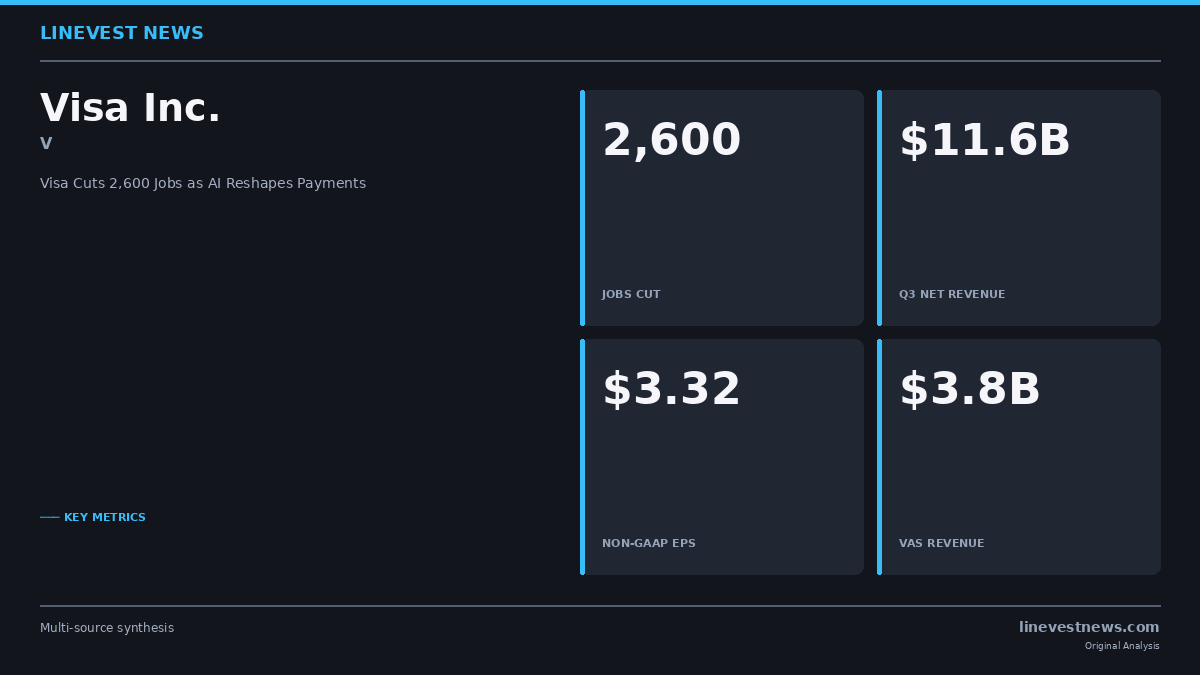
- Visa is eliminating 2,600 positions (7% of its ~34,100-person workforce), targeting technology and product teams — announced July 28, 2026 alongside a blowout Q3 earnings report.
- CEO Ryan McInerney cited AI acceleration as reshaping how work gets done; a $563 million GAAP severance charge was booked in Q3.
- Fiscal Q3 net revenue rose 14% to $11.6 billion; non-GAAP EPS of $3.32 beat the $3.22 Wall Street consensus by 3.1%.
- Value-Added Services — Visa's fastest-growing segment — surged 34% year-over-year to $3.8 billion, outpacing core payment volume growth of 10%.
- Wall Street consensus: Strong Buy across 41 analysts, average price target $401.
Visa's Dual Announcement: Record Volume, Workforce Reduction
When Visa Inc. (NYSE: V) reported fiscal Q3 2026 results on July 28, 2026, it delivered two simultaneous messages to Wall Street: the company's payments network processed more than $4 trillion in volume for the first time in a single quarter — and it was cutting roughly one in fourteen of its employees.
The workforce reduction of approximately 2,600 employees, equal to 7% of Visa's 34,100-person headcount, falls primarily on technology and product teams. Employees began receiving notifications on July 29, 2026. Visa booked a $563 million GAAP severance charge in Q3, which depressed headline GAAP earnings but did not appear in the non-GAAP figures investors typically use for comparisons.
CEO Ryan McInerney addressed the restructuring in both an internal memo and on the Q3 earnings call. His message to staff: "I have deep conviction that we are doing what is right for Visa, our clients and our partners as we continue to focus on driving efficiency across the company in order to reinvest in our highest potential opportunities." On AI's specific role, McInerney stated that artificial intelligence is "helping to accelerate this evolution and shape the way work gets done at Visa," while making clear that AI was not the sole driver of the decision.
Q3 FY2026 Financial Results
| Metric | Q3 FY2026 | YoY Change |
|---|---|---|
| Net Revenue | $11.6B | +14% |
| Non-GAAP EPS | $3.32 | +11% (beat $3.22 consensus) |
| Payments Volume | +10% constant currency | First quarter above $4T total |
| Cross-Border Volume | +13% | +12% ex-intra-Europe |
| Processed Transactions | 71.7 billion | +10% |
| Value-Added Services | $3.8B | +34% |
The Q3 results represented across-the-board beats. Visa revised its full-year FY2026 guidance: revenue growth is now expected at the "low end of low teens," and EPS growth at the "low end of mid-teens" — a slight tightening from prior ranges but a signal that management views the restructuring cost as finite and manageable.
What the Layoffs Signal to Investors
AI Is Automating Payments Infrastructure Engineering
Visa's technology organization is responsible for maintaining the global VisaNet authorization and clearing network — a real-time system processing thousands of transactions per second in more than 200 countries. Historically, this required large teams to monitor, maintain, and iteratively update the network.
AI-driven tooling now handles significant portions of network monitoring, anomaly detection, routine code review, and fraud model iteration. When these functions no longer require the same headcount, companies like Visa face a structural choice: retain the redundant staff, reduce costs and reinvest, or a hybrid. Visa chose to reduce.
This follows a recognizable pattern across fintech and financial services in 2026: - Mastercard reduced its workforce by approximately 4%, citing similar efficiency goals. - Block (NYSE: SQ), Jack Dorsey's payments-and-banking conglomerate, cut roughly 50% of its headcount as part of a focus-first restructuring. - PayPal (NASDAQ: PYPL) also announced material workforce reductions as it repositioned under new CEO Enrique Lores.
In each case, the narrative centers on reallocating human capital from operational maintenance toward product innovation, sales, and high-margin services — while ceding the maintenance workload to AI.
The Real Story: Value-Added Services at 34% Growth
For investors, the layoffs are less significant than what replaces the cut positions. Visa's management has been consistent in directing savings toward three reinvestment buckets:
1. Value-Added Services (VAS): At $3.8 billion and growing 34% year-over-year in Q3, VAS is rapidly becoming Visa's core growth engine — not just a supplement to transaction volume. VAS includes data analytics and licensing, risk and fraud tools sold to banks and merchants, tokenization infrastructure, and a suite of B2B solutions. The margin profile on VAS is high: unlike core payment volume, where Visa pays out substantial client incentives, VAS products are sold as software-like subscriptions and per-use fees with fewer offsets.
2. Cross-Border and Commercial Payments: Visa Direct — which enables real-time push payments to bank accounts, cards, and digital wallets in 195 countries — and Visa B2B Connect are growing volumes rapidly. Cross-border transactions typically carry higher interchange rates than domestic swipes, making them disproportionately valuable to Visa's revenue.
3. Stablecoin Settlement Infrastructure: In a move that has received less mainstream coverage, Visa has been quietly expanding its settlement capability to operate across blockchain networks. The company now supports settlement in Circle's USD Coin (USDC) and has extended its stablecoin pilot to five additional blockchain ecosystems. As institutional and retail stablecoin adoption grows — accelerated by the recent U.S. Genius Act framework — Visa is positioning its clearing infrastructure as the settlement layer for regulated digital dollars.
FIFA World Cup 2026: Cross-Border Tailwind Not Over
The 2026 FIFA World Cup, co-hosted across the United States, Canada, and Mexico through mid-August, has already shown up in Visa's cross-border transaction data. Management highlighted elevated international spending during the group stage and early knockout rounds. The tournament's later stages extend through mid-July, meaning Visa's fiscal Q4 (which ends October 31) will capture a full quarter of World Cup-related cross-border activity — including the high-spend demographic of international visitors traveling to U.S. host cities.
Analyst Consensus and Valuation
At a forward price-to-earnings ratio of approximately 27.9x, Visa trades at a meaningful premium to the broader financial sector (average ~15x). The premium reflects Visa's asset-light business model: the company collects fees on transaction volume without taking credit risk, requires minimal capital expenditure to expand its network, and generates gross margins on incremental volume that approach 100%.
Forty-one analysts polled by S&P Global rate V:
| Rating | Count |
|---|---|
| Strong Buy | 33 |
| Moderate Buy | 4 |
| Hold | 3 |
| Sell | 0 |
Consensus average price target: $401.16 — approximately 8% above the stock's level around $371 as of early August 2026.
Selected firm targets:
| Firm | Price Target |
|---|---|
| Morgan Stanley | $415 |
| Robert W. Baird | $412 |
| UBS | $410 |
| Oppenheimer | $403 |
Key Risks Investors Should Monitor
Interchange fee regulatory pressure. U.S. merchants have long sought lower interchange rates through legislation. Any revival of Durbin Amendment-style regulation or new congressional action on credit interchange fees would compress a key revenue component. The political environment in Washington in the second half of 2026 should be watched.
Q4 transition costs. While the $563 million severance charge was recorded in Q3, integration costs, knowledge transfer, and productivity dips during the transition period may create noise in Q4 non-GAAP results. Investors should strip out one-time items when evaluating Q4.
AI talent retention paradox. Cutting 7% of tech staff while betting on AI creates a risk: if remaining engineers feel less secure, voluntary attrition among top performers could accelerate, exactly when Visa needs AI-native talent to build the next generation of its network. McInerney's messaging will need to continue reassuring the engineering organization.
Fintech disintermediation. Stripe's embedded payments infrastructure, Block's Cash App rails, and FedNow instant payments continue to route select transaction flows outside the Visa/Mastercard duopoly. Stablecoin adoption at scale — while a long-term opportunity — could also create new competitive entrants in international money movement.
The Bottom Line
Visa's 2,600-person workforce reduction is not a distress signal — it is an AI-era efficiency play that frees capital for reinvestment in structurally higher-margin businesses. Q3 results came in ahead of expectations on every key metric, and full-year guidance was maintained despite the restructuring charge.
For investors, the 34% growth in Value-Added Services is the most important data point to track in subsequent quarters. If VAS sustains above 20% growth as the revenue base expands, the market may re-rate Visa's multiple upward — making the current ~$371 price look attractive relative to the $401 average analyst target.
Watch points for Q4 FY2026 (report in October 2026): (1) whether VAS growth holds above 20%; (2) stablecoin settlement volume disclosures; (3) cross-border activity from World Cup final stages; and (4) any language on the pace and completion of the restructuring.
Disclosure: This article is for informational purposes only and does not constitute investment advice or a recommendation to buy or sell any security. Investors should conduct their own due diligence.
Sources: - Visa is cutting 7% of employees in efficiency push as AI reshapes work — CNBC, July 28, 2026 - Visa layoffs 2026: company cutting 7% of workforce — Yahoo Finance / Quartz, July 28, 2026 - Visa Stock Looks Attractive After Layoffs, Strong Earnings — Yahoo Finance, August 1, 2026 - Visa Cuts 2,600 Tech Jobs as AI Automates Payments Network Engineering — TechTimes, July 28, 2026 - Visa cuts 2,600 jobs as AI reshapes how work gets done — HR Executive, July 28, 2026 - V Stock Layoffs: What to Know About the Latest Visa Job Cuts — Barchart, 2026