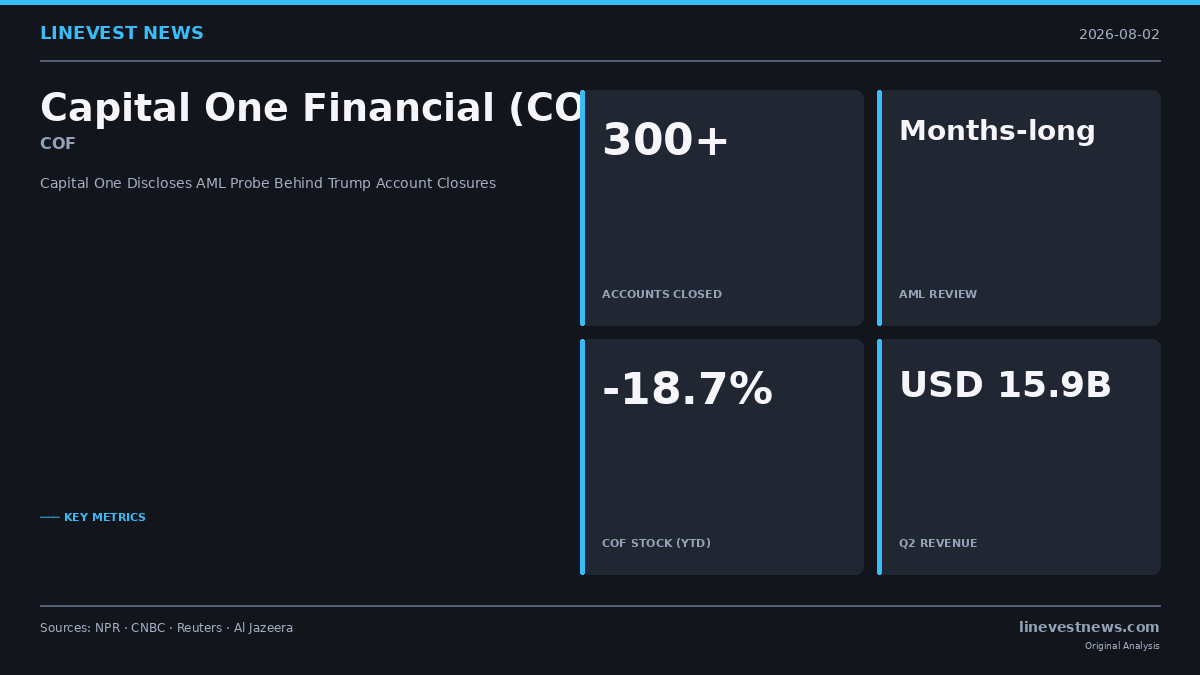
Capital One Financial Corp. (NYSE: COF) disclosed in an August 1, 2026 court filing that it closed more than 300 bank accounts linked to the Trump Organization in mid-2021 following a formal anti-money laundering review — marking the first time a major U.S. bank has formally attributed Trump-affiliated account closures to AML compliance processes. The disclosure intensifies scrutiny on how U.S. banks balance regulatory obligations with an administration that has made financial "debanking" a political priority.
TL;DR - Capital One closed 300+ Trump Organization accounts in mid-2021 after an internal AML review; formal disclosure came August 1, 2026 in court filings - The bank did not accuse the Trump Organization of illegal money laundering — AML flagging reflects regulatory process, not criminal findings - Lawsuit (25-cv-21596, S.D. Fla.) alleges politically motivated debanking; Capital One denies political motivation - Trump's August 2025 executive order on debanking creates dual regulatory-legal risk for COF - COF stock: ~USD 201.53 (-18.7% YTD) despite Q2 revenue of USD 15.9B (+27% YoY) and Discover integration gains
Part A: What the Court Filing Reveals
The Account Closures
Capital One notified the Trump Organization in March 2021 — weeks after the January 6 Capitol riot — that it would close more than 300 accounts belonging to Trump-affiliated entities: the Trump Organization itself, Eric Trump, and associated businesses including a winery, a bottled-water company, and a golf course developer. The accounts had been maintained by Capital One for over a decade.
In its August 1, 2026 court submission, Capital One stated the closures followed "months of analysis and a careful review by the bank's financial-crimes team in accordance with bank policies and regulatory guidance." Professionals with "decades of law enforcement experience" conducted the review. The bank cited "transaction patterns that are among the types of activity flagged by federal banking guidance" — stopping well short of alleging criminal conduct by the Trump Organization.
Capital One emphasized it retained contractual rights to close accounts "at any time, for any or no reason," and had kept its AML rationale confidential until compelled to disclose it in litigation.
The Lawsuit
The Donald J. Trump Revocable Trust and Eric Trump filed suit in March 2025 in Florida state court, later removed to U.S. District Court for the Southern District of Florida (Case 25-cv-21596). The plaintiffs allege Capital One engaged in politically motivated "debanking" — cutting ties with Trump businesses in the wake of January 6, then inventing an AML rationale as legal cover. Key sections of the amended complaint remain sealed. Specific damages sought have not been publicly disclosed. A parallel debanking lawsuit against JPMorgan Chase involving similar allegations is ongoing.
Part B: What This Means for COF Investors
The Dual-Risk Framework
Capital One finds itself in an unusual regulatory-legal bind that has few precedents in modern U.S. banking.
On one side, the Bank Secrecy Act and FinCEN anti-money laundering rules require financial institutions to monitor accounts for suspicious activity, file Suspicious Activity Reports (SARs), and — where necessary — exit relationships that pose unacceptable compliance risk. Banks that fail to do so face civil and criminal penalties. Capital One's decision to close the Trump accounts, if genuinely compliance-driven, was legally required.
On the other side, President Trump signed an executive order in August 2025 directing federal banking regulators — including the OCC and CFPB — to review financial institutions' debanking practices and address what conservatives characterize as politically motivated account closures targeting right-leaning businesses and individuals. This EO effectively puts banks under government scrutiny for the very AML-driven account exits that regulators separately mandate.
Capital One's explicit AML disclosure in its August 1 filing reads, in part, as a preemptive defense against that regulatory review: by formally placing the closures within the AML compliance framework, the bank attempts to demonstrate that the decision was regulatory process, not political preference.
For investors, the result is a litigation-regulatory sandwich:
| Risk Layer | Source | Potential Impact |
|---|---|---|
| Lawsuit liability | Trump Org/Eric Trump complaint | Damages unspecified; settlement or judgment possible |
| Regulatory examination | Trump Aug 2025 EO → OCC/CFPB review | Supervisory scrutiny; potential consent order risk |
| AML precedent | Public disclosure of compliance rationale | Could embolden future litigation by other debanked clients |
| Operational risk | Banks reluctant to exit problematic accounts | Long-term weakening of AML enforcement culture |
COF's Financial Snapshot
The AML disclosure arrives against a backdrop of COF significantly underperforming the market despite solid fundamentals. COF trades at approximately USD 201.53, down 18.7% year-to-date, against an analyst consensus price target of roughly USD 259.82 — implying approximately 29% potential upside that the market has declined to award the stock.
Q2 2026 results were operationally strong. Capital One reported:
| Metric | Q2 2026 |
|---|---|
| Total Net Revenue | USD 15.9B (+27% YoY) |
| Net Income | USD 3.0B |
| Diluted EPS (GAAP) | USD 4.73 |
| Adjusted EPS | USD 5.81 |
| Net Interest Margin | 8.01% |
| CET1 Ratio | 13.7% |
The Discover Financial acquisition — completed roughly 14 months ago — is gaining traction. Credit Card revenue rose 29% year-over-year as Capital One migrates card volume from Visa and Mastercard networks onto the Discover payment network. Management is targeting approximately USD 2.5 billion in total synergies. The combined entity now commands approximately 24% of U.S. credit card revenue, making it the nation's largest credit card issuer by that measure.
Yet the stock's -18.7% YTD trajectory reflects several overhangs: credit delinquency trends in the Discover card portfolio, integration execution risk, and — now — the uncertainty introduced by the Trump Organization lawsuit.
Investor Watch Points
1. Lawsuit trajectory. The case (25-cv-21596) is in the discovery phase. A settlement or adverse judgment — damages unquantified in public filings — could crystallize legal costs. More significantly, any ruling that constrains banks' AML-based account exits would carry systemic risk across the sector.
2. EO regulatory response. Whether the OCC or CFPB initiates a formal supervisory review of Capital One's debanking practices under the August 2025 executive order will be a key signal. A consent order or formal MOU would represent incremental compliance cost and reputational damage.
3. Discover integration milestones. Q3 2026 results (expected October 2026) will mark the 15-month point of the Discover integration. Management's synergy realization pace — and the credit quality trajectory of the acquired Discover card portfolio — will determine whether the YTD stock discount narrows.
4. Broader banking sector read-across. The Trump Organization's parallel suit against JPMorgan Chase, combined with the Capital One disclosure, suggests the debanking litigation wave is broadening. Banks with significant AML-driven account-exit activity — including BAC, WFC, and GS — may face similar discovery demands.
This article is journalistic reporting based on publicly available court filings and financial disclosures. It does not constitute investment advice. Capital One has not been found to have engaged in any wrongdoing; the Trump Organization's allegations are contested claims.
Sources: NPR · CNBC · Al Jazeera · Reuters/TradingView · Yahoo Finance · BigGo Finance · NBC News