TL;DR
- Bloomberg and FT report AstraZeneca explored acquiring Bristol-Myers Squibb in preliminary talks, citing unidentified sources
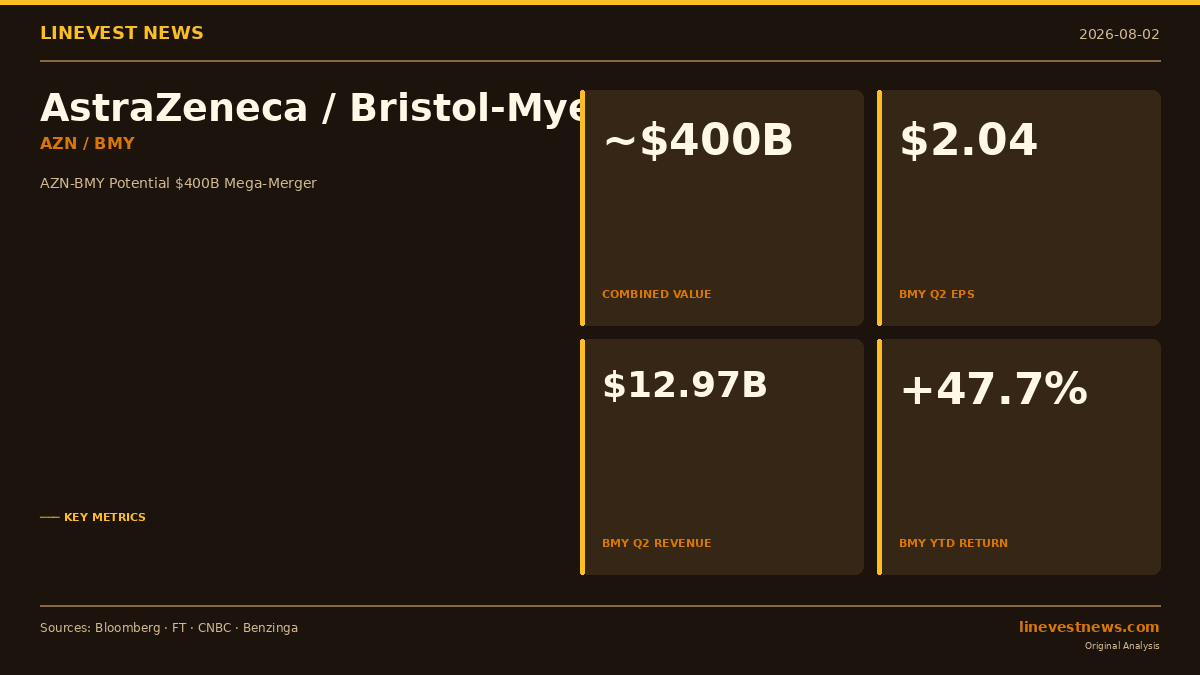
- Combined entity would be valued at roughly $400 billion — potential largest pharma deal ever
- BMY Q2 2026 beat on both EPS ($2.04 vs $1.61 est.) and revenue ($12.97B vs $11.71B est.), YTD +47.7%
- Three-jurisdiction antitrust review required: FTC + UK CMA + EU Commission
- Korean CDMO Samsung Biologics (207940.KS), an existing AZN manufacturing partner, could see pipeline expansion
Part A — The Report
AstraZeneca plc (NYSE: AZN) has explored a potential acquisition of Bristol-Myers Squibb Co. (NYSE: BMY), Bloomberg and the Financial Times reported on August 2, 2026, citing people familiar with the matter. The discussions were described as preliminary, and a deal could still be delayed or collapse entirely.
Neither company has publicly confirmed the talks. A completed transaction would combine the two companies into a pharmaceutical group valued at roughly $400 billion — potentially the largest pharmaceutical merger in history, surpassing the 2000 Pfizer-Warner-Lambert deal ($90B) and the 2009 Pfizer-Wyeth transaction ($68B) by a wide margin. AstraZeneca's previous largest deal was the $39 billion acquisition of Alexion Pharmaceuticals in 2021.
Deal Structure and Timeline
The merger structure has not been determined, but sources indicate it would likely involve a combination of cash and shares, given the scale of the transaction. Bloomberg reported the talks have been ongoing for several months. The companies' Q4 2026 earnings calls — BMY on October 29 and AZN on October 30 — could precede any deal announcement, though the timeline remains uncertain.
Financial Snapshot
| Metric | AstraZeneca (AZN) | Bristol-Myers Squibb (BMY) |
|---|---|---|
| Market Cap | ~$264B | ~$142B |
| Q2 2026 Revenue | $15.38B (slight miss vs $15.45B est.) | $12.97B (beat $11.71B est.) |
| Q2 2026 EPS | $2.63 (beat $2.48 est.) | $2.04 (beat $1.61 est., +26.7%) |
| YTD Stock Return | ~–20% from 52-wk high $212.71; close $169.64 | +47.7%; close $65.31 (near 52-wk high $65.66) |
| Oncology Revenue Share | ~44% of product revenue | Opdivo, Revlimid (major brands) |
Strategic Rationale
For AstraZeneca, a deal would provide immediate scale in the U.S. market, where BMY has deep commercial infrastructure across oncology and immunology. AZN's oncology portfolio — Tagrisso, Lynparza, Calquence, Imfinzi — would merge with BMY's Opdivo (nivolumab) and the immunology blockbuster Orencia, potentially creating one of the world's deepest oncology pipelines. AZN and BMY both reported collaboration on a drug discovery AI initiative involving Anthropic, a further signal of the alignment between the two companies' research cultures.
For BMY, a merger would provide resources to navigate a challenging mid-decade period. Revenue from Revlimid (lenalidomide), BMY's top-selling multiple myeloma drug, has faced generic competition since 2022, and BMY's R&D spending fell roughly 11% to approximately $10 billion in 2025 as management sought to preserve cash. An AZN combination would inject both capital and pipeline depth.
Antitrust Hurdles
Regulatory complexity would be formidable. Any transaction would require simultaneous review by three major competition authorities:
- U.S. Federal Trade Commission (FTC) — which has shown greater scrutiny of large pharma combinations under recent administrations
- UK Competition and Markets Authority (CMA) — AstraZeneca is a UK-incorporated company headquartered in Cambridge
- European Commission (EC) — both companies have significant EU commercial operations
The overlap in oncology is the primary concern. Both AZN (Imfinzi, Tagrisso) and BMY (Opdivo, Breyanzi) compete across multiple tumor types, and regulators would likely require divestitures in specific indications before approving a combination.
Part B — Market and Investor Analysis
BMY Stock Approaching 52-Week High
BMY shares closed at $65.31 on August 2, near their 52-week high of $65.66, on above-average volume of 14.58 million shares — a typical signal of event-driven positioning ahead of a potential announcement. The stock's 47.7% YTD gain already reflects significant rerating from BMY's lows during the Revlimid patent-cliff period.
AZN closed at $169.64, down $1.70 on the day, and remains more than $40 below its 52-week high of $212.71. AZN weakness reflects in part the premium it would need to pay: at BMY's current market cap of ~$142 billion, a customary 25–35% control premium would imply a deal price of $177–192 billion — a historically large outlay.
Would This Create a New #1 in Oncology?
Based on 2025 reported oncology revenue, Roche currently leads global cancer drug sales, followed by Johnson and Johnson and Merck. An AZN-BMY combination — combining AZN's targeted therapy franchise with BMY's immuno-oncology portfolio — would challenge for a top-two position globally in cancer drug revenue. The combined entity would likely surpass AbbVie (currently ranked in the top five after its Humira franchise decline) in total pharma market cap.
Korean CDMO Angle: Samsung Biologics (207940.KS)
For Korean investors, the most immediate read-through is Samsung Biologics. AstraZeneca is an established client of Samsung Biologics, using its Incheon manufacturing facilities for biologics production under long-term contract manufacturing agreements. A combined AZN-BMY entity would have an expanded pipeline requiring more biologics manufacturing capacity — a dynamic that could lead to new or enlarged contracts with Samsung Biologics.
Samsung Biologics currently operates four plants in Songdo, Incheon, with a fifth under construction, giving it over 780,000 liters of total bioreactor capacity — the largest single-site capacity in the world. The company has guided for continued revenue growth as its plant expansions come online through 2027. An AZN-BMY merger would, if completed, represent a demand tailwind for CDMOs generally and Samsung Biologics specifically.
Celltrion (068270.KS) and Samsung Bioepis (a Samsung Biologics subsidiary) also compete in biologic manufacturing and biosimilar development in therapeutic areas overlapping with BMY's portfolio — the merger could reshape competitive dynamics in those markets as well.
Risks to the Thesis
- Deal collapse risk: Bloomberg noted discussions may be delayed or collapse. The FT described the talks as "preliminary." Investors should price in significant deal uncertainty.
- AZN balance sheet strain: AZN carries significant leverage from the Alexion deal. A $140–200 billion acquisition would require either substantial debt issuance or a large share component that dilutes AZN holders.
- Regulatory timeline: Three-jurisdiction review typically takes 12–18 months minimum; antitrust conditions (divestitures) could materially affect the combined entity's value.
- BMY pipeline execution: BMY's mid-2020s strategy depends on newer assets (Reblozyl, Camzyos, Opdualag) scaling fast enough to offset Revlimid losses. If those assets underperform pre-close, deal economics shift unfavorably.
Comparable Transactions
| Deal | Year | Value |
|---|---|---|
| AbbVie / Allergan | 2020 | $63B |
| AZN / Alexion | 2021 | $39B |
| Pfizer / Seagen | 2023 | $43B |
| AZN / BMY (reported) | TBD | ~$140–200B (control premium over current BMY market cap) |
This article is based on unconfirmed media reports and does not constitute investment advice. Neither AstraZeneca nor Bristol-Myers Squibb has confirmed the discussions. All deal figures are estimates based on current market capitalizations and standard precedent transaction premia.
Sources
- Bloomberg: "AstraZeneca Is Said to Have Explored Bristol Myers Mega-Merger" (August 2, 2026)
- Financial Times: AZN-BMY preliminary merger discussions (August 2, 2026)
- CNBC: "AstraZeneca, Bristol Myers Squibb mull $400 billion deal" (August 2, 2026)
- Benzinga: "AstraZeneca, Bristol Myers Squibb Reportedly in Talks for $400 Billion Merger" (August 2, 2026)
- Investing.com: "AstraZeneca and Bristol-Myers Squibb in talks over potential merger" (August 2, 2026)