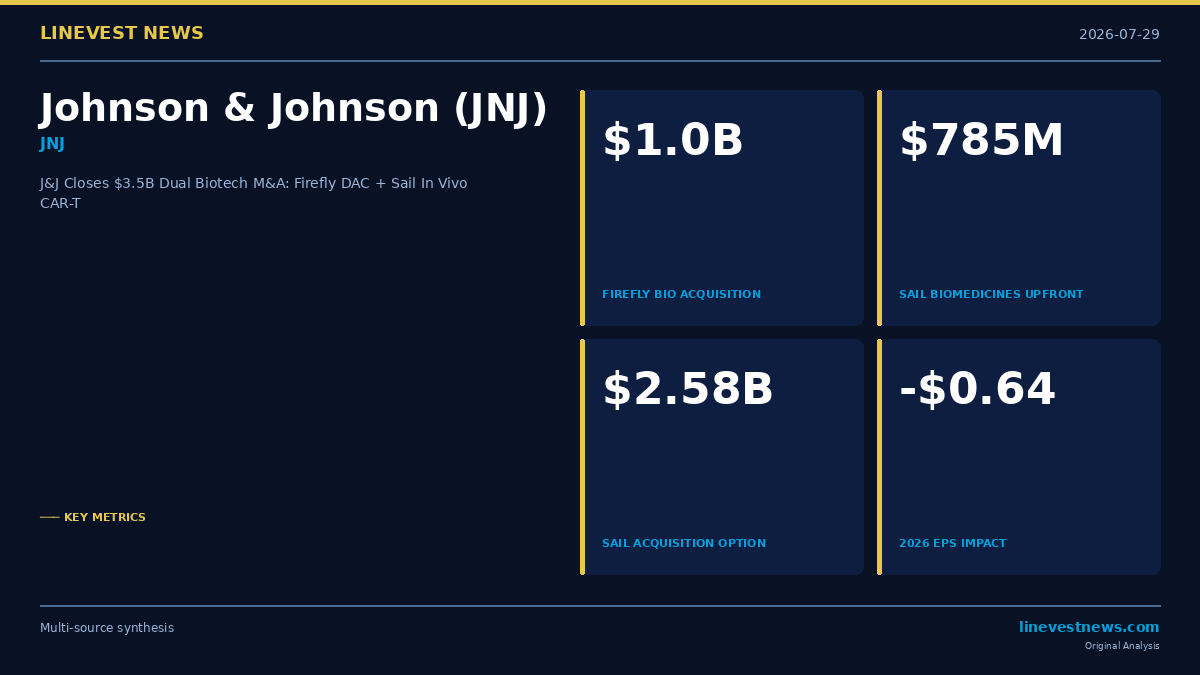
Johnson & Johnson (NYSE: JNJ) closed two biotech acquisitions on July 29, 2026 that together represent up to $3.5 billion in new pipeline investment — a dual bet on next-generation oncology and in vivo immunology that cuts the company's 2026 adjusted EPS guidance by approximately $0.64.
TL;DR - J&J completed the $1 billion cash acquisition of Firefly Bio, adding the Firelink™ degrader antibody conjugate (DAC) platform for KRAS-driven solid tumors - J&J simultaneously entered a $785 million collaboration with Sail Biomedicines and secured an exclusive option to acquire the company for an additional $2.58 billion - Combined 2026 adjusted EPS reduction: ~$0.64 ($0.46 Firefly + $0.18 Sail), partially offsetting J&J's Q2-raised guidance of $11.68 - JNJ shares fell 3.63% to $255.88 on July 30 as investors priced in the near-term earnings dilution
Part A: The Deals
Firefly Bio — $1 Billion Into KRAS Oncology
The Firefly Bio acquisition brings J&J the Firelink™ DAC (Degrader Antibody Conjugate) platform, a technology designed to deliver highly selective protein degraders directly to cancer cells while sparing healthy tissue.
The target: KRAS-driven solid tumors — one of oncology's most persistent challenges. KRAS mutations are present in approximately 25% of all human cancers, including non-small-cell lung cancer (~33%), pancreatic adenocarcinoma (~90%), and colorectal cancer (~40%). Existing KRAS inhibitors have made incremental progress, but protein degrader payloads — delivered via the DAC format — represent a distinct mechanism that J&J believes can address tumors where current therapies fail.
"By bringing together Firefly Bio's differentiated technology with our deep expertise in oncology and antibody engineering, we are well positioned to accelerate the development of more precise and effective therapies." — John Reed, M.D., Ph.D., EVP Innovative Medicine R&D, J&J
Financial impact: The acquisition triggers approximately $1 billion in in-process R&D charge in Q3 2026 and reduces 2026 adjusted EPS by approximately $0.46, with a smaller $0.08 impact in 2027.
Sail Biomedicines — In Vivo CAR-T for Autoimmune Disease
On the same day, J&J entered a strategic collaboration with Sail Biomedicines, a private company developing in vivo CAR-T therapies — an approach that reprograms a patient's immune cells inside the body rather than extracting, engineering, and reinfusing them (the conventional ex vivo approach).
Deal structure:
| Component | Amount |
|---|---|
| Upfront equity investment | $465 million |
| Development milestones (upfront) | $320 million |
| Total initial payment | $785 million |
| Exclusive acquisition option | $2.58 billion |
| Maximum potential consideration | ~$3.37 billion |
Focus: autoimmune and immune-mediated diseases where conventional CAR-T has been limited by manufacturing complexity and cost. In vivo delivery directly addresses those barriers.
Financial impact: The Sail collaboration reduces 2026 adjusted EPS by approximately $0.18. If J&J exercises the acquisition option, additional 2027 adjusted EPS dilution of approximately $1.28 would follow.
Part B: Investor Analysis
Why Both Deals Now?
J&J's timing is deliberate. On July 16, the company reported Q2 2026 revenue of $25.3 billion (+6.6% YoY) and raised full-year 2026 adjusted EPS guidance to $11.68 — placing it on course for more than $101 billion in annual sales for the first time in its 140-year history.
That financial firepower enabled J&J to absorb the dual pipeline investment without derailing its growth narrative. Even after the $0.64 EPS headwind from Firefly and Sail, J&J's 2026 earnings growth trajectory remains intact relative to 2025 levels.
The KRAS Opportunity
KRAS inhibitors have been among pharma's most-sought breakthroughs for three decades. Amgen's sotorasib (Lumakras) and Mirati's adagrasib (Krazati) opened the door for direct KRAS targeting, but each operates on specific mutation subtypes (G12C) with limited durability.
The DAC format — essentially an antibody-drug conjugate that delivers a degrader (PROTAC-like) payload instead of a cytotoxin — offers a potentially broader approach:
- Can target KRAS protein regardless of specific mutation
- Protein degradation (not just inhibition) may reduce drug resistance
- Antibody scaffold enables tumor-selective delivery
J&J already has a large oncology footprint through Darzalex (daratumumab, multiple myeloma, >$10B in annual sales) and Rybrevant. Adding a KRAS-targeted DAC platform expands its addressable solid tumor space materially.
In Vivo CAR-T: The Manufacturing Disruption
Traditional ex vivo CAR-T therapy (Novartis's Kymriah, Kite's Yescarta) requires a weeks-long, patient-specific manufacturing process that costs $400,000–$700,000 per treatment. That model works for rare hematologic malignancies but is impractical for widespread autoimmune indications.
In vivo CAR-T sidesteps the manufacturing bottleneck entirely. Engineered genetic vectors are infused directly, reprogramming T cells inside the patient. If safety profiles hold:
- Cost per treatment could be 70–90% lower
- Autoimmune indications (lupus, multiple sclerosis, inflammatory bowel disease) become commercially viable
- Manufacturing capacity constraints disappear
The global in vivo CAR-T therapy market is projected to reach $861 million in 2026, expanding to approximately $10.8 billion by 2035 at a 32.5% CAGR (Precedence Research), driven by J&J's own landmark CAR-T work in immunology and the broader pipeline from Capstan Therapeutics (Pfizer-backed) and Interius BioTherapeutics.
J&J's move to acquire equity and secure an option — rather than outright purchase — preserves capital while locking out competitors from Sail's platform.
Risks and Watch Points
Near-term: - $1 billion IPR&D charge weighs on Q3 2026 GAAP earnings - Stock declined 3.63% as the market discounted immediate EPS dilution versus uncertain pipeline timelines (typically 5–8 years from DAC/in vivo CAR-T platform to marketed product)
Pipeline: - KRAS DAC: No published clinical data from Firelink yet; pre-clinical-stage acquisition - Sail in vivo CAR-T: Early clinical stage; no pivotal readouts expected near-term
Competitive: - Gilead/Kite, BMS/Celgene, and Novartis are all expanding into in vivo gene-modified cell therapies - Vertex Pharmaceuticals and AstraZeneca are advancing PROTAC-adjacent approaches in oncology
Balance sheet: - J&J held approximately $19 billion in cash and equivalents as of Q2 2026, providing capacity for both transactions without requiring debt financing
What Investors Should Track
- Q3 2026 earnings (October): IPR&D charge from Firefly will appear as a $1B one-time hit — watch for management commentary on Firelink IND (Investigational New Drug) filing timeline
- Sail option exercise decision: The $2.58B option likely contains clinical milestone triggers; early data from Sail's in vivo vector delivery could set the timeline
- Updated guidance: J&J's effective 2026 adjusted EPS is now approximately $11.04 after the $0.64 combined reduction from the pre-deal raised guidance of $11.68
Johnson & Johnson is not an investment advisory client of LineVest. This article is journalistic reporting and does not constitute investment advice.
Sources: - J&J Investor Relations: Firefly Bio Acquisition Completion - BusinessWire: J&J Completes Firefly Bio Acquisition - MedCity News: J&J Joins Immune Reset Race — Sail Bio $785M Deal - Bloomberg: J&J Gains Option to Buy Sail Biomedicines for $2.6 Billion - StockTitan: J&J Q2 2026 Results — Sales $25.3B, Outlook Raised - Benzinga: J&J Advances Cancer and Immunology Treatments