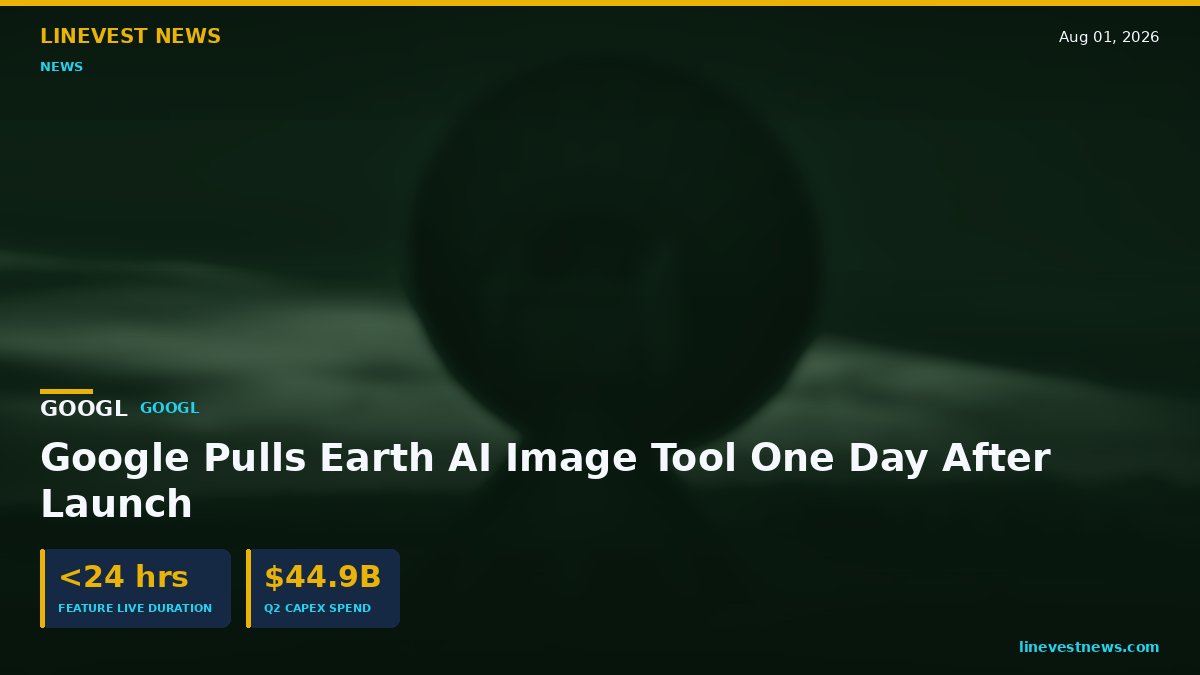
Alphabet (NASDAQ: GOOGL) shipped a generative image tool into Google Earth on July 30 and withdrew it the next day, after researchers used it to paste fabricated bomb craters and nuclear facilities onto real satellite maps.
The feature was announced by Bryan Horowitz, a product manager on Google Earth, in a post on Google's own blog dated July 30. Users of Google Earth on the web could "zoom in to a place in Google Earth on web, tap 'create image,' and type whatever you want to see," with the Nano Banana image model rendering a photorealistic scene grounded in Google's satellite, aerial and 3D imagery of that exact location. The post says image generation was "available globally today for Google Earth web users." Paul Monckton, writing in Forbes on July 30, noted the tool was web-only at launch, with daily caps on generations and roughly two minutes per image — while the Google Earth mobile app, which he put at over 100 million Play Store downloads, did not get it.
An update appended to that same launch post, dated July 31, reverses the launch: "we're rolling back this feature in Google Earth while we work on implementing stronger guardrails." Google's fuller statement, quoted by TechCrunch on July 31, reads: "We've seen geospatial professionals using this feature for a range of useful purposes, however we've also seen people sharing screenshots of generated imagery that appear to violate our policies." Business Insider reported the same day that the pull came "within 24 hours of its launch, after users created deepfakes depicting disasters." Engadget's account adds that 404 Media demonstrated the tool producing fictional blast craters and protest scenes.
Financial context: $1.3 billion of revenue a day
The direct financial impact is not measurable. Alphabet does not break out Google Earth revenue, and the tool was live for about one day. For scale: Alphabet reported consolidated revenues of $119,796 million for the quarter ended June 30, 2026, per its July 22 earnings release — roughly $1.3 billion of revenue per day across the 91-day quarter. Nothing about a one-day web feature moves that.
The same release shows where the real constraint sits. Purchases of property and equipment reached $44,924 million in the quarter — exactly double the $22,446 million of a year earlier, and equal to 37.5 percent of the quarter's $119,796 million in revenue. On that spending base, capital is unlikely to be what limits Alphabet's AI rollout. What the Earth episode tests is launch governance — whether safety review keeps pace with a shipping cadence funded at that rate.
The watermark claim was contested within hours
Google's defense was provenance. The July 31 update to the launch post states generated images "didn't appear in the main Google Earth experience for others to see and were watermarked as AI generated." Matt Korda, associate director for the Nuclear Information Project at the Federation of American Scientists (a Washington think tank focused on nuclear and security policy), quoted Google's fuller claim in a July 31 analysis: "every image created with Nano Banana in Google Earth includes the SynthID digital watermark, so if someone is unsure about an image, they can ask the Gemini app or use Lens in Search to see if the image was AI-generated." Korda writes that researchers — he credits an account belonging to Talha Gin — quickly disproved that in practice. Korda himself generated a fake Russian ICBM silo next to a real one; he cites tech researcher Henk Van Ess on the structural problem: "the fake is made inside the thing people use to check whether pictures are true."
Korda's summary of the stake: "If we accept that any satellite image could be a deepfake, one of the best tools that analysts have used for decades to challenge government narratives or inform the public will be severely degraded."
The regulatory clock: August 2, with a carve-out
The timing is the part with legal teeth. Article 50 of the EU AI Act "applies as from 2 August 2026," per the European Commission's own guidance page, and requires providers to "ensure that AI-generated or manipulated content are marked in a machine-readable format and detectable as artificially generated or manipulated." Deployers of deepfakes must "disclose deepfake content to a natural person upon first exposure at the latest." The Commission puts fines at "up to 15 million euros or 3% of total worldwide turnover for the preceding financial year" — €15 million is about $17.2 million at the ECB euro reference rate of 1.1485 dollars per euro on July 31, 2026, though for a company of Alphabet's revenue base the turnover-linked ceiling is the binding one.
One carve-out matters here, and it blunts the August 2 date. Sidley Austin lawyers Francesca Blythe and Eleanor Dodding wrote on June 24 that under the EU Digital Omnibus agreement of May 7, 2026, the content-marking obligation is delayed to December 2, 2026 for systems already placed on the market before August 2. A tool launched July 30 and withdrawn July 31 sits awkwardly against that line — and Google's rollback statement, as published, gives no date for its return.
Precedent: February 2024
The closest comparison is Gemini's image generator. Google suspended its ability to generate images of people on February 22, 2024, after it produced historically inaccurate depictions. Fox Business reported on February 28, 2024 that Alphabet shares fell 5.3% over that stretch and market capitalization dropped from $1.798 trillion to $1.702 trillion — a decline of roughly $96 billion, though that move spans a period in which broader market factors were also at work — with CEO Sundar Pichai calling the outputs "completely unacceptable" in a note to employees.
The contrast is instructive in both directions. That 2024 suspension followed days of escalating coverage; this one took under 24 hours, which suggests a faster internal trip-wire. But the underlying sequence — ship globally, discover the abuse case in public, withdraw — repeated in a product whose value rests on being taken as a reliable view of the world.
Korean-market context: Alphabet as a holding for overseas investors
Alphabet is among the most widely held US technology stocks by Korean retail investors — known domestically as 서학개미 (overseas-stock ants) — who access American equity through domestic brokerages. The one-day Earth episode produced no measurable effect on the share price on August 1, and a feature with no discrete revenue line that was live for under 24 hours is not a valuation event. For Korean holders, the episode is a governance signal: whether launch discipline at a company deploying $44,924 million in capital expenditure per quarter — exactly double the year-earlier level — keeps pace with its shipping cadence.
The Korean AI Act parallel
South Korea enacted its own AI transparency framework — the Artificial Intelligence Basic Act (인공지능기본법) — requiring providers of AI systems to disclose when output is AI-generated in contexts where it could mislead users. The Act, in force as of 2026, applies to AI services available in the Korean market. Google Earth is accessible to Korean users; a re-launch of the generative feature would trigger disclosure obligations under Korean law simultaneously with the EU's Article 50 regime. Unlike the EU's turnover-linked maximum fine, Korean penalties do not scale with global revenue, which limits the financial deterrent for a company of Alphabet's size without removing the compliance obligation.
Korean satellite-imagery and mapping operators
Satrec Initiative (KOSDAQ: 099190), South Korea's principal commercial satellite-imaging company, designs and operates electro-optical satellites and sells imagery commercially to government and private clients. NAVER (KOSPI: 035420) operates South Korea's dominant digital-mapping platform. The concern Korda articulates — that the ability to insert AI-generated elements into a satellite-imagery platform degrades its value as an independent check on official accounts — applies to any mapping platform operating globally, including platforms available in Korea. Domestic operators that do not offer generative features gain a differentiation argument if user trust in AI-augmented satellite imagery erodes, while Korean government procurement of domestic satellite imagery — already a stated policy priority — may attract renewed institutional momentum.
What to watch
Two dated checkpoints will indicate whether this was an isolated stumble or a pattern with regulatory consequence. First, any re-launch of the Earth feature. The December 2, 2026 transition window that Sidley Austin identified applies only to systems already placed on the market before August 2; a feature withdrawn July 31 and re-released after that date counts as a new placing on the market, and would need to comply with Article 50's machine-readable marking requirement immediately, not on December 2. The SynthID claim was contested within hours the first time; the question on a re-launch is whether the implementation has been hardened enough to hold. Second, whether any EU or national authority opens an inquiry into the launch; no such action appears in the July 30–31 coverage from TechCrunch, Business Insider, Engadget or the Federation of American Scientists cited above. Alphabet's next quarterly disclosure of legal and regulatory proceedings is the document where such an action would surface.
This article is journalism, not investment advice. LineVest is not a registered investment adviser and holds no mandate to recommend the purchase or sale of any security. All figures are attributed to the sources named inline; readers should verify against primary filings before acting on any information.