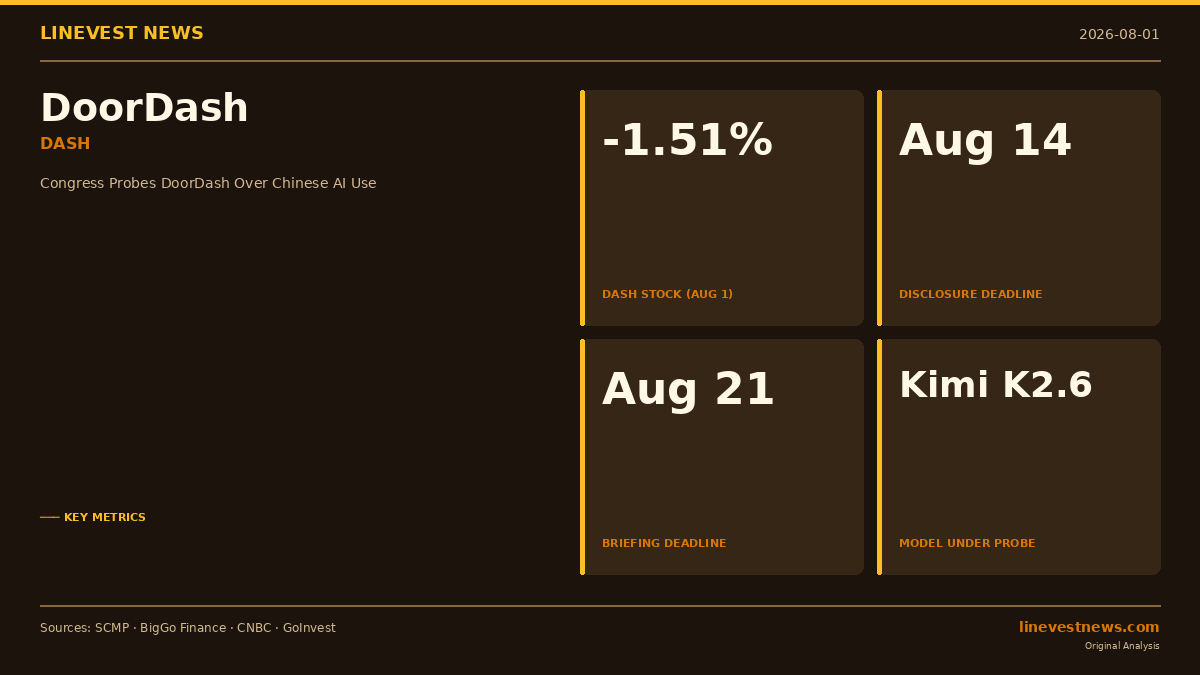
TL;DR - Two House committees launched a formal inquiry on July 31 after DoorDash co-founder Andy Fang disclosed the company used Moonshot AI's Kimi K2.6 for lower-level coding tasks - Lawmakers set a hard deadline of August 14 for full documentation and August 21 for an executive briefing with Congress - DASH fell 1.51% to USD 194.55 on the news; the stock is 31.9% below its 52-week high of USD 285.50 - The White House OSTP separately alleged Moonshot AI operated a covert distillation platform to copy U.S. AI models using unauthorized computing resources
Part A — The Disclosure and Congressional Response
DoorDash landed at the center of a bipartisan congressional investigation on July 31 after the company's co-founder Andy Fang publicly disclosed that DoorDash had been using Kimi K2.6 — an open-weight model developed by Beijing-based Moonshot AI — to handle lower-priority tasks in its software development pipeline.
House Select Committee on China Chairman John Moolenaar and House Committee on Homeland Security Chairman Andrew Garbarino responded the same day with a formal letter to DoorDash CEO Tony Xu. The letter demands:
- A complete list of every Chinese AI model deployed or evaluated by the company
- All security assessments and risk evaluations performed on those models
- An in-person briefing by staff responsible for AI infrastructure, security, procurement, and legal or compliance review
| Requirement | Deadline |
|---|---|
| Full documentation (models + security tests) | August 14, 2026 |
| In-person executive briefing | August 21, 2026 |
DoorDash described its use of Kimi K2.6 as a deliberate hybrid configuration: the Chinese open-weight model handled lower-complexity tasks in code review, while a U.S.-developed frontier model managed higher-stakes workloads. The company said the setup delivered better performance than its previous all-U.S. stack at lower cost, without disclosing specific savings figures.
In a public statement, DoorDash said it "strongly supports American leadership in artificial intelligence and is committed to ensuring AI benefits the real U.S. economy, not just the largest companies."
The inquiry is an extension of a broader congressional investigation that began in April 2026 and has already examined multiple U.S. companies for their use of Chinese open-weight AI models.
Part B — What This Means for DASH Investors
Market Reaction and Near-Term Risk
DASH fell 1.51% to USD 194.55 on August 1, compounding a difficult 2026 — the stock is 31.9% below its 52-week high of USD 285.50. While the single-day decline is modest, the investigation introduces a category of regulatory risk that the market has not previously priced into DoorDash's valuation.
This is not a casual inquiry. Both committees hold subpoena authority, and hard deadlines with a required in-person executive briefing indicate lawmakers are treating the matter seriously. The investigation could escalate if the August 14 documentation is deemed insufficient.
Why the White House Angle Matters
The congressional letter also cited an allegation from the White House Office of Science and Technology Policy (OSTP): that Moonshot AI operated a covert distillation platform designed to replicate American AI models at scale, using advanced computing systems it was not authorized to access.
If that allegation is substantiated, DoorDash would have unwittingly deployed a model whose training methodology involved unauthorized replication of U.S.-developed AI systems. That framing shifts the story from a routine cost-saving procurement decision to a potential national security exposure.
House Homeland Security Chairman Garbarino stated: "The Chinese Communist Party is no longer just nipping at our heels in artificial intelligence; it is closing the gap on certain core capabilities that will shape the future of cybersecurity."
The Structural Dilemma for U.S. Companies
Lawmakers acknowledged in their letter that using Chinese open-weight models is rationally motivated: lower cost, greater customization, and a hedge against over-dependence on a small number of U.S. proprietary providers. They wrote: "These pragmatic considerations do not eliminate the need for risk-based safeguards, nor do they reduce the national security concerns regarding growing reliance on models developed on entities subject to the jurisdiction of the People's Republic of China."
| Factor | Chinese open-weight models | U.S. proprietary models |
|---|---|---|
| Cost | Significantly lower | High (API pricing) |
| Customization | High (open weights) | Limited |
| Regulatory risk | Escalating | Low |
| Supply dependency | PRC jurisdiction | Concentrated in a few U.S. firms |
This creates a bind: Chinese models offer real economic advantages, but deploying them now carries political and regulatory risk that is only rising. Any U.S. company that has quietly incorporated Moonshot AI, DeepSeek, or other Chinese open-weight models into production systems should expect similar inquiries.
DoorDash Business Fundamentals — Not Yet a Financial Crisis
For now, the investigation is a governance and reputational risk, not a financial one. DoorDash's Q1 2026 results showed the core business performing strongly: Revenue of USD 4.0 billion (+33% year-over-year), Gross Order Value of USD 31.6 billion (+37%), and Adjusted EBITDA of USD 754 million (+28%). The DoorDash Air autonomous delivery division received FAA Part 135 certification and launched formally in July, adding a longer-term growth vector.
The financial risk materializes if Congress enacts legislation restricting or prohibiting the use of Chinese AI models in corporate settings — forcing DoorDash to rebuild its AI toolchain at material cost. No such legislation has been introduced; this remains an inquiry phase. The August 14 and August 21 deadlines are the next catalysts to watch.
Key Watchpoints for Investors: 1. DoorDash's August 14 disclosure response — content and tone will determine whether Congress escalates 2. DoorDash Q2 2026 earnings (expected August 2026) — results will provide context for stock valuation 3. Whether Congress names additional companies, signaling a sector-wide review
Sources: South China Morning Post, BigGo Finance, CNBC, GoInvest. This article is journalistic coverage and does not constitute investment advice.