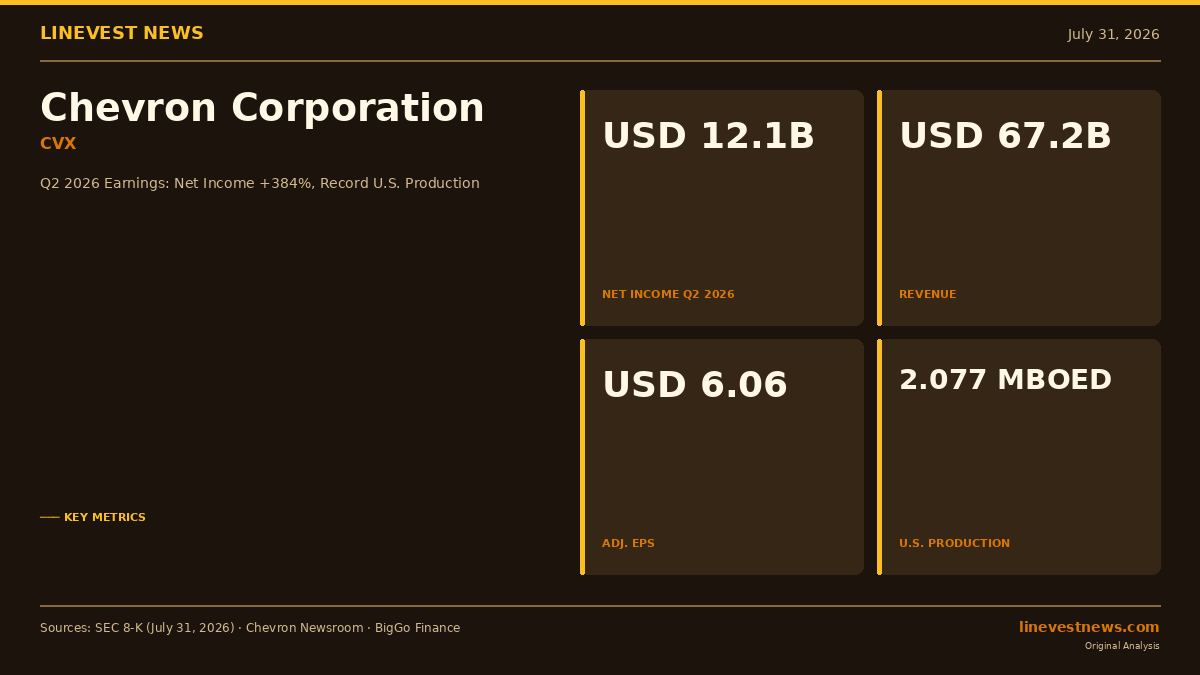
TL;DR - Chevron Q2 net income surged 384% YoY to $12.1 billion as Brent crude averaged USD 104/bbl versus USD 68 a year ago - U.S. production hit an all-time record of 2.077 MBOED; global output rose 20% year-over-year to 4.070 MBOED - Adjusted EPS of USD 6.06 beat the USD 5.57 consensus by 8.8%; adjusted free cash flow reached USD 15.4 billion in a single quarter - Chevron signed a 20-year, 2.67 GW power purchase agreement with Microsoft, entering the AI infrastructure energy market
Part A: Q2 2026 Results Summary
Chevron Corporation (NYSE: CVX) reported second-quarter 2026 net income of USD 12.1 billion, or USD 6.11 per diluted share, on July 31, 2026 — a 384% surge from USD 2.5 billion (USD 1.45 per share) in Q2 2025. Adjusted earnings came in at USD 12.0 billion (USD 6.06 per share), beating the Wall Street consensus of USD 5.57 by 8.8%.
Sales and operating revenues reached USD 67.2 billion, up 51% from USD 44.4 billion a year earlier, as average Brent crude climbed from USD 68 to USD 104 per barrel while production volumes rose sharply.
| Metric | Q2 2026 | Q2 2025 | Change |
|---|---|---|---|
| Sales and Operating Revenue | USD 67.2B | USD 44.4B | +51% |
| Net Income (GAAP) | USD 12.1B | USD 2.5B | +384% |
| EPS Diluted (GAAP) | USD 6.11 | USD 1.45 | +321% |
| Adjusted EPS | USD 6.06 | — | Beat USD 5.57 consensus (+8.8%) |
| Operating Cash Flow | USD 22.6B | — | — |
| Adjusted FCF | USD 15.4B | — | — |
| Return on Capital Employed | 21.4% | 6.2% | +15.2pp |
| Avg. Brent Crude | USD 104/bbl | USD 68/bbl | +53% |
Source: Chevron Q2 2026 Earnings Press Release, SEC 8-K filed July 31, 2026
Segment Performance
| Segment | Q2 2026 | Q2 2025 | Change |
|---|---|---|---|
| Upstream — Total | USD 8.182B | USD 2.727B | +200% |
| — U.S. Upstream | USD 3.541B | — | — |
| — International Upstream | USD 4.641B | — | — |
| Downstream — Total | USD 4.868B | USD 737M | +561% |
| — U.S. Downstream | USD 2.411B | — | — |
| — International Downstream | USD 2.457B | — | — |
Production: All-Time U.S. Record
Total production reached 4.070 million barrels of oil-equivalent per day (MBOED), up 20% from 3.396 MBOED in Q2 2025. U.S. production set a company all-time record at 2.077 MBOED. U.S. refinery throughput also hit a record at 1.07 million barrels per day (97% utilization rate).
Capital Allocation
- Debt reduction: USD 8.4 billion in Q2 (a single-quarter record), bringing total debt to USD 37.1 billion from USD 40.8 billion at year-end 2025; net debt-to-CFFO ratio now 0.6x
- Quarterly dividend: USD 1.78 per share
- Share repurchases (YTD): USD 5.689 billion
- Full-year capital expenditure guidance: USD 18–19 billion, expected to finish at the low end
Cost Discipline Highlights
- USD 3 billion in structural cost reductions achieved six months ahead of schedule
- USD 1.5 billion in Hess acquisition synergies realized within one year — 50% above the original target
Part B: What This Means for Investors
1. The USD 104 Oil Equation: Cyclical Peak or Structural Shift?
Chevron's dramatic year-over-year improvement rests on one variable: Brent crude prices. The 53% price lift, combined with 20% production growth from the Hess integration, produced the 384% net income surge. For CVX investors, the central question is how long USD 100+ oil persists.
Supply factors currently support elevated prices. OPEC+ production discipline has held, Middle East geopolitical tensions remain elevated, and the unexpected power demand surge from AI data center buildouts is creating new sources of energy consumption. However, at USD 104/bbl, meaningful earnings-per-share compression risk exists if non-OPEC supply growth outpaces demand in the second half of 2026.
2. Record U.S. Production: The Permian Effect
The 2.077 MBOED U.S. production record reflects the full integration of Hess Corporation's Permian and Gulf of Mexico assets. Chevron realized USD 1.5 billion in Hess synergies — 50% above target — within one year of closing the deal. This production momentum should persist into 2027 as Permian drilling efficiency continues to improve.
Simultaneously, U.S. refinery utilization at 97% demonstrates downstream operational excellence, delivering USD 2.411 billion in U.S. downstream earnings — a business segment that generated far less just a year ago.
3. Big Oil Enters the AI Infrastructure Market
The most strategically significant disclosure in Chevron's Q2 results was the 20-year, 2.67-gigawatt power purchase agreement with Microsoft for Project Kilby in West Texas. This behind-the-meter arrangement, targeting mid-teens returns, directly links Chevron's natural gas production capacity to Microsoft's AI data center electricity requirements.
As hyperscalers race to secure reliable baseload power for AI workloads, integrated energy companies with natural gas portfolios are increasingly positioned as critical AI infrastructure suppliers — not merely commodity producers. CEO Mike Wirth's statement that Chevron is "positioned to help power American AI dominance" signals a deliberate expansion of the company's strategic identity.
This dynamic carries clear valuation implications: energy majors that transition toward hybrid commodity-plus-contracted-infrastructure business models may warrant higher multiples than traditional cyclical commodity producers.
4. Capital Return Firepower
Adjusted FCF of USD 15.4 billion in a single quarter gives Chevron exceptional capital return capacity. The record USD 8.4 billion debt reduction brought the net debt-to-CFFO ratio to 0.6x — a near-balance-sheet-neutral posture that opens the door to accelerated buybacks or an above-inflation dividend increase.
For income investors, the USD 1.78 quarterly dividend (USD 7.12 annualized) at recent prices near USD 190 yields approximately 3.7%. With trailing twelve-month CFFO of USD 45.3 billion, Chevron's cash conversion is strong relative to its market capitalization.
5. Peer Context: Big Oil's Banner Quarter
Chevron's results accompany strong Q2 2026 reports from ExxonMobil and Shell, confirming that the quarter was broadly exceptional for integrated oil majors riding the USD 100+ Brent cycle. The differentiation within the sector centers on three levers: (1) Permian Basin exposure, where Chevron's U.S. production record is a structural advantage; (2) long-duration contracted revenue streams, where the Microsoft power deal provides a new moat; and (3) capital discipline, where Chevron's 37+ consecutive years of dividend growth signal long-term reliability.
CVX stock rose approximately 2.8% in the week following earnings. Analyst consensus price targets of approximately USD 215 imply roughly 13% upside from recent levels near USD 190.
This article is for informational purposes only and does not constitute investment advice. Investors should conduct their own independent due diligence.
Sources: - SEC 8-K Exhibit 99.1 — Chevron Q2 2026 Press Release (July 31, 2026): https://www.sec.gov/Archives/edgar/data/0000093410/000009341026000162/a06302026ex9918-k.htm - Chevron Newsroom: https://www.chevron.com/newsroom/2026/q3/chevron-reports-second-quarter-2026-results - BigGo Finance — CVX Q2 2026 Earnings Call: https://finance.biggo.com/news/US_CVX_2026-07-31 - NPR — Major Oil Companies Q2 2026: https://www.npr.org/2026/07/31/nx-s1-5910660/major-oil-companies-report-sky-high-earnings-off-higher-crude-prices - TIKR — CVX Stock Forecast 2026: https://www.tikr.com/blog/chevron-stock-forecast-2026-why-the-q2-unwind-could-reprice-cvx-past-the-215-wall-street-mean