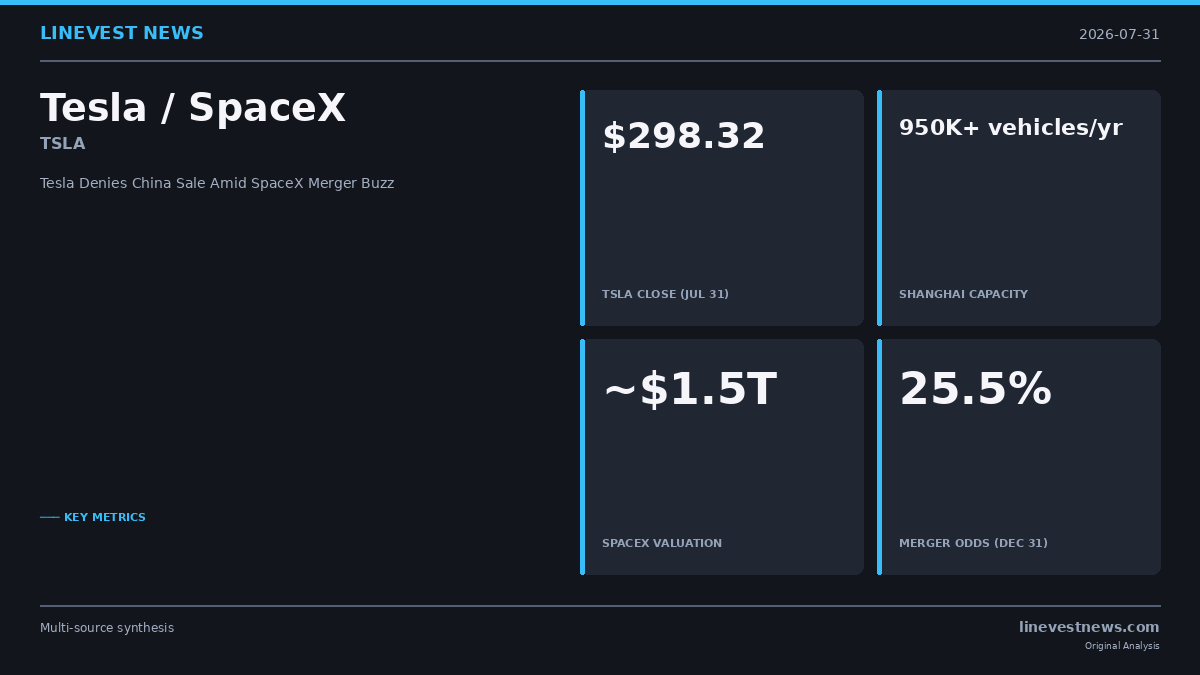
TL;DR - Wall Street Journal (July 30) reported Tesla executives were told to prepare options for separating its China business — spinoff, outright sale, or wind-down — to ease a potential SpaceX merger - Elon Musk dismissed the story as "absurdly fake news — this has never even come up in a discussion ever"; Tesla China formally echoed the denial - Shanghai Gigafactory produces more than half of Tesla's global vehicle output; China is the company's second-largest market - The core obstacle: SpaceX is a U.S. defense contractor, and merging it with Tesla's China manufacturing base would trigger national security reviews in both Washington and Beijing - TSLA bounced +2% in premarket on Musk's denial but closed -2.97% at $298.32 on July 31
The Report That Shook Tesla Shares
On July 30, The Wall Street Journal reported that Tesla had directed executives to explore options for separating its Chinese operations ahead of a potential merger with SpaceX. Three scenarios were reportedly under internal discussion: a spinoff of the China unit, an outright sale to a third party, or an orderly wind-down of operations. No timeline was identified, and the sources stressed that no decision had been made.
The strategic rationale for the separation, per the WSJ: SpaceX serves as a major U.S. defense contractor. Its Starlink satellite constellation supports military communications; its rockets carry national-security payloads. Senators have already asked the Pentagon to review Chinese ownership stakes in SpaceX-adjacent entities. Folding Tesla's sprawling Shanghai manufacturing footprint into a merged entity would almost certainly attract scrutiny from the Committee on Foreign Investment in the United States (CFIUS) as well as Chinese antitrust and national security regulators.
The WSJ report drove immediate market volatility before Musk stepped in.
Musk's Denial — and the Caveat
Elon Musk responded on X with characteristic bluntness: "This has never even come up in a discussion ever. Absurdly fake news." He added a broader advisory: "assume news is fake until proven otherwise." Tesla China's official account published a formal denial as well.
However, the vehemence of the denial sits in some tension with Musk's own comments at Tesla's Q2 2026 earnings call on July 22. Asked directly about a potential merger, he acknowledged "more and more overlap, especially with Terafab" — SpaceX's chipmaking initiative — and said the two companies "can't talk about combining... on an earnings call. It's got to be done with the appropriate process." He did not rule out a merger. That ambiguity kept speculation alive heading into the WSJ report eight days later.
Part B: Why China Is the Load-Bearing Variable
Tesla's Shanghai operations are not a peripheral revenue stream — they underpin the company's entire global production model.
| Metric | Value |
|---|---|
| Shanghai Gigafactory annual capacity | >950,000 vehicles |
| Share of Tesla's global deliveries | >50% |
| China local component sourcing rate | >95% |
| Tesla's China market rank | 2nd-largest globally |
| June China-made vehicle deliveries (YoY) | +24.4% |
| Q2 2026 Shanghai export volumes (YoY) | +32.8% |
| China-made Tesla milestone | 4 millionth vehicle (December 2025) |
Selling or winding down this operation would, as one analyst framed it, effectively "transform Tesla from a globally integrated carmaker into a smaller U.S.-based operation nested within a SpaceX-xAI holding company." That is not a neutral trade-off — it would remove the highest-volume, highest-efficiency manufacturing asset Tesla possesses in exchange for merger optionality.
Merger Structure: The Structural Complexities
Even absent the China question, a Tesla-SpaceX merger faces formidable structural obstacles:
| Factor | Tesla | SpaceX |
|---|---|---|
| Estimated valuation | ~$1.2 trillion | ~$1.5 trillion |
| Elon Musk voting control | ~20% | ~85% |
| Exchange listing | NASDAQ (public) | Private (Nasdaq IPO in progress) |
The asymmetric voting structure means Musk would effectively sit on both sides of any negotiation — controlling the acquirer (SpaceX) while holding a minority stake in the target (Tesla). That creates an inherent conflict of interest requiring rigorous independent board oversight, external fairness opinions, and almost certainly a Tesla shareholder vote before any deal could close.
JPMorgan analysts have described the combination as "strategically coherent" given the shared AI-robotics-energy thesis, but identified regulatory approval as the "practical bottleneck." Prediction markets currently assign a 25.5% probability to a formal merger announcement by December 31, 2026, and just 3.5% by September 30 — suggesting the market sees this as a medium-term story at the earliest, not an imminent event.
The Companies Are Already Intertwined
Whatever the legal outcome, Tesla and SpaceX are already deeply operationally integrated:
- Grok AI — originating from xAI, now absorbed by SpaceX — is embedded in Tesla vehicles
- Cybercab robotaxis are designed to use Starlink satellite connectivity for real-time routing and mapping
- Terafab, SpaceX's chipmaking unit, is positioned to supply the AI inference hardware that Tesla's autonomous driving stack will require at scale
Musk's "more and more overlap" comment is therefore factually grounded in engineering reality. The open question is whether the legal, regulatory, and governance complexity of a formal corporate marriage can be resolved without sacrificing the China revenue engine that funds much of Tesla's current operations.
Context: Tesla's Weakest Operating Margin in Years
The merger speculation arrived against an already stressed backdrop. Tesla reported a 1.4% operating margin in Q2 2026 — the weakest in recent memory — as the company accelerates spending on AI development, robotaxi infrastructure, and Optimus humanoid robot production. Shares had already declined roughly 14% following the Q2 print before the China/SpaceX story added a second leg of pressure.
TSLA's +2% premarket bounce on Musk's denial suggests investors initially treated it as a relief signal — losing the China business would strip a critical revenue pillar at the worst possible time. But the -2.97% close at $298.32 indicates that the broader context (compressed margins, unresolved merger overhang) continued to weigh on sentiment through the end of the session.
China Could Push Back
A geopolitical dimension often underappreciated in merger commentary: even if Tesla elected to exit China, Beijing would have significant leverage over the terms. U.S. restrictions on foreign-manufactured humanoid robots — a category directly relevant to Tesla's Optimus ambitions — have already prompted Chinese warnings about potential countermeasures, including restrictions on rare earth mineral exports that are critical to Tesla's battery supply chain.
Any perception that Tesla is strategically withdrawing from China to serve a U.S. defense-contractor merger could invite retaliatory measures that affect not just Tesla but the broader EV and battery industry. That is a risk calculus that extends well beyond the two companies involved.
Five Things Investors Should Watch
- SEC filings: Any formal merger would require 13D disclosures, proxy filings, and an S-4 registration statement. The complete absence of such filings is the most concrete signal that no imminent deal exists.
- Tesla Q3 operating margin recovery: Whether margins recover from 1.4% will determine how much financial flexibility management has in any deal discussion. A margin rebound strengthens Tesla's standalone case.
- SpaceX Nasdaq IPO progress: A SpaceX public listing would resolve the private/public valuation gap that complicates merger exchange ratios and make any deal structurally more tractable.
- CFIUS and Congressional signals: Informal government communication about SpaceX-Tesla national security overlap would be a leading indicator of regulatory sentiment before any formal filing.
- China monthly delivery data: Tesla's Shanghai sales trajectory in H2 2026 will quantify exactly how much revenue is at stake in any divestiture scenario — and whether the China growth story remains intact.
This article is for informational purposes only and does not constitute investment advice. LineVest News is an independent financial news outlet and is not affiliated with any brokerage or investment advisory firm.
Sources: - The Wall Street Journal, "Tesla Weighs China Unit Sale Ahead of SpaceX Deal" (July 30, 2026) - Electrek, "Tesla weighs selling China business to clear path for SpaceX merger" (July 30, 2026) — https://electrek.co/2026/07/30/tesla-weighs-selling-china-business-spacex-merger/ - Benzinga, "Elon Musk Dismisses Report Tesla Could Sell Chinese Business for SpaceX Merger" (July 31, 2026) — https://www.benzinga.com/markets/tech/26/07/60828099/elon-musk-dismisses-report-tesla-could-sell-chinese-business-for-spacex-merger-absurdly-fake-news - Yahoo Finance / Reuters, Tesla-SpaceX WSJ report (July 30, 2026) — https://finance.yahoo.com/markets/stocks/articles/tesla-weighs-sale-china-business-011228562.html - The Motley Fool, "Elon Musk Wouldn't Rule Out a Tesla-SpaceX Merger on the July 22 Earnings Call" (July 24, 2026) — https://www.fool.com/investing/2026/07/24/elon-musk-wouldnt-rule-out-a-tesla-spacex-merger-o/ - Cryptobriefing, "Musk Denies Tesla China Sale for SpaceX Merger" (July 31, 2026) — https://cryptobriefing.com/musk-denies-tesla-china-sale-for-spacex-merger-impacting-market-expectations/ - Nikkei Asia, "Tesla denies sale of China business amid SpaceX merger buzz" (July 31, 2026) — https://asia.nikkei.com/business/automobiles/electric-vehicles/tesla-denies-sale-of-china-business-amid-spacex-merger-buzz