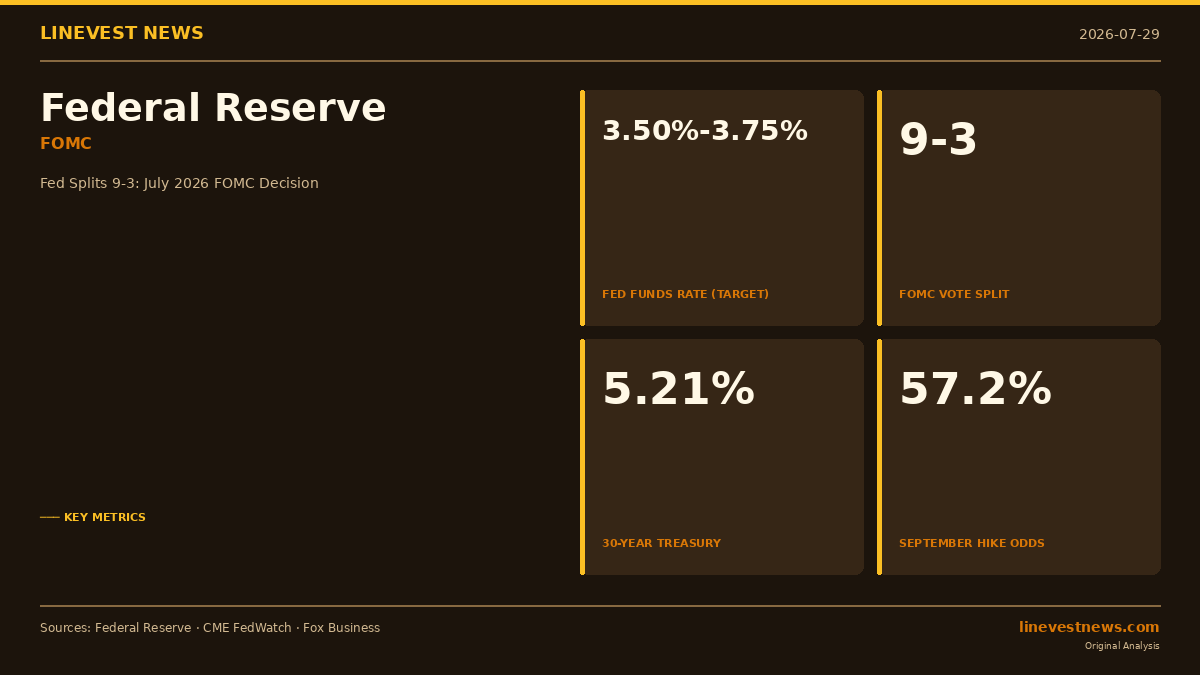
TL;DR - Federal Reserve held the federal funds rate at 3.50%–3.75% on July 29, the fifth consecutive hold - Historic 9-3 vote split — three regional presidents each wanted a 25-basis-point increase - New Chair Kevin Warsh: "five-plus years of inflation above target cannot be cured in nine weeks" - 30-year Treasury yield surged to 5.21% — highest in 19 years; S&P 500 fell 1% - CME FedWatch now prices 57.2% probability of a September hike; next FOMC is September 15–16
Part A: The Decision
The Federal Open Market Committee voted 9-3 on July 29 to leave the federal funds rate unchanged at a target range of 3.50% to 3.75%, marking the fifth straight meeting at which policymakers declined to move.
Three regional bank presidents — Beth M. Hammack (Cleveland), Neel Kashkari (Minneapolis), and Lorie K. Logan (Dallas) — broke from the majority and voted to raise the target range by 25 basis points. The 9-3 split is among the most divided FOMC votes in recent memory, a sharp contrast to the near-unanimous decisions typical of the Powell era.
The Committee's formal statement described economic conditions as broadly resilient: "Economic activity is expanding at a solid pace despite elevated uncertainty." Job gains are keeping pace with workforce growth, and the unemployment rate remains stable. But the inflation diagnosis was unambiguous: "Inflation remains elevated relative to the Committee's 2 percent goal," with energy and other supply shocks cited as contributing factors.
Kevin Warsh's Key Statements
Chairing only his second full FOMC meeting since taking over in mid-2026, Chair Warsh put his characteristic directness on display. On why the Committee didn't hike:
"Five-plus years of inflation above target cannot be cured in nine weeks."
On the three dissents:
"I asked for a good family fight, and I got one. That's the designed feature."
Warsh also said the hold was "especially prudent at these uncertain times," citing geopolitical risk from the ongoing Middle East conflict as a factor weighing on the Committee's risk assessment.
Warsh's Communication Overhaul
The July meeting unfolded entirely within a new institutional framework. Since taking office, Warsh has stripped forward-guidance language from policy statements, launched a task force to review all Fed communications, and declined to publish his own rate projections in the quarterly dot plot. His stated philosophy: force market participants to react to economic data rather than parsing central bank signals.
The July 29 statement contained no explicit indication of the future rate path — a stark departure from years of conditional guidance that had anchored market expectations to specific scenarios.
Observers have described the approach as "regime change but in a velvet glove."
Part B: What It Means for Investors
Bond Markets Are Already Repricing
The market's immediate verdict was hawkish. The 30-year Treasury yield jumped 12 basis points to 5.21% — its highest level since 2007 — signaling that investors expect either a September hike or a prolonged period of policy restriction. The 10-year yield climbed 7 basis points to 4.67%, while the 2-year fell 4 basis points, producing a modest bear-steepening in long-duration bonds.
The S&P 500 fell 1% and the Nasdaq declined 0.9% after initially rallying during Warsh's press conference, only to reverse course as the hawkish implications set in. A stronger dollar added pressure across risk assets.
September Is Now a Live Coin Flip
The CME FedWatch tool now places the probability of a 25-basis-point hike at the September 15–16 FOMC meeting at 57.2%, up from 55.8% before the July decision. Morgan Stanley's chief U.S. economist Ellen Zentner summarized the outlook plainly: "September remains a live meeting."
The three dissenters' positions carry institutional weight. Under historical FOMC dynamics, a coherent bloc of three dissenters has often served as the intellectual runway for a majority shift at the subsequent meeting — provided incoming data cooperate. The critical readings ahead of September are the July and August CPI reports and the July PCE deflator.
| Scenario | Implied Probability (CME, Jul 30) |
|---|---|
| September hold (3.50–3.75%) | ~43% |
| September +25bps (3.75–4.00%) | ~57% |
| October hold / November hike | Residual |
Sector and Asset Class Implications
Rate-sensitive equities face the highest near-term pressure. Real estate investment trusts, utilities, and long-duration growth names — particularly unprofitable technology companies — are most exposed if 10- and 30-year yields continue rising. A 5.21% 30-year rate creates a structurally competitive alternative to equity risk premiums; multiple compression is the arithmetic result.
Financial stocks present a nuanced picture. Rising short-term rates can narrow net interest margins if the front end stays anchored while the long end runs higher, but a cleaner institutional narrative under Warsh may ultimately reduce structural policy uncertainty — a medium-term positive for bank valuations.
The dollar's strength following the decision introduces headwinds for U.S. multinationals. Companies with significant international revenue exposure — including technology and industrial names — may face currency translation drag in Q3 2026 reporting.
Gold and commodities pulled back as real yields rose and the dollar strengthened. This is the standard transmission mechanism when market expectations revise hawkishly: higher real rates reduce the opportunity cost of holding non-yielding assets like gold, and a stronger dollar suppresses dollar-denominated commodity prices.
The Warsh Factor as a Structural Wildcard
For investors who built risk models around Powell-era forward guidance, Warsh's overhaul creates a new baseline: higher meeting-to-meeting volatility as markets lose their customary anchors. Without a dot plot from the Chair and without conditional guidance language in statements, each FOMC meeting becomes genuinely open-ended.
The upside of this approach, as Warsh frames it, is that policy credibility is rebuilt through actions — not promises. If September's data force a hike, the Fed's delivery would reinforce its inflation-fighting reputation in a way that years of verbal guidance could not. The downside is that markets may price excessive uncertainty at every meeting, compressing valuations across the cycle.
The next FOMC meeting is scheduled for September 15–16, 2026.
This article is for informational purposes only and does not constitute investment advice. LineVest News is an independent financial publication and is not affiliated with any brokerage.
Sources: Federal Reserve press release (July 29, 2026) · Fox Business · CNN Business · CNBC · Verified Investing · Kiplinger · Morgan Stanley (Ellen Zentner)