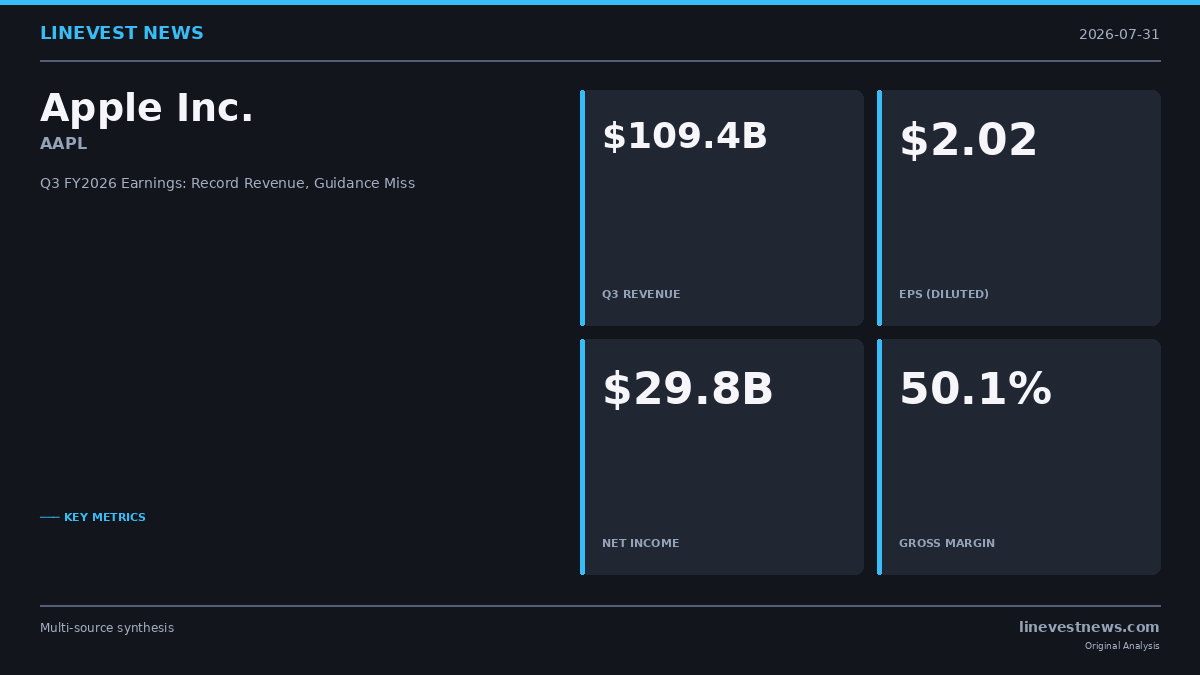
Apple (AAPL) logged its best June quarter on record Thursday — $109.4 billion in revenue, a 16.4% year-over-year gain — but investors immediately looked past the headline and sold the stock down more than 6% after hours. The selloff exposed three fault lines beneath the otherwise impressive results: a miss on Services, a widening China shortfall, and a surprisingly cautious Q4 outlook citing surging memory-chip costs that Tim Cook called "a once-in-a-century flood."
TL;DR - Q3 FY2026 revenue USD 109.4B (+16.4% YoY), EPS USD 2.02 (+29%) — both beat consensus - Services revenue USD 30.74B, missed USD 31.22B estimate; China USD 18.8B, missed USD 19.6B estimate - Q4 guidance: +9–11% revenue growth vs. 12% consensus — DRAM/NAND inflation flagged as headwind - AAPL fell 6.2% after-hours to USD 311.58, pulling back from a near-USD 344 all-time high - Tim Cook's final earnings call as CEO; John Ternus assumes the role September 1, 2026
Part A — Q3 FY2026 Results
Revenue Breakdown
| Segment | Q3 FY2026 | Q3 FY2025 | YoY | Consensus | Beat/Miss |
|---|---|---|---|---|---|
| iPhone | USD 54.25B | USD 44.47B | +22.0% | USD 53.86B | ✅ Beat |
| Services | USD 30.74B | USD 27.45B | +12.0% | USD 31.22B | ❌ Miss –USD 480M |
| Mac | USD 10.35B | USD 8.03B | +29.0% | USD 8.74B | ✅ Beat |
| iPad | USD 6.19B | USD 7.16B | –13.5% | USD 6.92B | ❌ Miss –USD 730M |
| Wearables, Home & Accessories | USD 7.93B | USD 6.97B | +13.8% | — | — |
| Total | USD 109.42B | USD 94.04B | +16.4% | USD 108.86B | ✅ Beat |
Geographic highlights: Greater China revenue USD 18.8B vs. analyst projection of USD 19.6B — a USD 800M shortfall that revived concerns about longer-term market-share erosion in Apple's most competitive geography.
Profitability
- Gross Margin: 50.1% (consensus: 48.0%) — a 210-basis-point beat. CFO Kevan Parekh noted approximately 2 percentage points of the gross margin upside came from tariff refunds, implying underlying margin was closer to 48%.
- EPS (diluted): USD 2.02 vs. USD 1.89 consensus (+6.9% beat). About USD 0.11 of EPS reflects the tariff refund benefit.
- Net Income: USD 29.79B (vs. USD 23.43B a year ago, +27.2%)
- Operating Cash Flow: USD 34.4B (+23.3% YoY)
Management Quotes
CEO Tim Cook: "Today, Apple is proud to report our strongest June quarter ever, with double-digit revenue growth across iPhone, Mac and Services, and in every geographic segment."
CFO Kevan Parekh: "We set new June quarter records for both EPS and operating cash flow. Our installed base reached a new all-time high across all major product categories and geographic segments."
Part B — Why the Stock Fell 6% on a Record Quarter
1. Services Deceleration Matters More Than iPhone Upside
Services is Apple's highest-margin business — gross margins are estimated at 70%-plus — and Wall Street increasingly values Apple as a software-and-subscription platform rather than a hardware maker. A USD 480M Services miss against a USD 31.22B estimate (a 1.5% shortfall) is small in dollar terms but directionally negative for the multiple.
Services has been decelerating on a YoY basis: from roughly 14% growth in FY Q2 to 12% in Q3. If that trend continues, the premium embedded in Apple's roughly 30× forward-earnings multiple becomes harder to justify. Investors who bought AAPL at near-USD 344 last week were pricing in re-acceleration — the results suggest the opposite.
2. China Weakness Is Structural, Not Cyclical
The USD 18.8B China figure (vs. USD 19.6B projected) marks the third consecutive quarter of China underperformance relative to consensus. Huawei's Mate and Pura flagship lines continue to reclaim premium market share domestically, and Apple Intelligence features have been slow to roll out in Mandarin due to regulatory requirements. Without a breakout China quarter, growth in the world's largest smartphone market will remain a drag.
3. DRAM/NAND as a "Once-in-a-Century Flood"
Cook's extraordinary description of memory-chip prices deserves attention. DRAM prices have surged alongside SK Hynix's and Samsung's HBM production pivots — wafers that used to go to commodity DRAM are now allocated to high-bandwidth memory for AI accelerators. NAND supply is also tightening as enterprise SSD demand from hyperscalers rises.
For Apple, this is a cost push at exactly the wrong moment: Mac and iPad production costs are rising while consumer price elasticity prevents equivalent price hikes. The guidance range of 9–11% revenue growth (vs. 12% consensus) is therefore not just a demand story but partly a margin-protection story — Apple may be choosing not to launch certain configurations until memory costs normalize.
4. Q4 Guidance Implies a Softer iPhone 17 Ramp
The September quarter has historically been Apple's biggest, anchored by new iPhone launches. The 9–11% growth guidance implies revenue of roughly USD 111B–USD 113B (Q3 FY2025 full-year run-rate basis), below the USD 115B+ some analysts had penciled in for an iPhone 17 upcycle. The company cited "assembly capacity constraints" alongside memory costs — a signal that supply, not just demand, may cap the ramp.
5. Tim Cook's Curtain Call and the Ternus Uncertainty
This was Tim Cook's last earnings call as CEO before he hands off to John Ternus — the executive who led Apple Silicon development — on September 1. While the succession was announced months ago, the market's 6% after-hours reaction may partly reflect increased uncertainty about strategy continuity, particularly on AI investment pacing, Services expansion, and the relationship with OpenAI and Google for on-device AI.
Investment Implications
| Bear Case | Bull Case |
|---|---|
| Services deceleration → multiple compression | iPhone 17 ramp unlocked as DRAM normalizes in H2 |
| China structural headwinds persist | WWDC26 AI Siri features drive installed-base monetization |
| DRAM/NAND inflation pressures Q4–Q1 margins | Mac upcycle still early; Apple Silicon adoption deepening |
| USD 0.11/EPS tariff refund benefit is one-time | Gross margin 50.1% shows operational leverage |
The pullback toward USD 311 brings AAPL back to roughly 28× the next-twelve-months consensus EPS — still a premium but more defensible than the 33× implied at USD 344. Investors looking for a re-entry point may watch whether memory costs ease by November, which would remove the largest known headwind to Q1 FY2027 margins.
This article is journalism, not investment advice. LineVest News is an independent publication.
Sources: - Apple Q3 2026 Earnings — 9to5Mac - Apple Q3 2026 earnings beat estimates but services revenue misses — Yahoo Finance / Quartz - Apple Shares Tumble Over 6% on Guidance Miss — TradingKey - Apple Earnings Send AAPL Toward USD 300 — FX Leaders - Apple (AAPL) Q3 2026 earnings report: Live updates — CNBC