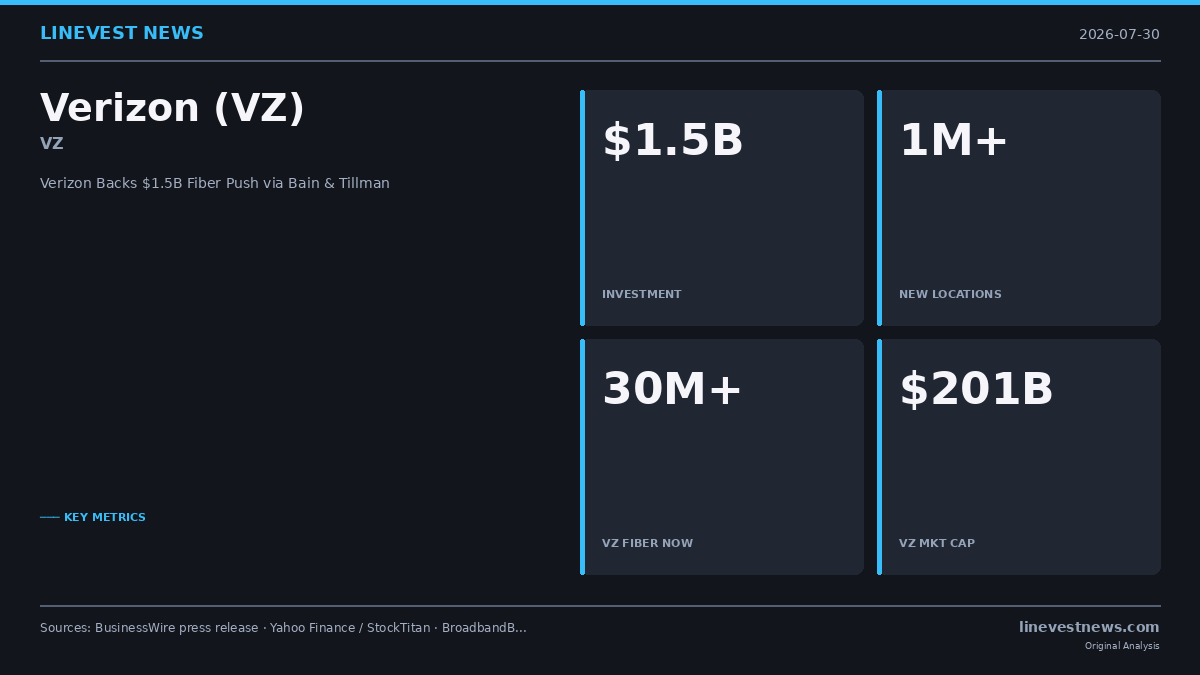
TL;DR - Bain Capital and Tillman Global Holdings invest $1.5B in Eaton Fiber, Verizon's exclusive wholesale fiber partner - Eaton Fiber acquires Ripple Fiber (Charlotte, NC; 10 states; ~300 municipalities; "hundreds of thousands" of homes and businesses) - Verizon will separately acquire Ripple's existing customers and North Carolina/South Carolina network assets - Expands Verizon fiber to 1M+ new locations beyond its current 30M+ post-Frontier footprint - CEO Dan Schulman doubles down on asset-light model as VZ races AT&T's 40-million-location target
Part A: The Deal
Bain Capital's North America Special Situations team and Tillman Global Holdings announced a $1.5 billion investment in Eaton Fiber on July 29, 2026, targeting a residential and small-business broadband expansion that could reshape the competitive balance between America's two largest wireline carriers.
Eaton Fiber — a wholesale fiber infrastructure platform founded by Tillman Global Holdings — entered into a commercial partnership with Verizon in October 2025 under which Eaton funds, builds, maintains and operates fiber networks while Verizon serves as the exclusive retail provider for residential and small-business customers. That arrangement meant Verizon could grow its fiber footprint without putting construction capital on its own balance sheet. Tuesday's announcement scales that model aggressively.
The Ripple Fiber Acquisition
The $1.5B will fund two things: first, Eaton Fiber's acquisition of Ripple Fiber, a 100% fiber-optic internet provider founded in 2021 by Greg Wilson and headquartered in Charlotte, North Carolina. Ripple currently serves hundreds of thousands of homes and businesses across 10 states and nearly 300 municipalities. Second, the capital will finance Eaton's next phase of organic network build.
The deal has a split structure: Verizon will separately acquire Ripple's existing customer relationships and a portion of Ripple's network assets in North Carolina and South Carolina. Eaton Fiber retains the rest of Ripple's footprint and absorbs it into its wholesale platform. The transaction is expected to close before the end of 2026, subject to customary regulatory approvals.
Debt financing for the deal was led by a syndicate including Société Générale, SMBC and Future Standard Digital Infrastructure, with Lazard serving as lead financial advisor. Existing investors Platform Investment Partners and KLT continue to back Eaton Fiber alongside the new capital.
| Parameter | Detail |
|---|---|
| Total investment | $1.5 billion |
| Lead investors | Bain Capital (Special Situations), Tillman Global Holdings |
| Target | Eaton Fiber (wholesale fiber) + Ripple Fiber acquisition |
| Ripple footprint | 10 states, ~300 municipalities, 100% fiber-optic |
| New locations targeted | 1M+ outside current Verizon fiber footprint |
| Verizon current footprint | 30M+ locations (post-Frontier deal close) |
| Deal close expected | Before end of 2026 |
| Debt lead arrangers | Société Générale, SMBC, Future Standard Digital Infrastructure |
| Financial advisor | Lazard |
Part B: Why This Matters for VZ Investors
1. Capital Efficiency Is the Core Thesis
Verizon's $20 billion acquisition of Frontier Communications, which closed earlier in 2026, immediately added tens of millions of fiber locations to VZ's network but also added significant debt. CEO Dan Schulman — the former PayPal chief who replaced Hans Vestberg in October 2025 — has been explicit that the priority is convergence (bundling fiber broadband with wireless) without blowing up the capital structure.
The Eaton Fiber model solves that equation directly. Bain and Tillman provide the construction capital; Verizon provides the customer acquisition machine. Angelo Rufino, Head of North America Special Situations at Bain Capital, summed up the logic: "Wholesale fiber platforms have emerged as the most capital-efficient way to close that gap at scale."
For VZ's dividend — which currently yields approximately 6% and is a central pillar of the investment thesis for income-oriented shareholders — keeping fiber CapEx off the balance sheet while still expanding footprint is essentially the holy grail of telecom strategy.
2. The AT&T Race Is Real
Verizon is not building in a vacuum. AT&T ended 2025 with fiber reaching 32 million locations and is targeting 40 million by the end of 2026, adding roughly 5 million locations per year organically. AT&T is also using a parallel vehicle — Gigapower, an open-access fiber joint venture — that mirrors the wholesale infrastructure model Eaton Fiber represents for Verizon.
Verizon's current footprint, post-Frontier, sits at approximately 30M+ locations serving more than 10.5 million fiber connections. Adding 1M+ through the Eaton/Ripple transaction is a meaningful increment, but it underscores that VZ is playing catch-up to AT&T in raw location count. Schulman has articulated a long-term target of 40 million to 50 million fiber passings — reaching that ceiling without another debt-heavy acquisition requires exactly the kind of capital-efficient wholesale model this deal provides.
3. T-Mobile's Shadow
The competitive pressure is not limited to AT&T. T-Mobile Home Internet, which uses 5G fixed wireless access (FWA) rather than fiber, has emerged as a lower-cost alternative for suburban and rural broadband. T-Mobile added millions of FWA customers in 2025, pulling directly from DSL and cable incumbents. While FWA cannot match fiber's peak throughput or latency, it appeals to price-sensitive customers in areas where fiber is unavailable.
By extending Verizon's fiber reach to 1M+ new locations — many of which may currently be served only by cable or DSL — Eaton/Ripple's expansion targets exactly the customers most at risk of churning to T-Mobile FWA. A Verizon fiber offer, backed by the brand and bundled with wireless service, gives VZ a credible response.
4. The Convergence Premium
Analysts tracking VZ have long pointed to the convergence ARPU uplift as the financial prize of fiber build-out. Customers who subscribe to both Verizon wireless and Verizon fiber broadband generate meaningfully higher lifetime revenue and exhibit significantly lower churn than single-service subscribers. The Eaton/Ripple deal directly adds to the addressable pool for those converged bundles — 1M+ new locations that were previously outside VZ's ability to offer a fiber product now become cross-sell targets for VZ wireless accounts.
Schulman framed the strategic rationale plainly in the announcement: "Fiber is the critical backbone of digital infrastructure required to meet the evolving needs of our customers. Expanding fiber reach is central to our growth and convergence strategy."
5. Risks to Monitor
Execution risk tops the list. Ripple Fiber operates in 10 states, and integrating a multi-state network operator's assets and customer base across two different acquiring entities (Verizon for NC/SC customers and assets, Eaton for the rest) is operationally complex. Any service disruptions during the transition could accelerate churn precisely when Verizon is trying to win customers.
Regulatory risk is present but appears manageable. The deal involves wholesale open-access networks rather than a direct consumer-facing acquisition, and no single transaction is large enough to attract obvious antitrust scrutiny. The end-of-2026 closing timeline builds in buffer for standard regulatory review.
Capital market risk is worth flagging for Eaton Fiber itself. Debt financing from SocGen, SMBC and Future Standard Digital Infrastructure implies Eaton carries leverage. If interest rates remain elevated or broadband demand in newly built areas undershoots expectations, the wholesale model's economics could deteriorate — creating financial pressure on the Eaton/Ripple operating entity even if Verizon's balance sheet remains insulated.
6. Bottom Line for Investors
The Eaton Fiber deal is structurally positive for VZ shareholders because it adds fiber coverage without adding construction capital to Verizon's already-stretched balance sheet. In a sector where AT&T's 40-million-location target and T-Mobile's FWA growth have raised the competitive stakes, standing still on fiber reach is not an option. The $1.5B that Bain and Tillman are deploying — rather than Verizon's treasury — is precisely the kind of creative capital structure that CEO Schulman was brought in to execute.
The key number to track going forward is not the $1.5B investment figure but the 1-million-location expansion: how quickly those homes come online, how many convert to Verizon fiber subscribers, and whether the converged bundle economics play out as the convergence thesis predicts. Schulman's credibility on the "capital-efficient model" hinges on those conversions materializing.
Sources: - BusinessWire, July 29, 2026 — Official press release - Yahoo Finance, July 29, 2026 - BroadbandBreakfast, July 29, 2026 - SDxCentral, competitive fiber analysis - StockTitan / VZ market data - CNBC, October 2025 — Dan Schulman CEO appointment
This article is for informational purposes only and does not constitute investment advice.