ICE to Buy MarketAxess for $6B, Betting NYSE's Playbook Can Fix the $145 Trillion Bond Market
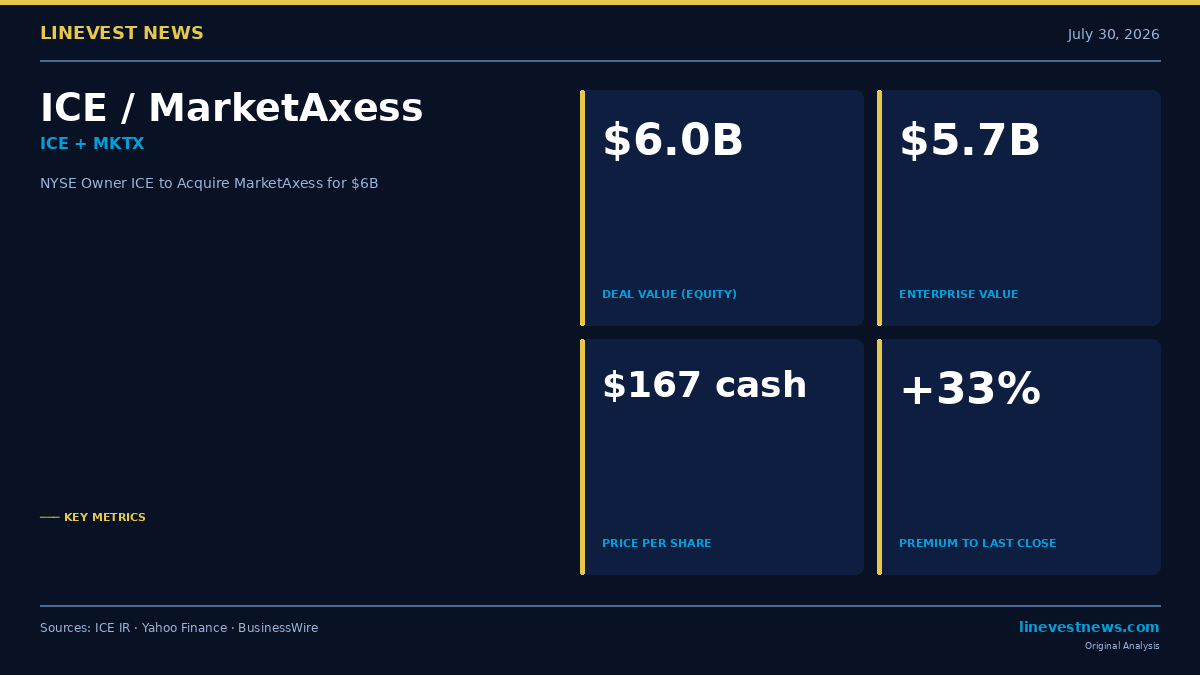
NYSE parent Intercontinental Exchange agreed to acquire electronic bond-trading platform MarketAxess for $167 per share in cash — a 33% premium — as it bets the fragmentation still plaguing global fixed income can be conquered the same way it conquered equities.
TL;DR - ICE (NYSE: ICE) will pay $167/share cash, valuing MarketAxess (NASDAQ: MKTX) at ~$6.0B equity / $5.7B enterprise value — a 33% premium to MKTX's July 29 close - All-cash deal financed via new debt; ICE starts at 3.4x gross leverage, targets return to 3.0x within 18–24 months - MarketAxess Q2 2026 revenue: $218.4M (roughly flat YoY); EBITDA margin 48.6%; MKTX stock had fallen ~31% year-to-date before the deal - Deal closes H1 2027 (subject to MKTX shareholder vote + regulatory clearance); expected accretive in first full year post-close - $100M annual run-rate expense synergies fully realized within three years
Part A: Deal Terms
Intercontinental Exchange on July 30 announced a definitive agreement to acquire MarketAxess Holdings, the leading institutional electronic bond-trading network, for $167.00 per share in an all-cash transaction unanimously approved by both boards.
| Metric | Value |
|---|---|
| Price per share | USD 167.00 |
| Premium to July 29 close | +33% |
| Equity value | ~USD 6.0B |
| Enterprise value | ~USD 5.7B |
| EBITDA multiple (pro forma) | ~10.6x LTM |
| Annual synergies | USD 100M run-rate |
| Expected close | H1 2027 |
The acquisition will be financed entirely through newly issued debt — a mix of bonds, term loans, and commercial paper — putting ICE's gross leverage at approximately 3.4x at close. Management targets a return to its 3.0x leverage ceiling within 18–24 months.
To signal conviction, ICE simultaneously raised its quarterly share buyback baseline from $350M to $400M — a move designed to reassure shareholders that the deal does not displace capital returns.
MarketAxess connects approximately 2,100 institutional investors and broker-dealers across 90+ countries, offering electronic execution in corporate bonds, municipal bonds, emerging market debt, Eurobonds, and U.S. Treasuries. Founded in 2000, the company reported 2025 full-year revenues of $846.3M (+4% YoY) and Q1 2026 revenues of $233.4M (+11.9% YoY). Its Q2 2026 results — released simultaneously with the merger announcement — showed revenue of $218.4M (roughly flat YoY) and EBITDA of $106M (48.6% margin), with the company immediately suspending its earnings call, quarterly guidance, and monthly volume releases pending deal close.
Part B: Why the $145 Trillion Bond Market Is the Real Prize
ICE's Strategic Logic: Replicating the Equities Playbook
ICE Chair and CEO Jeff Sprecher framed the deal with a formula the company has used to justify every major acquisition since its founding: "take the largest, least-efficient corners of global finance and apply technology and network effects to improve transparency."
That formula worked in energy futures (acquisition of IPE, 2001), in credit default swaps (ICE Clear Credit, 2009), and — most dramatically — in equities (NYSE acquisition, 2013). The global bond market, with an estimated $145.1 trillion in outstanding debt, is the largest pool of investable assets that has yet to fully undergo the same electronic transformation.
Despite two decades of digitization progress, a significant share of bond transactions still relies on voice brokering, bilateral phone negotiations, and fragmented dealer relationships. Electronic penetration, while growing, lags equities by a wide margin. For ICE — which already dominates derivative clearing, energy markets, fixed-income data (the ICE BofA bond indices are industry standard), and equities execution — owning the largest institutional corporate-bond venue completes a vertical integration story spanning the entire capital markets stack.
The Tradeweb Threat That Forced ICE's Hand
The competitive context helps explain the timing. MarketAxess, once the undisputed leader in U.S. high-grade electronic credit, has faced sustained market-share pressure from Tradeweb Markets (NASDAQ: TW) over the past three years, particularly in portfolio trading — where entire bond baskets change hands in a single transaction. MKTX's stock had lost approximately 31% year-to-date by July 29, 2026, as investors questioned whether the platform could defend its moat against a better-capitalized rival.
By absorbing MarketAxess, ICE inherits: - Open Trading — MKTX's anonymous all-to-all network that routes liquidity away from traditional dealer relationships - Portfolio trading ADV of $2.0B (record, +33% YoY in Q2 2026), a direct challenge to Tradeweb's core product - Block trading ADV of $5.9B (+11% YoY), where institutional accounts trade in size without signaling
Combined with ICE's existing ICE Bonds platform (focused on municipal and retail-facing products), the merged entity would offer institutional and retail bond-market participants a unified venue — exactly the capability that Tradeweb has been building through its own acquisitions. The deal transforms a three-way race (Bloomberg, MarketAxess, Tradeweb) into a two-superpower contest between ICE-MarketAxess and Tradeweb.
Revenue Synergies Are the Upside Not Yet Priced In
Management disclosed only $100M in expense synergies — a conservative figure that likely reflects back-office, technology infrastructure, and overlapping corporate functions. Revenue synergies were deliberately excluded from the deal rationale, a common practice designed to protect against regulatory scrutiny of market concentration arguments.
The revenue opportunity, however, is significant. ICE's core advantage is data monetization: the ICE BofA indices are licensed by hundreds of ETFs and structured products globally, and the company has repeatedly shown an ability to convert transaction data into high-margin information products. MarketAxess generates $31.5M in quarterly services revenue (record in Q2, +14% YoY) from a data and post-trade analytics segment — a business ICE could scale aggressively by cross-selling to its existing client base of 6,000+ financial institutions.
MarketAxess CEO Chris Concannon framed the combination: "MarketAxess contributes a leading fixed-income trading network while ICE brings retail protocols, data, connectivity, and broader capabilities."
Leverage Risk and the Debt Math
ICE CFO Warren Gardiner stated: "Our balance sheet strength allows us to finance this acquisition entirely in cash while maintaining our plans for returning capital to shareholders."
The numbers bear closer inspection. ICE's starting leverage of 3.4x is meaningfully above its self-imposed 3.0x ceiling — a ceiling the company has breached before (most notably in the Ellie Mae and Black Knight mortgage acquisitions). Management's 18–24 month deleveraging timeline implies roughly $600M–$800M in annual free cash flow directed toward debt repayment beyond organic reinvestment needs. That math is achievable — ICE generated approximately $3.6B in operating cash flow in 2025 — but it leaves little room for additional M&A during the integration window.
The implied LTM EBITDA multiple of ~10.6x (pro forma with synergies) compares favorably to Tradeweb's current trading multiple of approximately 30x EBITDA, reflecting the market's higher growth premium for TW. If the combined ICE-MarketAxess entity can close even part of that re-rating gap by demonstrating faster-than-expected synergy capture, the deal economics improve substantially.
Investment Implications
For MKTX holders, the path is clear: $167 cash represents a definitive exit at a 33% premium from a stock that had been in structural decline. The only scenario in which the deal does not close on these terms would be a competing bid or a regulatory block — both low-probability events given the deal's complementary rather than overlapping market structure.
For ICE shareholders, the acquisition is a calculated bet that the bond market's digitization curve is about to inflect and that ICE's platform-and-data model can extract superior returns from that transition. Near-term EPS dilution from acquisition costs and integration charges will likely weigh on the stock in H2 2026; the accretion story is a 2028 event at the earliest.
The deal also raises competitive implications for Tradeweb (TW): the combination does not close existing gaps overnight, but it removes the strategic uncertainty that had allowed Tradeweb to recruit clients away from a standalone, smaller MarketAxess. Investors in Tradeweb should watch for any acceleration in institutional win rates from clients who prefer not to trade on an ICE-controlled venue.
This article is for informational purposes only and does not constitute investment advice. Linevestnews.com is an independent financial news publication.
Sources: - ICE Investor Relations Press Release (July 30, 2026) — ir.theice.com - Yahoo Finance / PRNewswire press release - CNBC: "Intercontinental Exchange to buy MarketAxess in $5.7 billion deal" (July 30, 2026) - Bloomberg: "NYSE Parent ICE Agrees to Buy MarketAxess for About $6 Billion" (July 30, 2026) - BusinessWire: "MarketAxess Reports Second Quarter 2026 Financial Results" (July 29, 2026) - StockTitan / ICE Newsroom: MarketAxess Q2 2026 results and ICE deal - Quiver Quantitative: MarketAxess Q2 revenue and EPS data