PayPal (NASDAQ: PYPL) left the door open to a revised acquisition offer after reporting a second-quarter earnings beat on July 28, 2026 — a development that raises the stakes for Stripe and Advent International, whose USD 53 billion joint bid the board rejected just eight days earlier as too low.
Key Numbers
| Metric | Value | vs. Consensus |
|---|---|---|
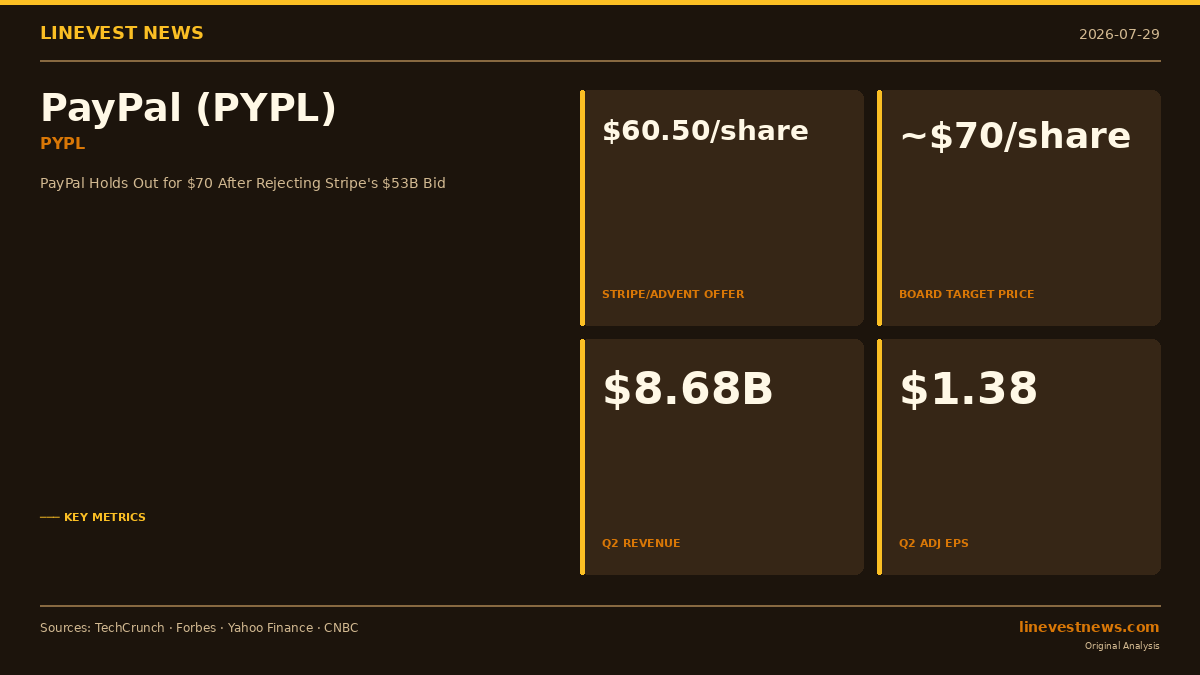
| Stripe/Advent offer | USD 60.50/share (USD 53B+ total) | Board target: ~USD 70 |
| Q2 Revenue | USD 8.68B (+5% YoY) | Beat USD 8.47B est. |
| Q2 Adjusted EPS | USD 1.38 | Beat USD 1.28 est. (+7.8%) |
| Q2 Adj. Free Cash Flow | USD 1.8B | — |
| Venmo MAU | 67 million | Rev. ~USD 1.7B in 2025 (+20% YoY) |
| PYUSD stablecoin cap | ~USD 2.8B (mid-2026) | Peak USD 4B (70 markets) |
| Stock peak (Jul 2021) | USD 305.88 (~USD 360B mkt cap) | Current ~USD 58 |
Part A: The Bid, the Rejection, and the Earnings Beat
On July 15, 2026, Stripe — the private payments infrastructure company last valued at USD 70 billion — and private equity firm Advent International jointly submitted an offer of USD 60.50 per share for PayPal, valuing the company at more than USD 53 billion. The deal structure envisioned a 50/50 ownership split between the two bidders, backed by approximately USD 50 billion in committed bank financing.
PayPal's board rejected the offer five days later, on July 20, citing inadequate valuation. According to people familiar with the matter, advisers told the bidding consortium that the board would need approximately USD 70 per share — roughly 15.7% above the Stripe/Advent proposal — to engage in serious negotiations.
The initial announcement on July 15 sent PayPal shares surging more than 16%, its largest single-day gain since 2022. The stock had been trading roughly 18% lower year-to-date before the bid was reported.
Then came the earnings test. PayPal's Q2 2026 results, reported July 28, showed the company's first revenue beat in several quarters:
- Revenue: USD 8.68 billion (+5% year over year), exceeding the USD 8.47 billion consensus estimate by 2.5%
- Adjusted EPS: USD 1.38, beating the USD 1.28 estimate by 7.8%
- Adjusted Free Cash Flow: USD 1.8 billion
CEO Enrique Lores — who joined PayPal from HP in March 2026 after Alex Chriss was removed amid slowing checkout growth — addressed the takeover question carefully on the earnings call: "We remain open and objective in evaluating opportunities. And if we see levers or a path that we believe would create superior value for our shareholders than executing our current strategy, we would, of course, carefully consider them."
The guidance was also raised, per reporting by TechTimes, reinforcing the board's position that the standalone turnaround is gaining traction.
Part B: Investment Analysis
Why the board held out at USD 70
PayPal's stock has declined approximately 90% from its peak of USD 305.88 reached in July 2021, when the company commanded a market capitalization of roughly USD 360 billion. At USD 60.50, Stripe and Advent would have been acquiring PayPal at a valuation that, while representing a ~28% premium to the pre-bid price, translates to a fraction of what investors once paid at the height of fintech euphoria.
Cantor Fitzgerald's sum-of-parts analysis puts fair value closer to USD 70 per share, citing three assets the market is underpricing:
1. PYUSD and stablecoin infrastructure. PayPal's dollar-pegged stablecoin is live across 70 markets with a market capitalization that reached USD 4 billion before contracting to approximately USD 2.8 billion by mid-2026. As stablecoin regulation in the United States advances, PYUSD positions PayPal as a regulated bridge between traditional card networks and blockchain-native payments.
2. Venmo's monetization runway. Venmo reported approximately 67 million monthly active users and an estimated USD 1.7 billion in revenue in 2025, up roughly 20% year over year. Venmo remains under-monetized relative to its engagement — business-to-consumer payment flows and credit products are early-stage revenue channels that analysts expect to scale.
3. Agentic commerce positioning. PayPal's Instant Checkout integration with OpenAI's ChatGPT embeds the company's checkout infrastructure directly into AI-generated purchasing flows. Analysts have described PayPal's consumer data advantage — accumulated from hundreds of millions of transactions — as "distinctive" in a world where AI agents complete purchases autonomously.
The credibility discount
PayPal's board price demand invites scrutiny. The company's recent record on execution is mixed:
- In February 2022, PayPal abandoned a stated target of 750 million active accounts
- The company walked away from what would have been a roughly USD 39 billion acquisition of Pinterest
- Elliott Management built and then dissolved an activist position in PayPal after approximately one year
- Branded checkout growth slowed to 1–2% in recent quarters; PayPal's U.S. digital wallet market share has fallen to approximately 40% from 90% in 2017
- Alex Chriss, Lores' predecessor, was removed in February 2026
Lores has held the CEO role for fewer than five months. His standalone plan targets USD 1.5 billion in gross run-rate cost savings over two to three years through AI-driven automation. A single quarter of revenue and EPS outperformance does not validate a multi-year structural transformation thesis.
The bidder's dilemma
Stripe's strategic rationale for acquiring PayPal is clear: a combined entity would own the most extensive checkout footprint in digital commerce, pairing Stripe's developer-first payment infrastructure with PayPal's branded consumer wallet, Venmo's social-payment network, and PYUSD's stablecoin rails.
For Advent International, the private equity calculus is more conventional — buy a distressed global brand with defensible underlying economics, execute on cost savings, and monetize through either a public listing or secondary sale.
At USD 70 per share, the deal would value PayPal at approximately USD 61.5 billion — roughly 16% above the rejected bid. At that level, the consortium would be paying approximately 16–17x estimated trailing twelve-month EBITDA, within the range of comparable fintech acquisitions but leaving limited margin for execution error.
| Scenario | Probability Estimate | Implication |
|---|---|---|
| Revised bid at USD 70–75 | Most likely path to deal | Requires bidders to absorb Q2 beat into their model |
| Rival bidder enters (Visa, Mastercard, sponsor) | Plausible | CEO openness + Q2 beat can trigger auction |
| Stripe/Advent walks away | Possible if internal return model breaks | Stock re-rates back toward USD 47–50 |
| Standalone strategy continues | Base case if no revised offer | Requires 3–4 more quarters of evidence |
Key risks
| Risk | Assessment |
|---|---|
| Branded checkout fails to re-accelerate above 3% | High — Q3 guidance will be the test |
| PYUSD market cap declines further | Medium — stablecoin competition intensifying |
| Venmo monetization timeline extends | Medium — still small vs. USD 35B+ gross revenue run rate |
| Bid collapses entirely, stock re-rates lower | High — bid announcement provided a ~16% floor |
| Regulatory review if deal proceeds | Medium — DOJ/FTC scrutiny of combined Stripe + PayPal checkout market power |
Investor takeaway
PayPal's Q2 beat puts the Stripe/Advent consortium in a difficult position. The earnings outperformance strengthens the board's argument that USD 60.50 undervalues the company. But the same board is asking Stripe to pay USD 70 for a company whose CEO has been in the role for less than five months and whose core branded checkout product grew at 1–2% as recently as Q1 2026.
For investors already holding PYPL, the Stripe bid effectively creates a soft floor near USD 60.50 — bidders are unlikely to withdraw without giving the board a final chance to negotiate. The ceiling absent a revised offer is determined by how credibly Lores can demonstrate that branded checkout and Venmo are reaccelerating.
The Q2 beat was a necessary condition for the board's USD 70 ask to be credible. It is not yet a sufficient one.
Sources: TechCrunch · Forbes · Yahoo Finance · CNBC · Gurufocus · Investors.com
This article is for informational purposes only and does not constitute investment advice. LineVest News is an independent publication and does not receive compensation from companies it covers.