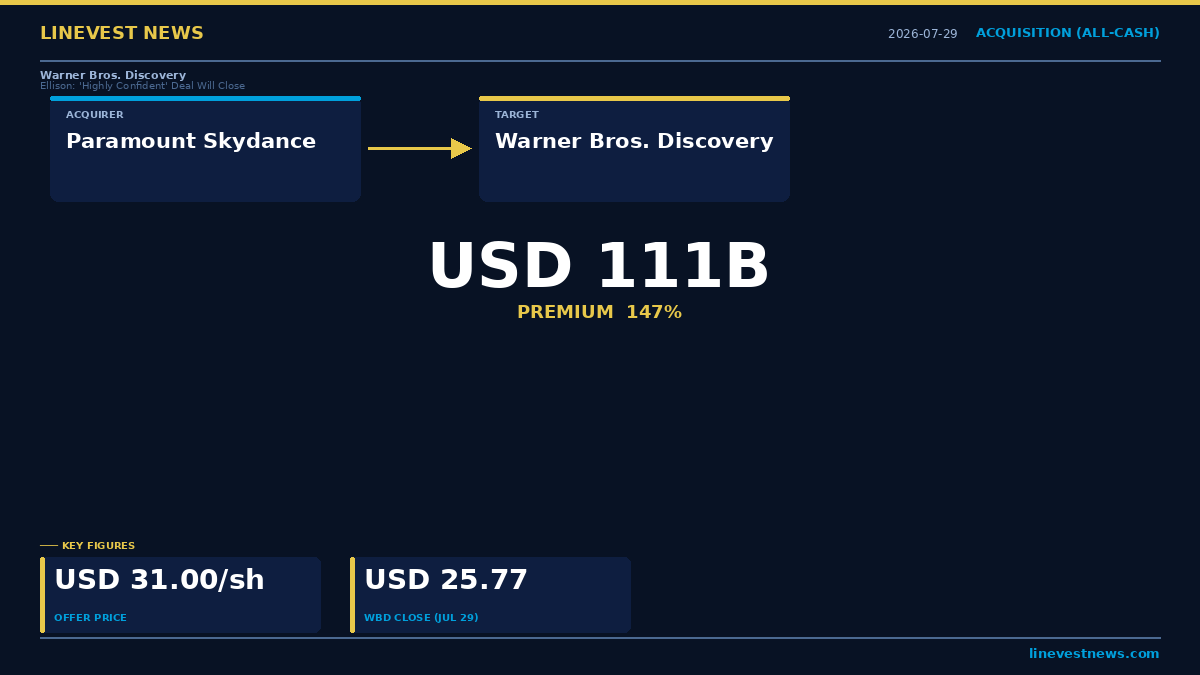
TL;DR - Paramount CEO David Ellison: "highly confident" the USD 111B WBD acquisition will complete despite legal headwinds - 12 state attorneys general won a temporary restraining order July 20; deal delayed to June 1, 2027 at latest - August 3 preliminary injunction hearing skipped — parties moving directly to trial on the merits; trial date update due July 31 - WBD at USD 25.77 vs USD 31.00 offer = ~USD 3.23/share arbitrage spread (~12.5%) as of July 29 close - Largest risk: Oracle stock down ~50% since early June has eroded Larry Ellison's USD 40.4B personal guarantee
Part A — The Deal and Where It Stands
On July 29, Paramount Skydance CEO David Ellison told staff in an internal memo that the company "remains highly confident that this transaction does not pose any legal issues, and we will complete it and bring these two companies together." The memo, widely reported by industry outlets including the Hollywood Reporter and Deadline, represents management's first public reassurance since a coalition of 12 state attorneys general won a court order pausing the USD 111 billion acquisition of Warner Bros. Discovery (NASDAQ: WBD) on July 20.
Deal Terms
Paramount agreed in February 2026 to acquire WBD for USD 31.00 per share in an all-cash transaction, valuing the company at approximately USD 111 billion — a 147% premium to WBD's pre-announcement price of USD 12.54. The deal would fold Warner Bros. Discovery's assets (HBO, CNN, Warner Bros. Studios, Discovery+, DC Comics, HGTV, TBS, TNT) into Paramount's portfolio (CBS, MTV, Nickelodeon, Paramount Pictures, Paramount+, BET) to create what would be the largest media conglomerate in the United States.
Financing structure:
| Component | Amount | Provider |
|---|---|---|
| Larry Ellison equity backstop | USD 45.7B (personal guarantee USD 40.4B) | Ellison family / Oracle holdings |
| Debt commitment | USD 54B | Bank of America, Citi, Apollo Global Management |
| WBD existing debt assumed | ~USD 33B | — |
| Combined debt burden | ~USD 87B | — |
A USD 2.8 billion breakup fee is payable by Paramount if the deal fails to close. A ticking fee of USD 0.25 per share per quarter kicks in after September 30, 2026 — equivalent to roughly USD 650 million per quarter — incentivizing rapid resolution.
Regulatory History
- April 23, 2026: WBD shareholders approved the transaction
- June 2026: U.S. Department of Justice antitrust division cleared the deal
- July 22, 2026: European Commission approved the transaction with concessions
The Legal Counteroffensive
Federal approvals were followed by state-level pushback:
- July 13, 2026: A coalition of 12 state attorneys general — led by California's Rob Bonta and including Arizona, Colorado, Connecticut, Massachusetts, Minnesota, Nevada, New Jersey, New Mexico, New York, Oregon, and Washington — filed suit in federal court, alleging the deal would "substantially lessen competition" in three markets: theatrical film distribution, anticipated blockbuster film licensing, and cable TV channel licensing
- July 20, 2026: Federal Judge Araceli Martinez-Olguin issued a 14-day temporary restraining order, pausing the merger
- July 24, 2026: Parties reached a standstill agreement: Paramount agreed not to close the acquisition until five days after a court decision on the merits or until June 1, 2027, whichever comes first. Paramount characterized the standstill as "a significant win" providing "a direct path to trial to demonstrate the merger benefits competition and consumers"
The originally scheduled August 3 preliminary injunction hearing has been bypassed in favor of proceeding directly to a full trial on the merits. Both sides must file proposed trial dates by July 31. The 12 states seek a 2027 trial date; Paramount is pushing for fall 2026.
Part B — Investment Analysis
The Arbitrage Spread
Warner Bros. Discovery (NASDAQ: WBD) closed July 29 at USD 25.77, against the USD 31.00 all-cash offer. The USD 3.23/share spread implies a 12.5% gross return contingent on deal completion — pricing in meaningful deal-failure risk.
| Risk Factor | Severity |
|---|---|
| 12-state antitrust trial — outcome uncertain | High |
| Trial delayed to 2027 — ticking fee escalation | Medium |
| Oracle stock collapse undermining Ellison guarantee | High |
| USD 54B debt financing market conditions | Medium |
The Oracle Problem
Larry Ellison personally guaranteed USD 40.4 billion of the equity financing. Oracle (NASDAQ: ORCL) — the foundation of Larry Ellison's net worth — has declined approximately 50% since early June, closing at roughly USD 117.74 in late July from a 52-week high of USD 345.72. According to The Motley Fool, the stock collapse has eroded an estimated USD 213 billion from Ellison's net worth, reducing it from approximately USD 388 billion to around USD 175 billion and dropping his global wealth ranking from second to approximately eighth place.
This creates what analysts describe as "concentrated, interlocking risk": one person's fortune, one company's stock, and one mega-merger are operationally bound. At Oracle's current price, the credibility of the personal guarantee — while still legally binding — faces heightened scrutiny from deal-closing lenders.
What the States Are Actually Arguing
The 12-state complaint invokes Section 7 of the Clayton Antitrust Act, arguing that a combined Paramount-WBD would control a disproportionate share of: 1. Theatrical output — Paramount Pictures and Warner Bros. are both top-five studios; combined, they would control an outsized fraction of wide-release product 2. Premium cable bundling — HBO (WBD) and Paramount Network, MTV, and BET under one owner could extract higher carriage fees from pay-TV distributors 3. Content licensing — Streaming buyers would face a consolidated counterpart with reduced bargaining leverage
Ellison's camp counters that both Paramount and WBD operate from positions of competitive weakness relative to Netflix, Amazon Prime Video, and Disney+. Their argument: the merger strengthens a viable fourth competitor against Big Tech-backed rivals rather than entrenching market power.
Trial Timing Is the Critical Variable
If the case goes to trial in fall 2026, deal uncertainty resolves before the ticking fee becomes onerous. If states succeed in pushing the trial to 2027, Paramount faces up to approximately USD 1.75 billion in additional ticking fees before closing — and WBD shareholders bear the cost of waiting through prolonged uncertainty.
If the deal is blocked entirely, WBD reverts to its pre-deal standalone profile: approximately USD 33 billion net debt, a legacy cable business in structural decline, and a streaming unit (Max) competing against better-capitalized rivals. The stock would likely revert toward the USD 10-12 range where it traded before deal speculation emerged in late 2025.
This article is for informational purposes only and does not constitute investment advice. Warner Bros. Discovery (WBD) and Paramount Global (PARA) are publicly traded on NASDAQ.
Sources: Bloomberg, Hollywood Reporter, TechCrunch, The Motley Fool, CNBC, Deadline, Graphic Policy