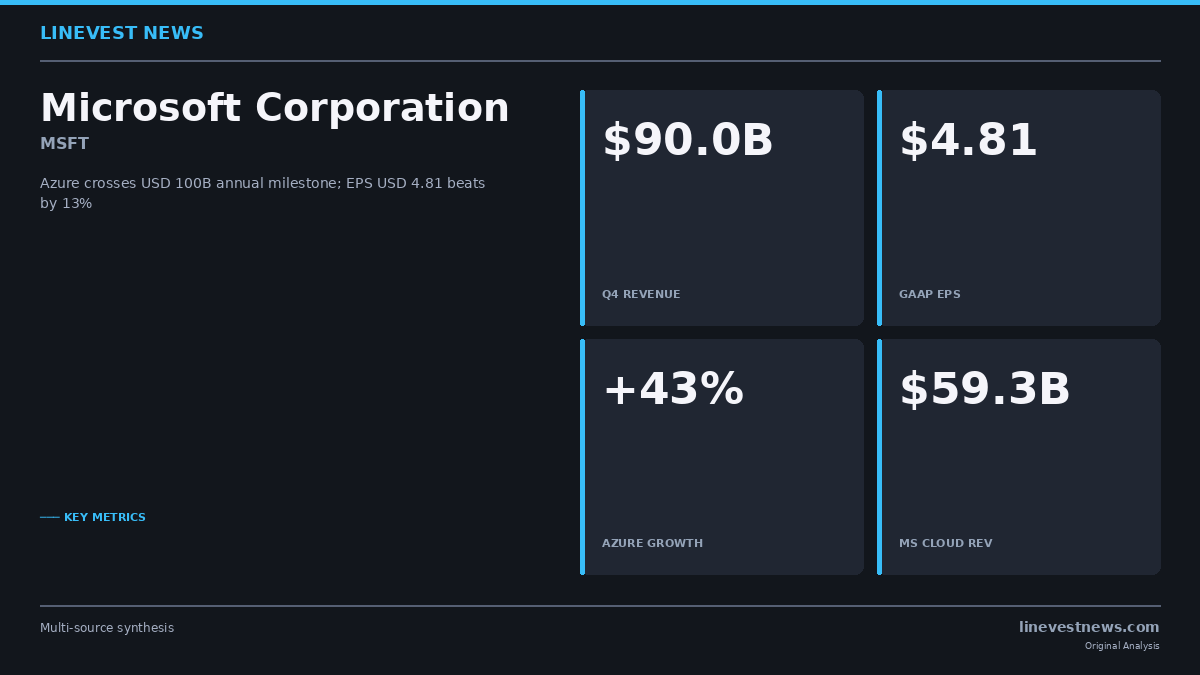
- Q4 FY2026 Revenue: USD 90.0B (+18% YoY); beat USD 87.7B consensus
- Azure cloud revenue: +43% YoY — crossed USD 100B annual milestone for first time
- GAAP EPS: USD 4.81 (+32%); beat USD 4.24 consensus by 13%
- Q4 CapEx: USD 35.8B — came in at or below estimates; unlike Meta/Alphabet which raised forecasts
- MSFT shares: +3–8% after-hours on earnings beat and CapEx relief
Part A — Q4 FY2026 Earnings Summary
Microsoft Corporation (NASDAQ: MSFT) reported fourth-quarter and full fiscal-year 2026 results after the market close on July 29, 2026, topping expectations across the board and triggering a sharp after-hours rally.
Q4 Key Financials
| Metric | Q4 FY2026 | YoY Change | vs. Consensus |
|---|---|---|---|
| Total Revenue | USD 90.0B | +18% | Beat (est. USD 87.7B) |
| Operating Income | USD 40.6B | +18% | — |
| Net Income (GAAP) | USD 35.8B | +31% | — |
| GAAP Diluted EPS | USD 4.81 | +32% | Beat (est. USD 4.24) |
| Non-GAAP EPS | USD 4.74 | +23% | Beat |
| Microsoft Cloud Revenue | USD 59.3B | +27% | — |
| Azure and Cloud Services | +43% YoY | — | Beat (est. ~40%) |
| Q4 CapEx | USD 35.8B | — | In-line/slight miss (est. USD 36.1B) |
Segment Breakdown
Intelligent Cloud — USD 39.3B (+32% YoY)
Microsoft's fastest-growing segment was powered by Azure, which grew 43% year-over-year, beating analyst estimates of approximately 40% growth. Azure crossed USD 100 billion in annual revenue during fiscal 2026 for the first time in the company's history.
Productivity and Business Processes — USD 37.8B (+14% YoY)
Microsoft 365 Copilot, the company's AI assistant embedded across Office products, surpassed 30 million paid seats during the quarter. Microsoft 365 Commercial cloud grew 14% (16% in constant currency), LinkedIn +12%, and Dynamics 365 +13%.
More Personal Computing — USD 12.9B (-4% YoY)
The consumer hardware division declined, with Windows OEM and Devices falling 7% and Xbox content and services down 10%, reflecting ongoing softness in consumer PC and gaming markets.
Full-Year FY2026 Results
| Metric | FY2026 | FY2025 | YoY Change |
|---|---|---|---|
| Revenue | USD 331.8B | USD 281.0B | +18% |
| Operating Income | USD 155.2B | USD 128.3B | +21% |
| Net Income (GAAP) | USD 133.7B | USD 102.0B | +31% |
| GAAP EPS | USD 17.95 | USD 13.60 | +32% |
Capital Expenditure and Cash Flow
Q4 capital expenditures came in at USD 35.8 billion, compared to USD 17.1 billion a year earlier — more than doubling year-over-year — but landing slightly below analyst estimates of USD 36.1 billion. Full-fiscal-year FY2026 capex totaled USD 115.9 billion, up approximately 79% from USD 64.6 billion in FY2025. The company generated USD 55.4 billion in Q4 operating cash flow and returned USD 10.2 billion to shareholders via dividends and buybacks.
Commercial remaining performance obligation (RPO) — a measure of contracted but not yet recognized revenue — expanded 84% year-over-year to USD 678 billion, signaling robust multi-year cloud and AI contract demand.
CEO Satya Nadella stated: "We are advancing the frontier on the cost-to-outcome curve, ensuring every customer can turn tokens into business results."
Part B — Market Analysis and Investment Implications
The CapEx "Hold" That Moved the Stock
The most market-sensitive data point from Microsoft's earnings was not a number that beat — it was a number that held steady. While Meta Platforms raised its FY2026 capital expenditure guidance to USD 64–72 billion in late July, and Alphabet has repeatedly revised its spending targets higher, Microsoft's Q4 capex of USD 35.8 billion came in slightly below the USD 36.1 billion analyst estimate. This is being interpreted as a signal of spending discipline rather than reduced ambition.
For investors who have spent the past two years worrying about "AI capex forever" risk — where hyperscalers keep spending without proportional revenue acceleration — Microsoft's steady hand sends a clear message: the company believes its current infrastructure spending curve is calibrated to actual demand, not speculative future demand.
That narrative matters for the broader AI investment thesis. If the largest enterprise AI platform in the world believes its infrastructure spending is appropriately sized, it reduces the risk of a sector-wide capex overshoot and the margin compression that would follow.
Azure's USD 100 Billion Milestone Is Structural, Not Symbolic
Azure crossing USD 100 billion in annual revenue is more than a headline number. At 43% quarterly growth — still accelerating despite a larger base — Azure is attracting enterprise workloads at a pace that validates Microsoft's multi-year infrastructure investment story. The key drivers: AI-powered workloads running on Azure, Copilot integration across Microsoft 365 driving net-new cloud seats, and multi-year enterprise contracts reflected in the USD 678 billion RPO backlog.
The backlog figure deserves particular attention. RPO growing 84% year-over-year means Microsoft has contracted future revenues at more than double the pace it is recognizing them. This provides exceptional revenue visibility heading into FY2027 and insulates the stock from short-term demand uncertainty.
Copilot Monetization Is Accelerating
Microsoft 365 Copilot reaching 30 million paid seats is a critical commercial milestone. At an estimated USD 30 per user per month blended price, 30 million paid seats represents approximately USD 900 million in annualized Copilot-specific ARR — a figure that did not exist two years ago. The trajectory — from pilot programs to millions of paid users in 18 months — validates the AI-era Office upgrade cycle and creates structural demand for Microsoft 365 premium tiers.
Investment Considerations
Positive signals: Azure growth re-acceleration to 43%, CapEx discipline relative to peers, RPO backlog visibility at USD 678 billion, and Copilot seat growth all support the thesis that Microsoft is monetizing AI investments faster than the market expected.
Risk factors: The More Personal Computing segment's 4% decline highlights consumer market softness. Full-year capex of USD 115.9 billion is still a historically unprecedented level of spending for any technology company, and AI revenue must continue scaling to justify ongoing infrastructure investment. Analysts cite a 3–5 year payback period on AI infrastructure, which remains a potential overhang on forward multiples.
This article is for informational purposes only and does not constitute investment advice. Past performance is not indicative of future results.
Sources: