DoorDash has received FAA Part 135 air carrier certification and is building DoorDash Air, a proprietary drone delivery division developed in-house through DoorDash Labs — marking a strategic shift from relying solely on third-party drone partners to owning the full autonomous delivery stack.
Part A: What Was Announced
DoorDash Air and FAA Certification
DoorDash confirmed on July 29, 2026, that it has obtained the FAA Part 135 Air Carrier Certificate, authorizing commercial drone operations in the United States. The certification enables DoorDash to conduct its own aerial deliveries rather than exclusively partnering with drone operators.
The initiative is operated under DoorDash Labs, the company's robotics and autonomy unit — the same team behind "Dot," DoorDash's autonomous sidewalk delivery robot currently deployed in Arizona and California.
Initial operations will involve short-distance flights under operator visual line of sight (VLOS) supervision. Full autonomous, beyond-visual-line-of-sight (BVLOS) operations require additional FAA approvals not yet granted.
The Autonomous Delivery Platform
At the core of DoorDash Air is the company's proprietary Autonomous Delivery Platform, an AI-dispatching system that coordinates three delivery modes simultaneously:
- Human Dashers (traditional couriers)
- Dot (ground-based sidewalk robots)
- Drones (aerial delivery via DoorDash Air)
The platform selects the optimal delivery method for each order in real-time based on distance, order weight, location density, and estimated cost-per-drop.
Existing Partnerships Continue
DoorDash emphasized that its current drone partnerships with Wing (Alphabet's drone subsidiary) and Flytrex remain active in parallel — servicing metro Atlanta, Charlotte (60,000+ homes), and Dallas-Fort Worth (30,000+ households). DoorDash Air represents an expansion of capability, not a replacement of existing agreements.
Co-Founder Stanley Tang's Rationale
Co-founder Stanley Tang framed the move around pragmatism: the company is addressing "actual customer problems" rather than pursuing autonomy as a novelty. By building its own drone infrastructure, DoorDash can coordinate aerial delivery alongside its ground and human networks within a single operating system — a capability Tang positioned as unique among food delivery platforms.
Part B: Investor Implications
Why the In-House Drone Division Matters for DASH
DoorDash's fundamental financial challenge has been its structural exposure to labor cost inflation. Human couriers represent the largest variable cost in the per-order economics. Every delivery completed by a drone or ground robot that would otherwise require a human Dasher reduces the marginal cost of fulfillment.
FAA Part 135 certification grants DoorDash the legal authority to operate its own drone fleet commercially — a prerequisite for moving beyond pilot partnerships into scalable autonomous delivery. By owning the stack (platform + air carrier certificate), DoorDash captures economics previously shared with Wing or Flytrex.
Current Operational Reality vs. Long-Term Optionality
Investors should note several constraints:
| Factor | Current Status |
|---|---|
| Flight range | Short-distance VLOS only |
| Payload limit | ~2.5 lbs (small orders: beverages, sides) |
| BVLOS approval | Pending additional FAA process |
| Urban deployment | Dense cities require separate waivers |
Near-term revenue impact from DoorDash Air is likely immaterial. Drone delivery economics improve meaningfully only at scale, and BVLOS capability — essential for suburban grid coverage without costly operator staffing — is still subject to regulatory timelines.
Business Fundamentals: Q1 2026
DoorDash's core metrics show continued strong growth even without autonomous delivery revenue:
| Metric | Q1 2026 | YoY Change |
|---|---|---|
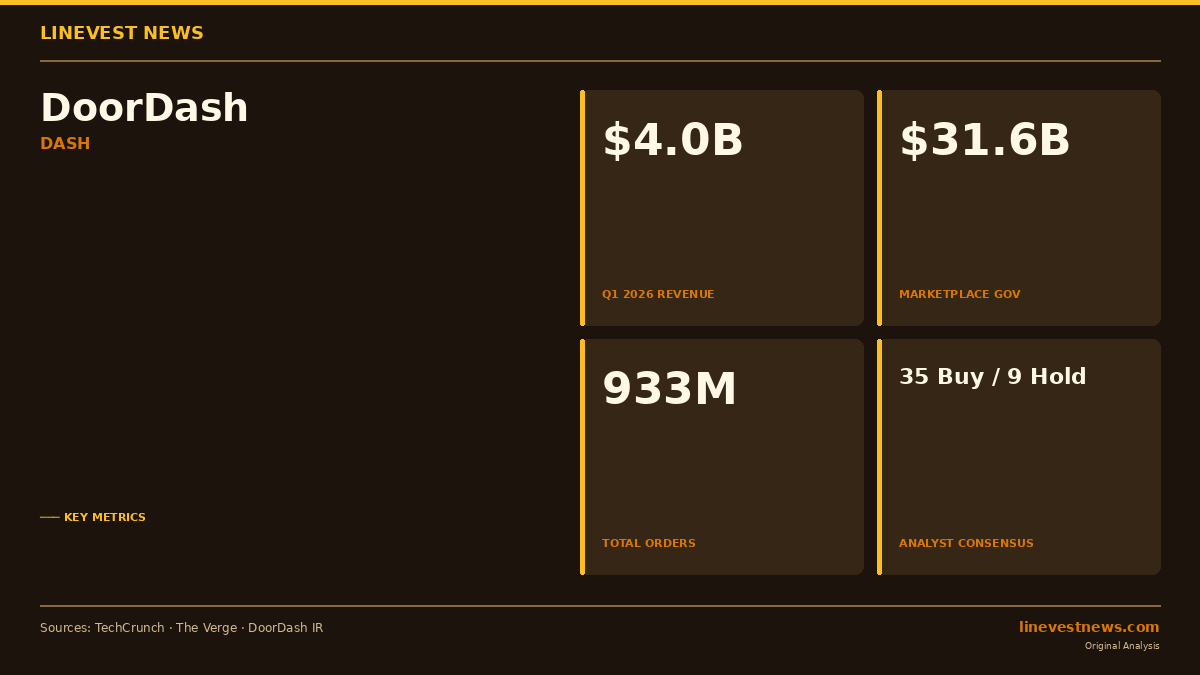
| Revenue | USD 4.0B | +33% |
| Marketplace GOV | USD 31.6B | +37% |
| Total Orders | 933M | +27% |
| Adjusted EBITDA | USD 754M | +28% |
For Q2 2026, management guided Marketplace GOV of USD 32.4–33.4B and Adjusted EBITDA of USD 770–870M. GAAP net income turned modestly positive in Q1 at USD 184M, though down 5% year-over-year as the company invested in autonomous infrastructure.
Stock Context and Analyst Sentiment
DASH has declined approximately 21% year-to-date in 2026 and trades roughly 36% below its 52-week high of USD 285.50. Wall Street remains broadly constructive: among 44 analysts tracked, 35 rate the stock Buy, 9 Hold, and 0 Sell, with a median price target of USD 250 — representing material upside from current levels.
The persistent discount to analyst consensus reflects the market's skepticism over whether autonomous delivery can scale fast enough to justify elevated valuation multiples during the investment phase.
Competitive Positioning
DoorDash Air enters a crowded, capital-intensive field:
- Amazon Prime Air: FAA Part 135 certified, commercial operations in College Station, TX and Phoenix, AZ; 25-minute delivery promise
- Wing (Alphabet): FAA Part 135 certified since 2019; DoorDash's own partner network
- Uber Eats / Flytrex: Launched U.S. drone delivery partnership July 2026
DoorDash's differentiation is the unified operating system — integrating aerial, ground-robot, and human delivery into a single dispatch layer. No competitor currently operates all three modalities under one platform. If FAA regulations permit BVLOS expansion and unit economics improve at scale, DoorDash's multi-modal stack could emerge as a structural competitive moat in suburban and semi-urban markets.
Key Risk: Regulatory Timeline
BVLOS operations — the key to making drone delivery economically viable at scale — depend on FAA's evolving regulatory framework. The FAA finalized new drone delivery rules in late 2025, but BVLOS waivers remain granted case-by-case. Any delay in the federal framework could push meaningful drone contribution to DoorDash's unit economics beyond 2027.
This article is for informational purposes only and does not constitute investment advice. DoorDash (DASH) shares are listed on the Nasdaq.
Sources: - TechCrunch: "DoorDash is building its own drone delivery business" (July 29, 2026) - The Verge: "DoorDash is going airborne with new drone delivery division" (July 29, 2026) - DoorDash IR: Q1 2026 Financial Results (May 6, 2026) - DoorDash Newsroom: DoorDash and Wing Expand to Atlanta (April 2026) - DoorDash Help Center: Drone Delivery page - MarketBeat: DASH analyst consensus (accessed July 29, 2026)