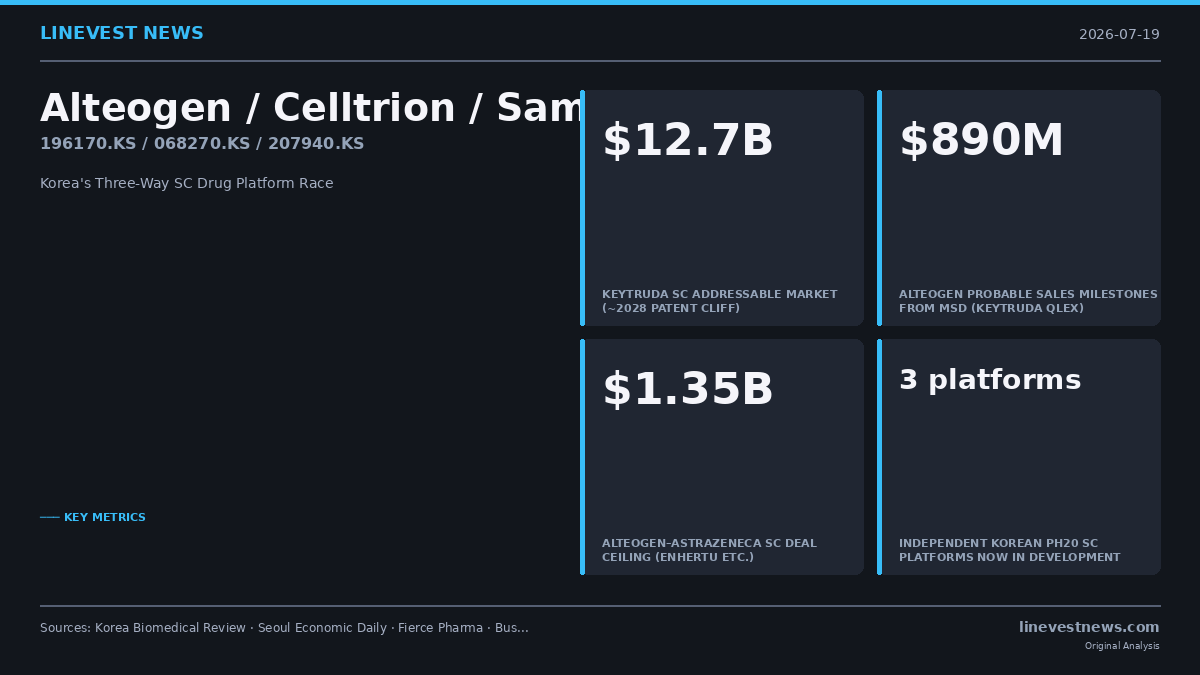
TL;DR - Alteogen (196170.KS) has locked in $40M in confirmed milestones from MSD for ALT-B4 powering Keytruda SC (Qlex), with up to $890M more tied to future sales. - Celltrion (068270.KS) filed for EMA and Korean approval of Herzuma SC in 2026, bypassing Halozyme and Alteogen with its own PH20 enzyme. - Samsung Bioepis (unlisted; parent Samsung BioLogics, 207940.KS) completed internal testing of a third proprietary SC platform and posted positive Phase 1+3 data for Keytruda biosimilar SB27. - Keytruda's substance patent expires in approximately 2028, opening a $12.7 billion addressable market for SC-formulated biosimilars.
Part A — What Is the SC Drug Conversion Market and Why Korea Matters
Subcutaneous (SC) drug delivery converts intravenous (IV) biologics into a syringe-sized injection administered in minutes. The enabling chemistry is a recombinant human hyaluronidase enzyme (PH20) that temporarily degrades hyaluronic acid in subcutaneous tissue, allowing high-concentration antibody payloads to disperse and absorb quickly.
The global SC biopharmaceutical market is projected to reach $286.3 billion in 2026, rising to $498.9 billion by 2031, according to industry estimates. SC versions of blockbuster drugs command renewed market exclusivity through separate formulation patents, making this the pharmaceutical industry's preferred tool for extending product life cycles beyond small-molecule patent cliffs.
Halozyme Therapeutics (HALO, Nasdaq) created this market with its ENHANZE platform, built on the recombinant human hyaluronidase enzyme rHuPH20, licensing it to Roche (Herceptin SC), Johnson & Johnson (Darzalex SC), and AstraZeneca, among others. Halozyme's ENHANZE patent portfolio comprises approximately 100 patents, with US protection extending to 2034 and European coverage to 2032.
But two Korean biotechs — Alteogen and, more recently, Celltrion and Samsung Bioepis — have built independent SC platforms that challenge Halozyme's near-monopoly and may disrupt royalty flows for years to come.
Part B — Korea's Three-Platform Race: Strategic Stakes for Investors
1. Alteogen (196170.KS) — The Licensor Model
Alteogen's ALT-B4 (berahyaluronidase alfa) is the most commercially advanced Korean SC platform. In 2025, MSD's Keytruda SC formulation — marketed as Keytruda Qlex — received both FDA approval (September 2025) and European Commission approval, securing $25 million and $15 million in regulatory milestones respectively ($40 million total).
The financial runway is considerably larger. Under the licensing agreement, MSD determined it was probable that future Keytruda Qlex sales would trigger $890 million in sales-based milestone payments to Alteogen, in addition to royalties on net sales. Alteogen also signed a $1.35 billion deal with AstraZeneca for SC conversions of oncology assets including Enhertu (trastuzumab deruxtecan), an antibody-drug conjugate.
However, Alteogen's position is not without risk. Halozyme filed a patent infringement lawsuit against Merck & Co. in April 2025, alleging that Keytruda SC infringes 15 of its patents. In December 2025, the Munich Regional Court issued a preliminary injunction blocking Keytruda SC sales in Germany, the EU's largest pharmaceutical market. Alteogen has publicly defended the independence of ALT-B4's technology, and no injunction has been granted in the US. The legal dispute remains active.
Investor angle: Alteogen operates a pure-licensor model with no manufacturing CAPEX. Revenue is milestone- and royalty-based. The $890M milestone figure represents a visible, high-probability earnings event tied directly to Keytruda Qlex commercial uptake. MSD projects 30–40% of IV Keytruda patients could switch to SC within two years, creating a large conversion opportunity before Keytruda's ~2028 patent cliff.
| Metric | Detail |
|---|---|
| Confirmed milestones received | $40M (FDA $25M + EC $15M) |
| Probable future milestones | Up to $890M (sales-based) |
| AstraZeneca deal ceiling | $1.35B |
| German injunction status | Preliminary injunction granted (Dec 2025) |
| US court ruling | Not yet issued |
2. Celltrion (068270.KS) — The Biosimilar Direct Challenger
Celltrion is taking a different path: instead of licensing SC technology to innovators, it is developing SC formulations of existing biosimilars using its own proprietary hyaluronidase platform.
The lead program is Herzuma SC (CT-P6 SC), a biosimilar of Roche's Herceptin SC (trastuzumab + hyaluronidase). Celltrion launched pivotal pharmacokinetic trials in February 2025, and in 2026 filed for EMA approval (April) and Korean Ministry of Food and Drug Safety approval (May). Pivotal trial results showed pharmacokinetic equivalence to the reference product, satisfying the primary endpoint.
A second program, CT-P44, targets Darzalex SC (daratumumab + hyaluronidase), with clinical trials commenced in August 2025.
The strategic rationale: by owning its PH20 enzyme outright, Celltrion eliminates the royalty burden that would otherwise flow to Halozyme (which supplies Roche's and J&J's SC platforms). This in-house approach also positions Celltrion to target the high-value Keytruda SC biosimilar market post-2028 without licensing exposure to either Halozyme or Alteogen.
Investor angle: Celltrion's SC pipeline adds optionality to an already complex biosimilar portfolio. Herzuma SC and CT-P44 face competition from other biosimilar developers — but Celltrion's proprietary PH20 lowers structural costs. Execution risk lies in regulatory timelines; EMA biosimilar reviews typically take 12–15 months, suggesting a 2027 commercial window for Herzuma SC in Europe, if approved.
3. Samsung Bioepis (Parent: Samsung BioLogics, 207940.KS) — The Late Entrant With Independent Tech
Samsung Bioepis, a joint venture majority-owned by Samsung BioLogics, completed internal validation of its own recombinant human PH20 hyaluronidase platform in early July 2026 and filed related cultivation and purification process patents. The company explicitly designed its enzyme to be distinct from Halozyme's ENHANZE technology and Alteogen's ALT-B4, aiming to avoid IP disputes while delivering equivalent SC conversion capability.
On June 29, 2026, Samsung Bioepis announced positive preliminary Phase 1 and Phase 3 data for SB27, its proposed Keytruda (pembrolizumab) biosimilar, meeting both pharmacokinetic and safety primary endpoints — the first company globally to publish Phase 3 Keytruda biosimilar data. SB27 was developed using the IV formulation; the SC application of Samsung's new proprietary platform has not yet been publicly announced for specific drugs.
Keytruda's global revenue was $31.7 billion in its most recent fiscal year. With a substance patent expiry of approximately 2028, the addressable biosimilar market — including the SC formulation — is the largest biosimilar opportunity in pharmaceutical history.
Investor angle: Samsung BioLogics (207940.KS) is the publicly traded parent. Samsung Bioepis results consolidate into the BioLogics balance sheet. Investors watching the Keytruda biosimilar opportunity should note that regulatory filing timelines have not been disclosed for SC SB27; approval and launch would likely fall post-2028. Samsung Bioepis's first-mover advantage in Phase 3 Keytruda biosimilar data is strategically significant for partnership and licensing negotiations.
SC Platform Competitive Snapshot
| Company | Platform | Key Drug | Stage | Business Model |
|---|---|---|---|---|
| Halozyme (HALO) | ENHANZE (rHuPH20) | Darzalex SC, Herceptin SC | Commercial | Licensing to innovators |
| Alteogen (196170.KS) | ALT-B4 | Keytruda Qlex (SC) | Commercial (US, EU) | Licensing to innovators |
| Celltrion (068270.KS) | Proprietary PH20 | Herzuma SC, CT-P44 | EMA/KR review | In-house biosimilar |
| Samsung Bioepis (parent: 207940.KS) | Proprietary PH20 | SB27 (Keytruda biosimilar) | Phase 3 data readout | In-house biosimilar |
| Huons Lab (Huonskl, unlisted) | HyDifuse | Pre-licensing | Pre-clinical / early BD | Licensing to innovators |
What to Watch
- Halozyme vs. Merck Germany ruling: A permanent injunction or settlement would directly affect Keytruda Qlex EU revenues — and Alteogen's downstream milestone payments.
- Celltrion EMA decision on Herzuma SC (expected 2027): First Korean SC biosimilar to reach the European market would validate the independent-platform strategy.
- Samsung Bioepis SC filing announcement: The company has said it is evaluating which drugs to apply its new PH20 technology to — an announcement targeting Keytruda or Enhertu SC would be a material catalyst for 207940.KS.
- Alteogen $890M milestone timeline: MSD's 30–40% IV-to-SC conversion projection underpins the milestone trigger; sales data for Keytruda Qlex in 2026 will offer a first read.
This article is journalistic analysis, not investment advice. Alteogen (196170.KS), Celltrion (068270.KS), and Samsung BioLogics (207940.KS) are South Korean Exchange-listed securities. Investors should conduct their own due diligence.
Sources: - Korea JoongAng Daily / Chosunbiz — SC platform biosimilar race (July 19, 2026) - Korea Biomedical Review — Alteogen $15M MSD EU milestone - Seoul Economic Daily — Samsung, Celltrion target $12.7B Keytruda SC market (July 14, 2026) - Seoul Economic Daily — Samsung Bioepis cracks high-dose SC tech (July 13, 2026) - BusinessWire — Samsung Bioepis SB27 Phase 1 and Phase 3 data (June 29, 2026) - Fierce Pharma — AstraZeneca $1.35B Alteogen deal - PR Newswire — Halozyme wins Germany PI against Merck Keytruda SC - Pearce IP — Celltrion EMA Herzuma SC filing (April 2026) - Pearce IP — Celltrion Korean Herzuma SC filing (May 2026)