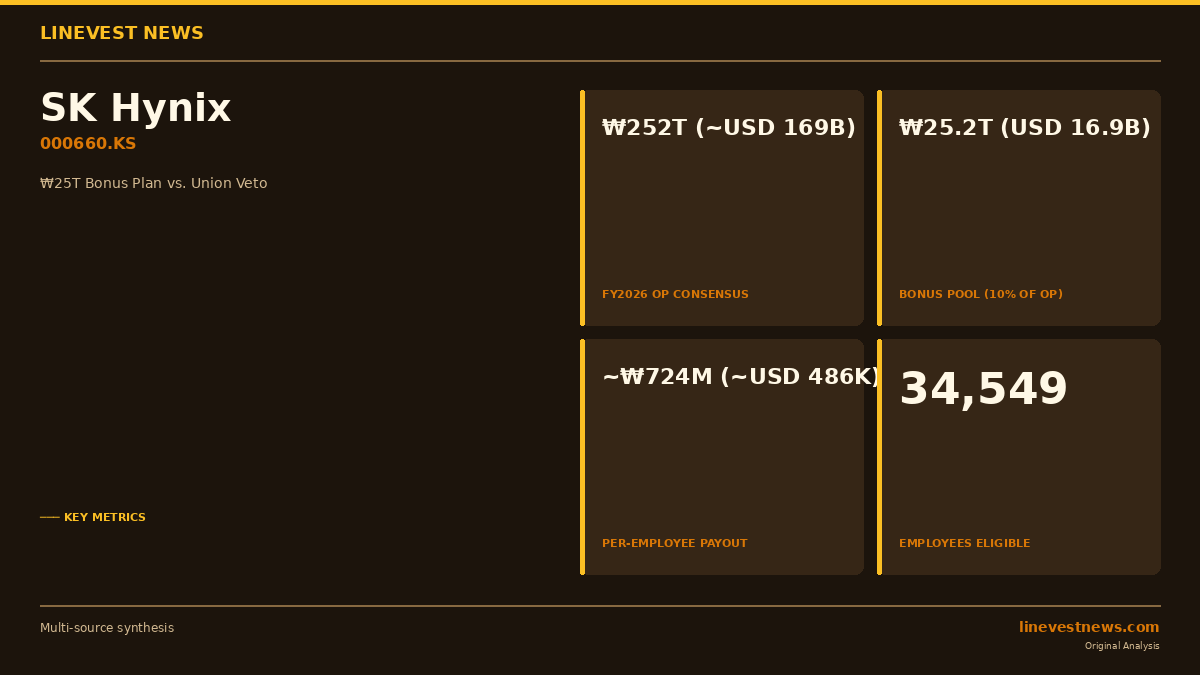
TL;DR - SK Hynix management has proposed paying part of the 2026 performance bonus in treasury shares rather than cash - With FY2026 operating profit consensus at ~₩252 trillion (~USD 169 billion), the 10%-of-OP bonus pool reaches roughly ₩25 trillion ($16.8 billion) - Divided among 34,549 employees, that implies a per-worker payout of approximately ₩724 million (~$486,000) - The union objects: Korean law taxes share-based pay as earned income at the price on the payment date, potentially forcing workers to sell shares immediately to cover the tax bill - Wage talks opened June 22; Samsung Electronics went a different route — a 6.2% cash raise plus subsidized housing loans
Part A: The Proposal and the Pushback
SK Hynix (000660.KS), the world's second-largest memory chipmaker by revenue, has put an unusual offer on the table in its 2026 wage and collective bargaining negotiations: pay part of this year's performance bonus in treasury shares rather than cash.
The offer, reported Friday by the Seoul Economic Daily, marks a potential departure from the formula labor and management agreed on last year — 10% of annual operating profit, distributed entirely in cash. With analyst consensus placing SK Hynix's FY2026 operating profit at approximately ₩252 trillion (around USD 169 billion), the bonus pool would reach roughly ₩25.2 trillion ($16.9 billion). Divided among the company's 34,549 employees, that implies a per-worker payout of around ₩724 million (approximately $486,000 at prevailing exchange rates), consistent with Tom's Hardware's independently calculated estimate of approximately $477,000 per employee.
Management's stated rationale is threefold: reducing the immediate cash drain on the balance sheet, encouraging employees to align their interests with long-term shareholders by holding the stock, and stabilizing the share register.
The union is unconvinced. Under Korean income-tax law, share-based compensation is treated as earned income and taxed at the closing price on the payment date. An employee receiving 3,000 shares at a market price of ₩180,000 per share faces a wage-income tax liability calculated on roughly ₩540 million — regardless of whether the employee intends to hold. In practice, many workers would need to liquidate a significant portion of the award on receipt simply to settle the tax bill, ironically creating short-term selling pressure in the very stock the company wants employees to hold.
The added complication is price risk. SK Hynix shares declined roughly 40% from their 2026 peak amid AI-capital-expenditure concerns that swept through global memory markets in mid-July. An employee who receives shares at a depressed price and cannot sell faces meaningful mark-to-market exposure; if the price recovers sharply before the payment date, the income-tax liability could exceed initial expectations.
Wage talks formally opened on June 22, 2026. Both sides describe the negotiations as preliminary. "No specific negotiation plan is being bargained by labor and management yet," an industry official told the Seoul Economic Daily.
How Samsung Handled It
Samsung Electronics (005930.KS), which reported Q2 2026 operating profit of ₩89.4 trillion — a record — concluded its own 2026 wage agreement in May with a 6.2% base wage increase. Management added a housing-stability loan: up to ₩500 million for home purchases and up to ₩300 million for jeonse (lease deposits), both at an annual interest rate of 1.5%. The bonus payment structure remained in cash.
SK Hynix's union is reportedly seeking Samsung-equivalent welfare benefits on top of the performance bonus.
| Item | Samsung Electronics | SK Hynix (proposed) |
|---|---|---|
| Base wage increase | +6.2% | Under negotiation |
| Bonus vehicle | Cash | Partial treasury shares (proposed) |
| Housing loan (purchase) | ₩500M at 1.5% | ₩100M at undisclosed rate |
| Bonus formula | ~10.5% of OP | 10% of OP |
| Bonus pool (est.) | ~₩34.6T | ~₩25.2T |
Part B: Why This Matters for Investors
The Macro Scale
The numbers are not marginal. Bloomberg reported in May 2026 that Samsung Electronics and SK Hynix combined could distribute as much as ₩30 trillion in performance bonuses as their semiconductor earnings surge, with analysts flagging that a significant share would flow into the semiconductor belt's real-estate markets (Suwon, Yongin, Icheon). The Bank of Korea cited financial-stability concerns when it raised the benchmark rate by 25 basis points to 2.75% on July 16 — its first hike in more than three years, approved unanimously 7–0. While BoK Governor Hyun Song Shin did not cite chip bonuses specifically, the central bank has made clear that household liquidity and asset-price dynamics remain live variables in its policy calculus.
Treasury Shares: Allocation vs. Cancellation
SK Hynix's board committed to retiring all approximately 50 million treasury shares (roughly 2.1% of the 728.87 million shares outstanding) held as of Q1 2026. In 2025, the company cancelled ₩12.2 trillion of shares and paid ₩2.1 trillion in dividends, for total shareholder returns of ₩14.3 trillion.
If management redirects some treasury shares into employee compensation rather than cancellation, the mathematical effect on supply is the same in the short run — shares move from the company's balance sheet to employee accounts. The critical difference is intent and timing: cancelled shares disappear permanently; employee shares are likely to be sold in part, particularly around the payment date when income-tax bills come due. Investors monitoring share-price dynamics should track the payment date if a treasury-share tranche is ultimately agreed upon.
Q2 Results — The Arithmetic Updates July 22
SK Hynix reports Q2 2026 results on July 22. Consensus operating profit stands at approximately ₩64 trillion, versus ₩37.61 trillion in Q1 2026 and ₩9.21 trillion in Q2 2025 (+595% year-over-year). A Q2 result near consensus would confirm H1 2026 operating profit at approximately ₩101.6 trillion, lending credibility to the full-year ₩250–265 trillion range and — crucially — enlarging the bonus pool. If the quarter beats materially, the union's resistance to any non-cash settlement is likely to harden.
| Metric | Q1 2026 (Actual) | Q2 2026 (Consensus) | FY2026 (Consensus Range) |
|---|---|---|---|
| Operating Profit | ₩37.61T | ~₩64T | ₩250T – ₩265T |
| Bonus Pool (10%) | ₩3.76T | ~₩6.4T | ₩25T – ₩26.5T |
| Per-Employee Bonus | ~₩109M | ~₩185M | ~₩724M – ₩767M |
| Per-Employee (USD) | ~$73K | ~$124K | ~$486K – $515K |
Exchange rate: ₩1,490/USD
The Precedent Question
Korea's semiconductor supercycle is generating compensation dynamics with no precedent in Korean corporate history. Per-employee bonuses approaching ₩724 million ($486,000) — in a country where the average annual wage is roughly ₩40 million — represent a structural compression of the wage distribution within a single industry. The negotiation over how to structure that payment is a test case for whether Korean conglomerates can use equity-based compensation to align workforce incentives with long-term shareholder value, or whether the tax architecture makes stock-based awards impractical without legislative change.
If the treasury-share proposal fails — as early union signals suggest it may — the debate could resurface in the next legislative session, where lawmakers may consider amending income-tax treatment of employer-issued shares to defer taxation until sale rather than receipt.
The Korea Exchange was closed July 17, 2026 for Constitution Day. SK Hynix Q2 2026 results are expected on July 22, 2026.
Sources: Seoul Economic Daily (July 18, 2026); Tom's Hardware (July 2026); Bloomberg via Seoul Economic Daily (May 27, 2026); SK Hynix Q1 2026 earnings release; Bank of Korea monetary policy statement (July 16, 2026).
LineVest News provides financial journalism for informational purposes only. Nothing in this article constitutes investment advice or a recommendation to buy or sell any security.