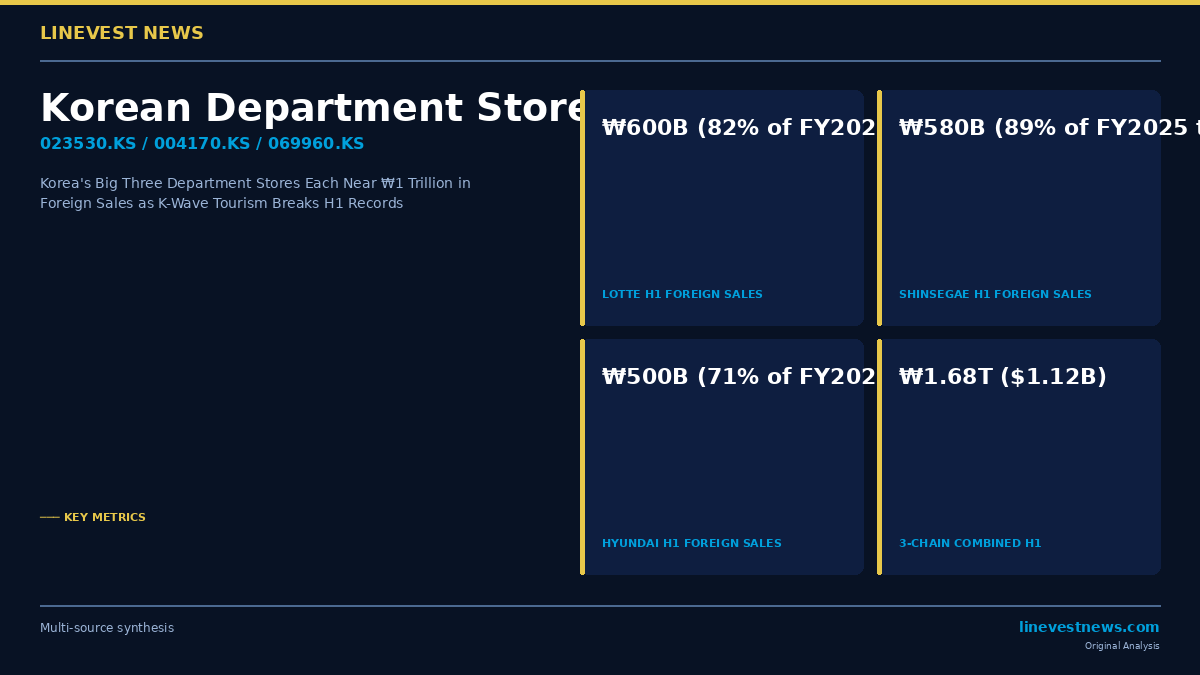
Korea's Big Three Department Stores Each Nearing ₩1 Trillion in Foreign Sales as K-Wave Tourism Shatters H1 Records
TL;DR - Lotte, Shinsegae, and Hyundai Department stores collectively drew ₩1.68 trillion ($1.12 billion) in foreign purchases in H1 2026 — already approaching their full-year 2025 totals - All three chains expect annual foreign revenue to top ₩1 trillion each for the first time ever in 2026 - Inbound tourism hit 10 million arrivals by mid-June, the earliest milestone ever, lifting May foreign tourist spending by 67.1% year-on-year - Kiwoom Securities raised 2026 operating profit forecasts by 14–70% across the sector; Shinsegae's stock has gained 166.5% over six months
Part A: H1 2026 Foreign Sales — A Structural Reset
South Korea's three largest department-store operators — Lotte Shopping (023530.KS), Shinsegae (004170.KS), and Hyundai Department Store (069960.KS) — posted their strongest ever first-half foreign sales figures in 2026, collectively booking ₩1.68 trillion ($1.12 billion) in purchases by international visitors from January through June.
| Company | H1 2026 Foreign Sales | FY2025 Full-Year | H1 as % of Prior FY |
|---|---|---|---|
| Lotte Department Store | ₩600B ($399M) | ₩730B | 82.2% |
| Shinsegae Department Store | ₩580B ($386M) | ₩650B | 89.2% |
| Hyundai Department Store | ₩500B ($333M) | ₩700B | 71.4% |
| Three-chain total | ₩1.68T ($1.12B) | ₩2.08T | 80.8% |
Exchange rate: approx. ₩1,503/$ (mid-July 2026 average)
All three operators have told analysts they expect to exceed ₩1 trillion in foreign sales for a full year for the first time in their histories, based on current run rates.
Lotte's flagship Myeongdong branch led the surge, with foreign sales climbing 140% year-over-year in H1. At Lotte's Kinetic Ground K-fashion zone — a dedicated hall for domestic and independent designer brands — foreigners accounted for 70% of all purchases.
Shinsegae disclosed the most granular customer breakdown: Chinese buyers represented 48.5% of its H1 foreign sales, down from 78% in 2019, while U.S. shoppers contributed 19% and other Asian nationalities 15%. The shift signals a broadening of Korea's tourism appeal well beyond the traditional Chinese visitor base.
Hyundai, whose flagship The Hyundai Seoul in Yeouido has become a social-media destination in its own right, launched an AI shopping assistant called "Heydi Global" in June 2025 and a real-time AI translation service for foreign shoppers in June 2026 — investments that are now visibly paying off.
The Tourism Backdrop
Foreign visitor arrivals to South Korea reached 4.7 million in Q1 2026, a record for any first quarter, up 22.6% year-on-year and 23.4% above pre-pandemic Q1 2019 levels. The cumulative ten-million-visitor milestone was crossed by mid-June — earlier in the calendar year than ever before. The Ministry of Culture, Sports and Tourism raised its 2026 arrival target to 23 million visitors, up from earlier guidance.
China remains the single largest source market with 1.45 million Q1 arrivals (+29%), though its share of department-store spend has contracted as visitors from the U.S. (+17%), Taiwan (+37.7%), and Europe emerge as fast-growing segments. In May alone, foreign tourists spent ₩2.1 trillion ($1.35 billion) inside Korea — a 67.1% increase year-on-year, driven heavily by luxury retail.
Korea's overall international favorability rating hit 82.3% in a 2026 survey, a record, underpinning what industry officials describe as a structural rather than cyclical tourism upgrade.
Part B: Investment Implications — The K-Wave Retail Premium
Stock Re-Rating in Progress
The department-store trio has benefited from twin tailwinds: a domestic wealth effect driven by the KOSPI's semiconductor-led rally, and the foreign-tourist boom. Over the six months to July 2026, Shinsegae gained 166.5%, Lotte Shopping 146.1%, and Hyundai Department Store 97.2% — well ahead of the broader KOSPI.
| Company | Ticker | 6-Month Return | Current Price | Analyst Target (Kiwoom) |
|---|---|---|---|---|
| Shinsegae | 004170.KS | +166.5% | ~₩760,000 | ₩850,000 (Daishin: ₩1,000,000) |
| Lotte Shopping | 023530.KS | +146.1% | — | ₩230,000 |
| Hyundai Dept Store | 069960.KS | +97.2% | — | ₩220,000 (from ₩147,000) |
Kiwoom Securities raised its 2026 full-year operating profit forecast for Shinsegae to ₩816.9 billion, up 70% year-on-year, and to ₩814.6 billion for Lotte Shopping, up 49%. Hyundai Department Store's projected OP of ₩431.3 billion would represent a 14% gain.
Why This Time May Be Different
Several structural dynamics distinguish the current cycle from previous K-pop-driven tourist waves:
1. Diversified origin mix. Shinsegae's Chinese share fell from 78% in 2019 to 48.5% today, with substantial gains from U.S., European, and intra-Asian visitors. This reduces concentration risk that plagued operators in 2020 when Chinese tourism collapsed overnight.
2. Premiumization. Sales of luxury brands — including Bulgari and Tiffany — hit records at Korean department stores. Premium positioning insulates operators from e-commerce encroachment, as online rivals cannot replicate the experiential dimension of luxury retail.
3. Stock-market wealth effect. Domestic consumers' portfolios swelled alongside the KOSPI's semiconductor-driven gains, supporting discretionary spending even among local shoppers who are not foreign tourists.
4. AI investment protecting margins. Hyundai's AI translation layer and Lotte's K-fashion curation reduce per-sale staff costs while enhancing conversion for high-value international visitors.
Risks to Monitor
The sector is not without headwinds. Traditional hypermarkets remain under structural pressure from e-commerce and single-person households, and Lotte Shopping's consolidated results include hypermarket losses that partially offset department-store gains. Currency risk also cuts both ways: a stronger won (₩1,480/$ as of mid-July) slightly reduces the purchasing-power advantage for inbound shoppers.
Korea's broader e-commerce market — estimated at $125 billion in 2026 — continues to capture roughly half of total retail spending, meaning department stores must keep defending the luxury-and-experience niche rather than compete on breadth.
Investors should also note that the July earnings season will provide a first formal read: Lotte Shopping reports Q2 results in August, and any shortfall relative to the bullish forecasts now embedded in valuations could trigger a reversal.
Sector Context
The data point to a broader thesis: the "Korea discount" that long plagued domestic consumer-facing stocks is quietly dissolving as the country's cultural export power translates into foot-traffic, transaction volume, and pricing power at bricks-and-mortar retail. For foreign investors, department-store equities offer a relatively liquid, diversified play on Korea's inbound-tourism story without concentration in any single luxury brand.
This article is for informational purposes only and does not constitute investment advice. LineVest News is not a registered investment adviser.
Sources: The Korea Times · Korea JoongAng Daily · Seoul Economic Daily · KED Global · Korea Herald · MICE Travel Advisor (Tourism Data)