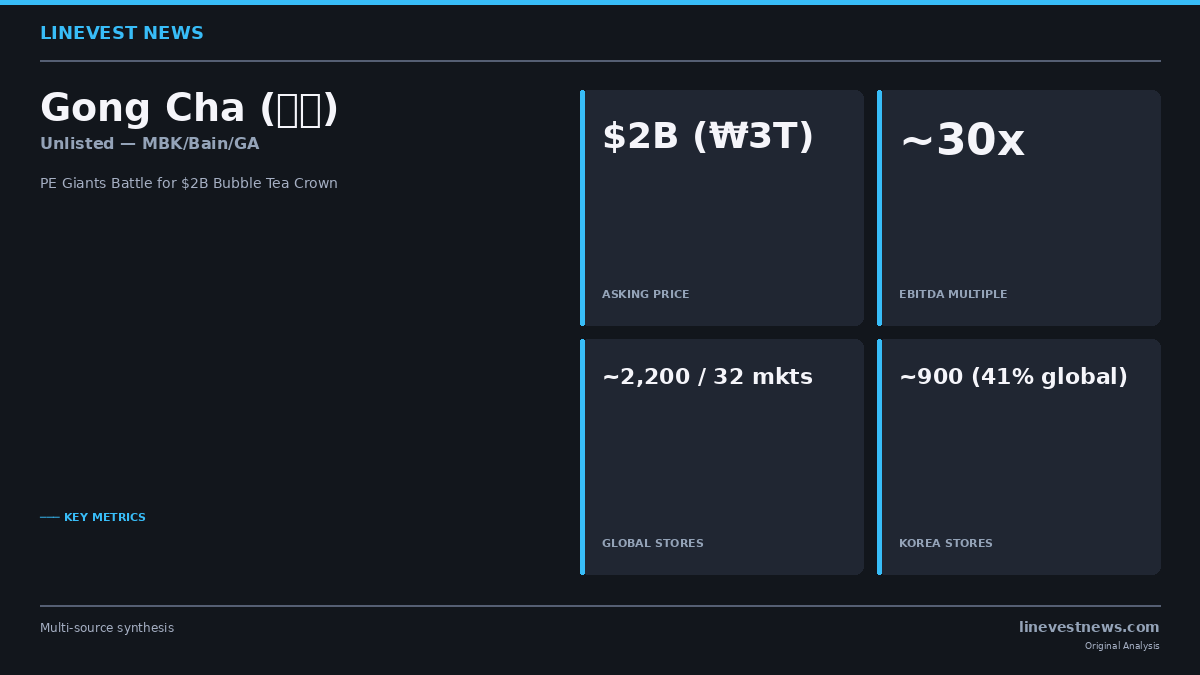
TL;DR - TA Associates is seeking $2 billion (~₩3 trillion) for bubble tea chain Gong Cha, implying ~30x EBITDA - Shortlisted bidders: Bain Capital, General Atlantic, and Korea's MBK Partners Ltd - South Korea is Gong Cha's single largest market (~900 stores, 41% of 2,200 global outlets) — yet Korea operating profit fell 78% in 2023 - Korean value-coffee chains Mega Coffee, Compose Coffee, and Paik's Coffee nearly doubled their combined market share from 9.8% (2020) to 20.3% (2023) - An MBK win would put Korea's largest domestic PE firm simultaneously at the helm of both Homeplus (rehabilitation) and Gong Cha
Part A — The Sale Process
TA Associates, the Boston-based private equity firm, has formally launched the sale of global bubble tea franchise Gong Cha at an enterprise value of approximately $2 billion (₩3 trillion), according to multiple market sources cited by KED Global and Seoul Economic Daily. JPMorgan is running the process as financial adviser.
Three PE firms have advanced to due diligence: Bain Capital, General Atlantic, and Korea's MBK Partners Ltd. Binding bids were expected by mid-June 2026.
The asking price implies roughly 30× Gong Cha's 2025 EBITDA of approximately $70 million on revenues of $217 million — a significant premium compared with domestic Korean food and beverage (F&B) deals that typically clear 8–12× EBITDA.
TA Associates' Return Math
TA Associates acquired Gong Cha in 2019 from Korean PE firm UCK Partners (Unison Capital Korea) for approximately ₩350 billion (~USD 288–300 million at prevailing exchange rates). A $2 billion exit would represent a roughly 6× money-on-money return over six years.
UCK Partners itself built the Gong Cha franchise empire from scratch, paying just ₩34 billion for Korean franchise rights in 2014 before purchasing the Taiwan headquarters in 2017. Under UCK's stewardship, Gong Cha expanded from 126 stores in 2013 to 1,201 stores and ₩208.2 billion in revenues by the time of the 2019 sale to TA Associates.
Scale and Geography
Today, Gong Cha operates approximately 2,200 outlets across 32 markets including Asia, North America, Europe, and the Middle East, with recent master franchise expansion into Colombia, Ecuador, Brazil, Poland, and Saudi Arabia.
South Korea accounts for roughly 900 stores — 41% of the global total — making it Gong Cha's single largest territory by outlet count. The Korean affiliate also manages operations in Japan (~160 stores) and Taiwan.
Part B — Korea Market: Headwinds at the Core
A Shrinking Home Base
Despite its dominance in store count, Korea is proving to be Gong Cha's most stressed market. In 2023 (the latest available full-year data), the Korea standalone business recorded revenues of ₩123 billion ($88 million), down 4% year-over-year, with operating profit collapsing 78% to just ₩3.4 billion ($2.4 million).
The Gong Cha Korea consolidated entity — which includes Japan and Taiwan operations — saw group revenue edge up 1% to ₩183 billion, but group operating profit dropped 62% to ₩6.3 billion.
| Metric | 2023 | YoY |
|---|---|---|
| Korea Revenue | ₩123B (USD 88M) | –4% |
| Korea Operating Profit | ₩3.4B (USD 2.4M) | –78% |
| Group Revenue (incl. Japan/Taiwan) | ₩183B (USD 131M) | +1% |
| Group Operating Profit | ₩6.3B (USD 4.5M) | –62% |
| Japan Revenue | ₩53.4B (USD 38M) | Record high |
Japan — a wholly owned subsidiary — delivered record sales in 2023 and now acts as a partial offset to Korea's deterioration.
The Mega Coffee Effect
The underlying shift is structural. South Korean consumers have pivoted sharply toward value-focused café chains amid wage stagnation and elevated living costs. The combined market share of Mega Coffee, Compose Coffee, and Paik's Coffee — Korea's three dominant low-price chains — nearly doubled from 9.8% in 2020 to 20.3% in 2023, directly compressing Gong Cha's pricing power.
In a market where a single Gong Cha bubble tea retails for ₩6,000–₩8,000, consumers have been substituting toward ₩1,500–₩2,500 alternatives. As one industry official told KED Global, the risk for any acquirer is "intensifying competition from new dessert drink entrants" in a market that is simultaneously oversupplied with café locations.
The MBK Question
Among the three shortlisted bidders, MBK Partners carries the highest Korea-market relevance. Korea's largest domestic PE firm — managing an estimated $23 billion in AUM across Korea, China, and Japan — has been under significant scrutiny since Homeplus, another MBK portfolio company, entered court-led rehabilitation proceedings in early 2026 after accumulating over ₩930 billion in unpaid supplier invoices.
A successful Gong Cha acquisition would place MBK simultaneously at the helm of two of Korea's most visible consumer-facing businesses: Homeplus (currently in rehabilitation) and Gong Cha (the proposed acquisition target). That concentration of consumer-sector exposure — and the capital commitment required at a $2 billion entry — would test limited partner patience alongside regulatory comfort.
Industry observers note that the more plausible scenario for MBK would be to underwrite the Japan and global expansion story rather than bet on a near-term Korea recovery, effectively treating the Korean operations as a stabilized cash-yield base while driving returns through international market growth.
Investor Takeaway
No directly listed Korean equities are party to the Gong Cha transaction. However, the auction carries three proxy signals for Korean market watchers:
Korean PE vintage returns: A $2 billion exit on a ~₩350 billion 2019 entry would confirm that Korean PE-assembled global franchise platforms can command U.S.-comparable EBITDA multiples — a data point relevant to the broader Korean PE sector's international credibility.
Korean consumer spending: Gong Cha's deteriorating Korea margins — in its brand-recognition stronghold — reinforce the structural squeeze on premium consumer discretionary spending that has weighed on mid-to-high-end food and beverage operators across the KOSPI consumer sector.
MBK's capital deployment: A Gong Cha win by MBK Partners would signal the firm retains LP confidence and dry powder despite the Homeplus situation — a signal that Korea's PE industry has not been broadly impaired by the single high-profile casualty.
This article is journalistic analysis based on public market sources. It is not investment advice. LineVest is not registered as an investment adviser.
Sources: KED Global · Seoul Economic Daily · World Coffee Portal · PE Insights