TL;DR - SK Group Chairman Chey Tae-won told a Korea Chamber of Commerce and Industry forum on July 17 to stop trading SK Hynix and simply hold the shares - He forecast memory demand will expand roughly 20x between 2026 and 2030 as AI matures from "a 4-year-old child" to adulthood - The remarks arrive one week after SK Hynix's USD 26.5B Nasdaq debut (SKHY) and one week before Q2 2026 preliminary results (July 22) - SK Hynix (000660.KS) has recovered sharply from a 36% selloff; the chairman's public endorsement signals long-term management confidence
Part A — What Was Said
At the Korea Chamber of Commerce and Industry (KCCI) Summer Forum held July 17 at the Jeju Shilla Hotel in Seogwipo, SK Group Chairman Chey Tae-won (최태원) weighed in on the debate that has divided Korean retail investors since SK Hynix's stock dropped more than 36% from its 2026 peak: buy more, trim, or hold.
His answer was unambiguous.
"Memory semiconductors will always be needed, so given time, the price trend will be upward," Chey said during a panel on artificial intelligence. "Rather than trading in and out, just holding is the better way to protect your wealth."
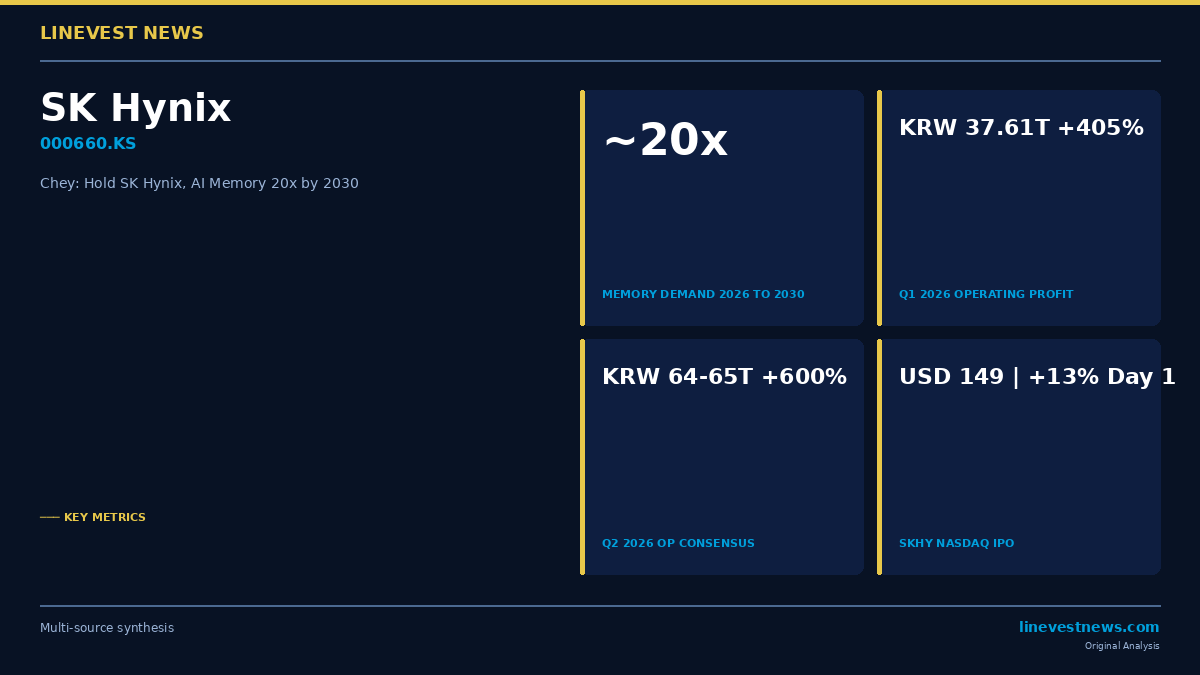
Chey, who also chairs the KCCI, sketched a demand curve to justify his view. He described AI today as "a 4-year-old child" that, once it reaches adulthood, will require exponentially more memory. He cited projections showing global computing memory capacity could expand from roughly 26 units today to approximately 400 units by 2030 — a roughly 20-fold increase within four years.
Beyond SK Hynix specifically, Chey argued South Korea should pivot from exporting hardware memory to exporting "intelligence" — applications, inference infrastructure, and AI services — to capture the space between the US (quality-led) and China (price-led) AI markets.
Part B — What It Means for Investors in 000660.KS / SKHY
Confidence Signal at a Pivotal Moment
SK Hynix (000660.KS) listed its American Depositary Receipts (ADRs) on Nasdaq on July 10, raising USD 26.5 billion under the ticker SKHY — one of the largest US equity offerings of 2026. The stock rose 13% on its first day. However, it then pulled back sharply over the next two sessions amid peak-cycle concerns before recovering. Listed-company executives in South Korea typically avoid specific forward-looking stock commentary at public forums, making Chey's explicit "just hold" advice at a high-profile event notable.
Retail Investor Context
Korean retail investors have poured a net KRW 5.8 trillion (~USD 3.9 billion) into Samsung Electronics and SK Hynix leveraged ETFs over the past month even as prices fell more than 40% from highs — a sign of retail conviction but also of significant mark-to-market losses. On July 16, Korea's financial regulators froze new issuance of triple-leveraged Samsung-Hynix ETFs and tripled the investor deposit requirement to KRW 30 million following extreme volatility. Chey's "just hold" message, framed as long-run AI memory demand rather than a short-term price call, cuts against the leveraged-trading culture that regulators are trying to cool.
Q2 Earnings Catalyst Ahead
SK Hynix is expected to release Q2 2026 preliminary earnings on July 22. Consensus estimates place Q2 operating profit at KRW 64–65 trillion, up roughly 600% year-on-year from KRW 9.21 trillion in Q2 2025. A result at that scale would add fundamental backing to Chey's long-term framing.
HBM Market Leadership
HBM (High Bandwidth Memory) drove SK Hynix's Q1 2026 outperformance: operating profit reached KRW 37.61 trillion (+405% year-on-year as officially reported), on revenue of KRW 52.58 trillion (+198%). The company holds an estimated 56.4% global HBM market share (Bank of America) and is the primary HBM3E and early HBM4 supplier to Nvidia. Chey's 20x demand projection over four years, if directionally correct, implies that demand destruction from AI commoditization would need to be severe to prevent SK Hynix from benefiting structurally.
Risk Factors
Chey's bullish comments are not without context. The chairman is currently in a high-profile divorce settlement dispute with former spouse Noh So-young; the valuation of SK Group's stake in SK Hynix is directly relevant to the settlement's outcome. Investors should weigh that context when assessing the statement. Additionally, the semiconductor cycle remains sensitive to US-China trade policy: any tightening of AI-chip export rules or HBM restrictions could alter the demand curve faster than long-run trends suggest.
| Metric | Value |
|---|---|
| SK Hynix (000660.KS) 52-week range | KRW 178,800 – KRW 296,500 |
| SKHY (Nasdaq ADR) IPO price | USD 149 (July 10, 2026) |
| Q1 2026 Revenue | KRW 52.58T (+198% YoY) |
| Q1 2026 Operating Profit | KRW 37.61T (+405% YoY, as officially reported) |
| Q2 2026 OP Consensus | ~KRW 64–65T (+~600% YoY) |
| Q2 Preliminary Results Date | July 22, 2026 |
| Chey's memory demand projection | ~26 to ~400 units by 2030 (~20x) |
| Forum | KCCI Summer Forum, Jeju Shilla Hotel, July 17, 2026 |
This article is journalistic coverage and does not constitute investment advice. LineVest is an independent publication not affiliated with SK Group or any brokerage.
Sources: Herald Business · Hankook Ilbo · Kyunghyang Shinmun